- Place
- Kėdainiai, Kėdainiai District Municipality
- Region
- Aukštaitija
- Type
- active seventeenth-century Evangelical Reformed church, burial crypts and museum-managed Radziwiłł mausoleum
- Address
- Senoji Street 3, Kėdainiai
- Coordinates
- 55.28560, 23.98035
- Visit duration
- 45-75 minutes; 2-3 hours with a Kėdainiai Old Town route
- Best time
- during museum hours from Wednesday to Saturday; on Sunday only after checking the worship and event schedule
Kėdainiai Reformed Church, Calvinist Church in Kėdainiai, Mausoleum of the Radziwiłł Princes, Kėdainiai Radziwiłł Mausoleum
The church, crypts and sarcophagi are not the same thing
At Senoji Street 3, three connected but distinct layers of heritage occupy one site. Above ground is an active Evangelical Reformed church; historic burial crypts lie beneath its floor; and a visitor-ready part of the underground complex contains the museum-managed mausoleum of the Radziwiłł princes. An ordinary museum visit introduces the church and mausoleum display but does not provide unrestricted access to every burial space beneath the building.
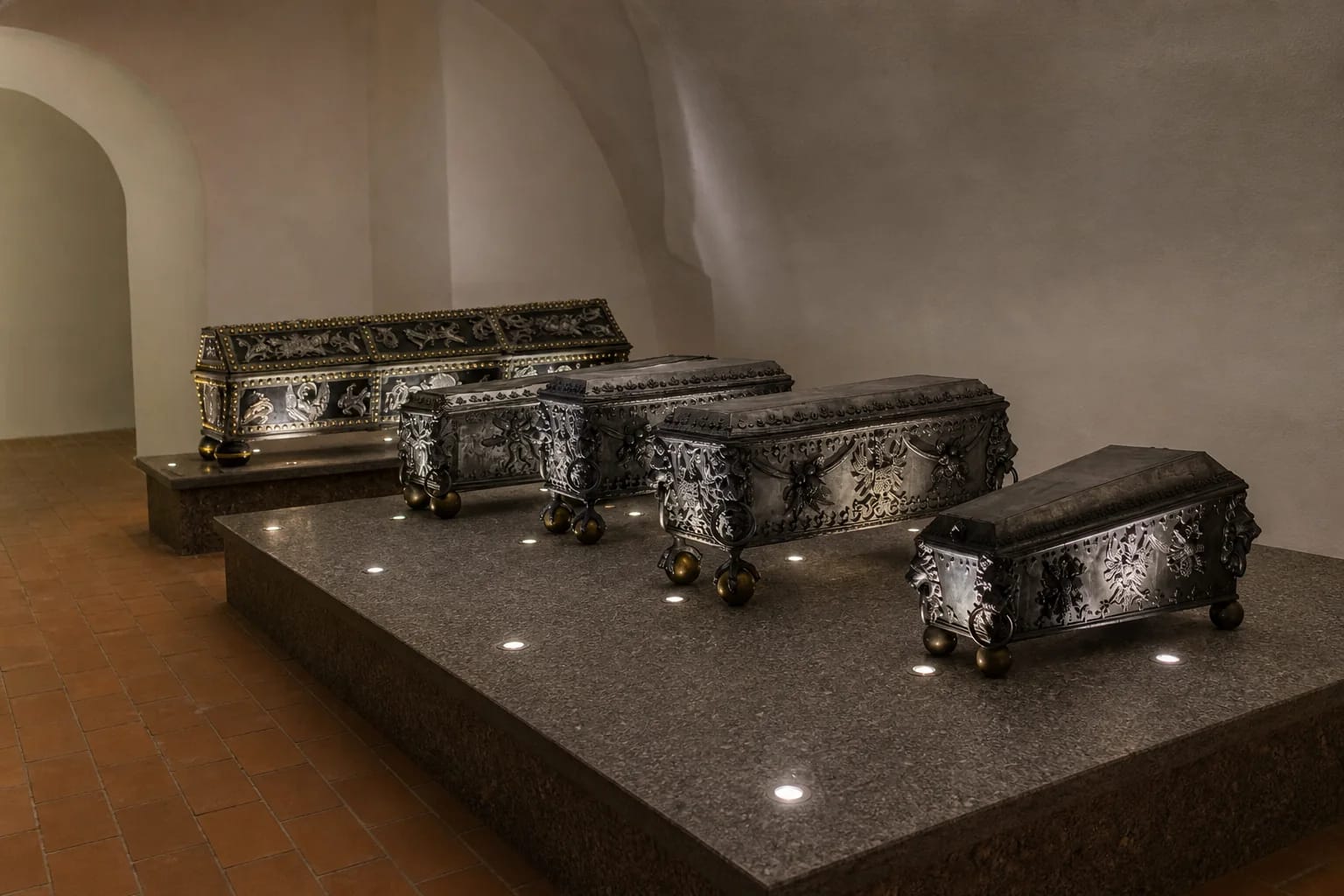
Nine masonry crypts beneath the church vaults received members of the Radziwiłł family and prominent people from the Reformed community. Do not confuse the nine crypts with the number of sarcophagi: the present mausoleum preserves six ornate seventeenth-century Radziwiłł sarcophagi. They are both burial monuments and artworks of national significance, making the crypt a memorial setting rather than simply an archaeological cellar.
From the wooden church of 1629 to the masonry building of 1652-1653
Several dates in the Kėdainiai Reformed story refer to different building stages. The Lithuanian encyclopaedia records a wooden Evangelical Reformed church in 1629. A foundation document issued by Krzysztof II Radziwiłł and Anna Kiszka in 1631 already described a large masonry church begun on new foundations at the Old Market. Krzysztof II did not see the work completed: he died in 1640 while construction was still under way.
His son Janusz II Radziwiłł completed the building. The museum and Lithuanian encyclopaedia give 1652, while the Cultural Heritage Register act gives 1653, so about 1652-1653 is the most accurate concise date. The Register also records reconstruction in 1757. A storm and lightning led to the roof and corner towers being lowered in the late nineteenth century, meaning today's silhouette is not exactly the one seventeenth-century townspeople knew.
Renaissance and Baroque architecture shaped for Reformed worship
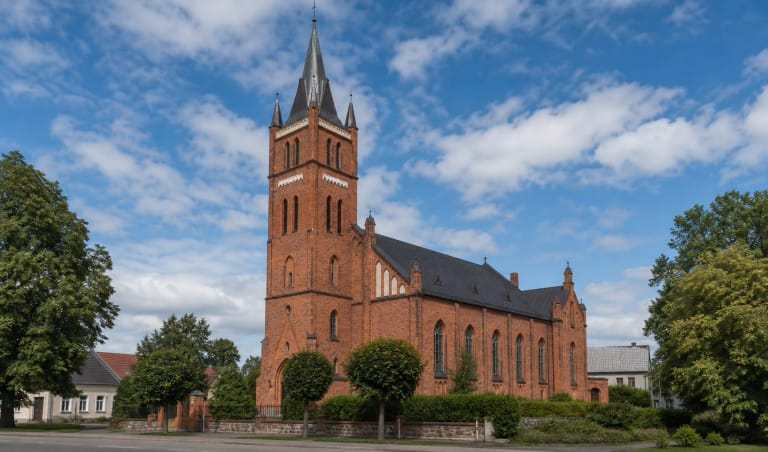
The protected complex consists of the church and a detached belfry. Light rendered walls, tall windows in deep arched recesses, a triangular gable and low corner turrets create a monumental but restrained exterior. The Cultural Heritage Register identifies Renaissance and Baroque features, while the churchyard fence and gates preserve a distinct sacred precinct within the townscape.
The Reformed interior deliberately differed from richly decorated Catholic churches. Historical descriptions mention the communion table, a Bible printed at Brest in 1563, a cross and the inscription Soli Deo Gloria, together with carved oak panelling, pulpit, ministers' pew, Radziwiłł throne and a large Mannerist chandelier. In the seventeenth century Kėdainiai became an important centre of the Samogitian district and of Reformed life across the Grand Duchy of Lithuania; synod sessions met here, and the community called the church a cathedral.
Six sarcophagi tell a story spanning three Radziwiłł generations
The two large sarcophagi belong to Krzysztof Radziwiłł the Thunderbolt (1547-1603) and his grandson Janusz II Radziwiłł (1612-1655). The first resembles a massive rectangular chest raised on six spheres and decorated with lions' heads, fruit clusters, heraldic eagles and princely coats of arms. Janusz II's sarcophagus uses copper and brass sheets over an iron framework, with silvered metal applications, ornament, heraldry and epitaphs set against dark panels.
Four smaller sarcophagi belong to children of Krzysztof II Radziwiłł and Anna Kiszka who died young: Mikołaj (1610-1611), Jerzy (1616-1617), Elżbieta (1622-1626) and Stefan (1624). Their differing sizes and decoration show that they are not four identical copies. Elżbieta's is the largest in the children's group and has engraved side panels, while Stefan's is the smallest.
Together the sarcophagi bridge Late Renaissance and Early Baroque art. Most makers remain unknown. The museum presents only as a hypothesis the attribution of Janusz II's sarcophagus to the Toruń goldsmith Johann Christian Bierpfaff. That distinction matters: exceptional workmanship is not the same as documentary proof of authorship.
Soviet-period desecration and two campaigns of sarcophagus restoration
Napoleon's troops used the church as stables in 1812, but the historic interior suffered its greatest destruction during the Soviet period. The building first became a grain store and later a children's sports school. Church fittings, sarcophagi and burials were damaged or desecrated, so today's ordered display should not be mistaken for an untouched seventeenth-century crypt.
The church was restored in 1986-1991. The mausoleum and sarcophagi were treated in two principal campaigns, in 1994-2001 and 2019-2020. The Cultural Heritage Department says the latter was followed by a modern display, while the wider project included restoration of the crypt and sarcophagi and scientific investigation of the burials. This history explains the neutral display plinths, directed lighting and information panels now placed beside the historic metalwork.
A 2026 visit depends on both museum hours and the worship schedule
On 18 July 2026 the official museum page listed Wednesday-Friday 11:00-18:00, Saturday 10:00-17:00 and Sunday 10:00-15:00, with Monday and Tuesday closed. Last admission was thirty minutes before closing. Standard admission was EUR 3, with a 50 per cent reduction or free admission for eligible groups; permanent displays were listed as free to all on the final Sunday of each month. Recheck all these details before travelling.
The church remains a religious space. The museum explicitly says that visitors cannot enter the mausoleum during services, events or rehearsals, and it publishes a separate changing worship schedule for 2026. Sunday museum hours therefore do not guarantee that the crypt will be accessible at every moment. A weekday or Saturday is a more dependable choice for a quiet visit, and calling the branch before a special journey is sensible.
The museum's own accessibility notice says the mausoleum is not adapted for wheelchair access: a mobility-impaired visitor can enter only the church interior, the doors are heavy and the outdoor paving is uneven. A staff member can unlock the central gate, so arrange access and assistance beforehand. The coordinate marks the church site, not a car park.