- Place
- Kaunas City Municipality
- Region
- Kaunas
- Type
- interwar basketball arena and building of the Azuolynas sports complex
- Address
- Perkūno al. 5, Kaunas
- Coordinates
- 54.89624, 23.93613
Sports Hall in Kaunas, Kaunas Hall, Sports Hall of the Kaunas Azuolynas sports buildings complex, Kaunas Sports Hall
The first arena in Europe designed for basketball
Kaunas Sports Hall is one of those buildings whose meaning is far larger than the restraint of its exterior. VLE defines it as the first hall in Europe designed specifically for basketball. The official hall page emphasizes the same point today, so this is not merely a local legend.
The building stands at Perkuno al. 5 in the Azuolynas sports complex. AUTC states that the hall was built on commission from the Physical Education Palace and, together with the football field, running tracks, Physical Education Palace, and state stadium, formed part of the sports system developed beside Azuolynas.
Why it appeared so quickly
The main impulse was the Lithuanian men's basketball team's victory at the 1937 European Championship in Riga. Two years later the championship was to be held in Lithuania, but Kaunas did not have an arena large enough to host it.
VLE gives a precise construction chronology: on November 22, 1938, the project was approved by the Construction and Road Inspection Council of the Ministry of the Interior; on December 5, 1938, foundation pouring began; on May 15, 1939, the first training sessions were already taking place; and on May 21, the European Championship opened in the hall.
Venue of the 1939 championship
The III European Men's Basketball Championship took place in the hall on May 21-28, 1939, and Lithuania won it. VLE states that more than 11,000 spectators watched the games, although there were only 3,500 seats. It was not only a sports event, but a moment of state representation.
AUTC cites a contemporary European basketball official's assessment that Kaunas now had the only such excellent hall in Europe built especially for basketball. The hall brings mass sports emotion and international attention into the Kaunas modernism story, not the prestige of banks or ministries.
Rozenbliumas's engineering and Kudokas's architecture
VLE states that the hall was designed by engineer Anatolijus Rozenbliumas, with the architectural part prepared by architect Stasys Kudokas. The Cultural Heritage Register lists engineer Anatolijus Rozenbliumas as the project author, so the main heritage wording must preserve his engineering role.
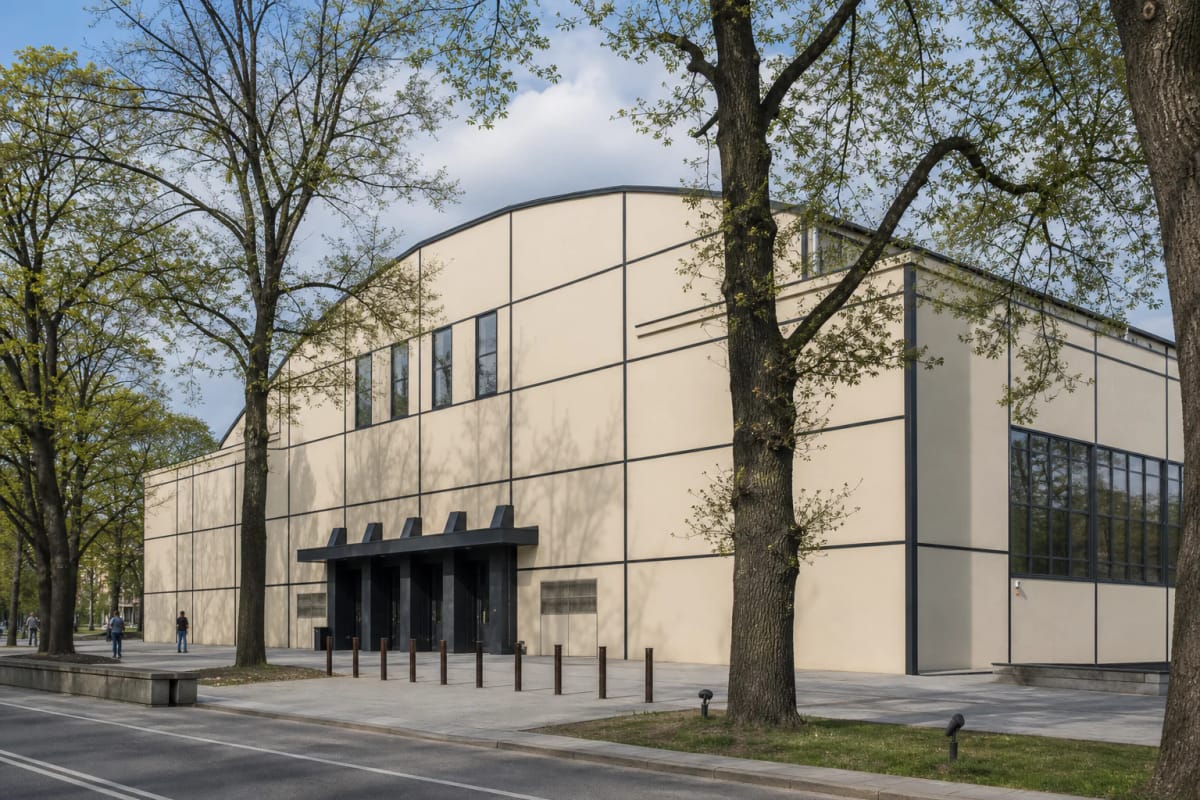
That makes sense because the essence of the hall is construction. VLE describes a one-storey rectangular building, 62.8 m long, 61 m wide, and 15.2 m high at the arch crown. The register calls the volume basilical, rectangular in plan, one storey, with one continuous hall space through the full height.
Four 60 metre arches
The Cultural Heritage Register protects the exposed arched riveted metal structure, based on 60 m wide arches placed every 13.5 m. VLE adds that each 12-ton steel arch was assembled from 12 sections on reinforced-concrete foundations.
These arches explain how the hall could have a large open space without ordinary supports. The building looks austere, but its engineering was highly ambitious. The register evaluates its engineering significance as unique and its architectural significance as rare.
Austere modernism
AUTC emphasizes that the hall was built under limits of time and money: the cheapest means were used to create a building with as many seats as possible. From this came an austere structure, without special decoration but monumental in its ambition.
The register describes the facade solution through plastered brick-masonry planes divided by riveted metal beams. The western and northern facades have portals with half-columns and flat canopies, while vertical and horizontal rectangular window openings were restored during restoration.
A building of criticism and its time
Interestingly, not everyone in the interwar period thought the hall was beautiful. AUTC mentions a 1939 text in Naujoji Romuva whose author called it unsuccessful and ugly. Today that criticism is valuable because it reminds us that modernist economy and strictness were not yet self-evident beauty at the time.
That is exactly why the hall is architecturally interesting. It is not decorative. It speaks about necessity, deadline, mass event, construction, and a minimal but effective solution. It is a very clear interwar modernist situation.
Home of Zalgiris and sports memory
VLE writes that from 1944 to 2010 Kaunas basketball team Zalgiris played its home games in Kaunas Sports Hall. The official operator page summarizes this as 67 years during which the hall was Zalgiris's home.
For many visitors, the hall is therefore not only the venue of the 1939 European Championship, but also the long-term emotional address of Lithuanian basketball. After Zalgiris moved to the new arena, the hall became a smaller and historically denser place where sport meets heritage.
Political and cultural layers
VLE notes that on August 14-15, 1940, during the Lithuanian teachers' congress held in the hall, the Lithuanian national anthem was sung. In 1949 the famous boxing match between Antanas Socikas and Nikolai Korolyov took place here; the spectators' unrest after it is considered the beginning of Lithuanian dissatisfaction with the Soviet regime being expressed at sports events.
Later the hall also became a cultural-event space: VLE mentions Rock March across Lithuania concerts in 1987-1990. This helps explain why the hall matters beyond basketball. It worked as a large city hall where sport, politics, and culture sometimes intersected in one grandstand atmosphere.
Reconstruction and restoration
VLE states that in 1958-1962 the arena was partly reconstructed: wooden stands were replaced by reinforced-concrete ones, thermal insulation was improved, and a heating system was installed. The Cultural Heritage Register shortens this stage to 1962 as a partial reconstruction marker.
In 2021 the building was restored according to a project by architect-restorer Dalia Laurinaitiene. VLE writes about renewed and insulated facades, changed room layout, and 2,500 spectator stands. The official operator gives 2019-2022 as the restoration period and says the rebirth for new events was completed in 2022.
Use today
Today the hall is an active sports and entertainment venue. The official operator presents it as a sports and entertainment arena in Kaunas, adapted after reconstruction for various events, not only sport, and for after-school activities.
Official space information lists a 1,343.48 square metre main hall for sports and entertainment events, accommodating up to 2,000 spectators in specific rental formats. The total number of seats after reconstruction is given as 2,500 by the operator's history section and VLE. Visitors should therefore check the specific event plan and ticket information.
Heritage status
The formal Cultural Heritage Register name is the Sports Hall of the Kaunas Azuolynas sports buildings complex. Its unique code is 15971, and it belongs to the Kaunas Azuolynas sports buildings complex, code 31618. The significance level is national, status is initiated to be declared state protected, and the style is constructivism.
The register's valuable features include not only facades, but the continuous hall space, portals, riveted steel arch structure, restored door and window systems, and original purpose for basketball competitions and other mass events.
UNESCO and European heritage context
Kaunas Sports Hall belongs to the Azuolynas sports complex and Kaunas modernism context associated with the UNESCO World Heritage property Modernist Kaunas: Architecture of Optimism, 1919-1939. It is most accurate not to call the hall an individually separate UNESCO-inscribed building.
VLE also states that in 2014 Kaunas Sports Hall received the European Heritage Label together with other Kaunas 1919-1940 architecture objects. This is another sign that the hall's value goes beyond sports history alone.
How to visit
The exterior is best viewed from Perkuno Avenue, looking at the broad volume, dark metal-line grid of the facade, portals, and window rhythm. The trees around the hall are not a nuisance but part of the Azuolynas sports-complex atmosphere.
The interior is most reliably accessible during events, sports activities, tours, or hired space use. Do not plan the hall as a permanently open museum: entry rules, prohibited items, seating, and parking depend on the specific event and operator rules.