- Place
- Klaipėda City Municipality
- Region
- Klaipėda
- Type
- historic town hall, former residence of the Prussian royal family, and active administrative building
- Address
- 17 Danės Street, Klaipėda
- Coordinates
- 55.71021, 21.13111
- Visit duration
- 20-40 minutes for the exterior and historical context; longer only for a prearranged visit or event
- Best time
- daylight, when the full river-facing facade and its relief decoration are easy to read
Klaipėda City Town Hall, former Prussian royal residence in Klaipėda, Memel Town Hall
The Pale Facade by the Danė Holds Several Different Lives
Klaipėda Town Hall stands at 17 Danės Street, on the north bank of the river opposite the old-town side. The point at 55.710215, 21.131108 marks the footprint of the building listed in the Cultural Heritage Register as administrative building 1179, not a particular doorway or parking place. Its principal facade faces the Danė and is most legible from the riverside and the approaches on the opposite bank.
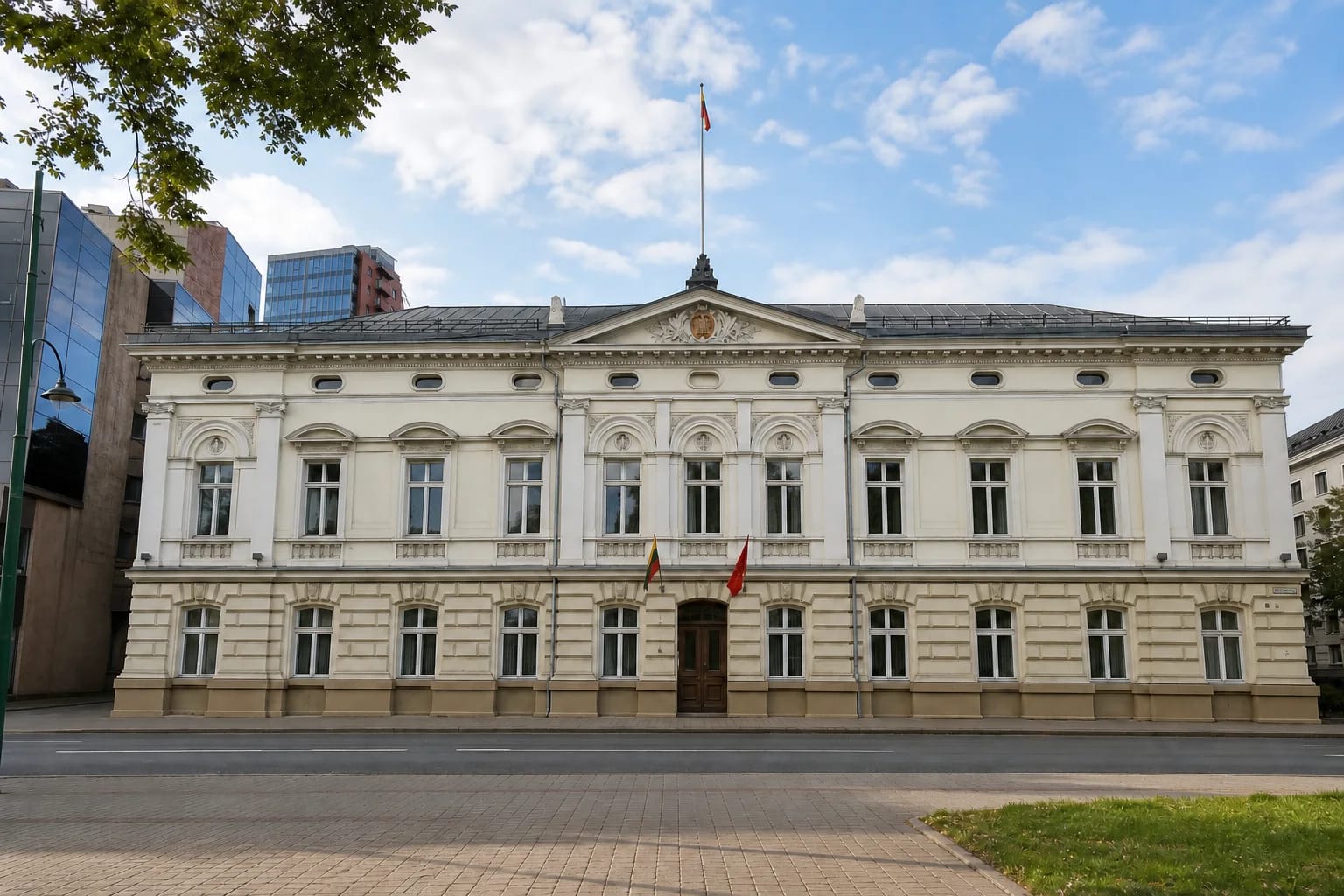
The present town hall is a long, two-storey rectangular building finished in pale render beneath a low grey roof. Deep rustication gives the ground floor visual weight, while tall windows with segmental and arched surrounds set the rhythm above. Small oval openings run below the cornice, a triangular pediment with a heraldic feature crowns the centre, and flags mark the principal entrance.
Do not confuse it with the warm-toned Klaipėda Drama Theatre on Theatre Square, which image searches sometimes mislabel as the town hall. The Danės Street building has no columned portico, tower, or fountain before its entrance. Its character comes from a long horizontal composition, restrained relief work, and the contrast with contemporary Klaipėda rising behind it.
Before It Became a Town Hall, This Was a Prosperous Merchant's House
The building went up in the late eighteenth or early nineteenth century as a representative residence. It belonged to Lorck, a prominent Klaipėda merchant and Danish consul. Ownership later passed to his son-in-law Friedrich Ludwig Consentius, which is why sources refer to the same property as both the Lorck and the Consentius residence.
That history explains why the building itself predates its municipal role. Klaipėda received self-government rights in 1254, and its first masonry town hall with a tower stood at the junction of Turgaus and Tiltų streets from the late sixteenth century. After that building burned in the second half of the seventeenth century, the magistrate occupied various old-town houses until it acquired a permanent home beside the Danė in the nineteenth century.
Danės Street 17 is therefore neither the remnant of a medieval town hall nor a structure designed from the outset for a council. Its value lies in the successive use of a merchant's house by a royal family, the city magistrate, a regional parliament, and later administrative institutions, each adding another layer to its biography.
The Prussian Royal Family Lived Here in 1807-1808
After Napoleon's forces occupied much of Prussia, King Frederick William III, Queen Louise, and their children reached unoccupied Klaipėda in January 1807. The royal couple settled in the Consentius house and remained in the city until January 1808. Klaipėda then functioned as the Prussian monarch's temporary residence and a political centre of the state, although Berlin formally remained the capital.
This chapter matters for more than the enduring popularity of Queen Louise. Official city and encyclopedic sources connect the period in Klaipėda with the beginning of major Prussian reforms: administrative measures were prepared here, and the October Edict of 1807 began dismantling the peasants' hereditary servitude. It is more accurate to link these decisions with the royal-residence period in Klaipėda than to assign every one of them to a particular room surviving today.
In 2017 the municipality installed an open-book-shaped display about Louise and the royal family's year in Klaipėda in a first-floor meeting room. No continuously valid tourist timetable or confirmation of unrestricted daily access to that room could be found, so do not treat the display as a guaranteed part of an independent visit.
The Magistrate Moved In in 1846, Then Recast the Facade in 1875-1877
Klaipėda's magistrate purchased the house for 13,000 thalers on June 26, 1845, and opened the town hall here in 1846. Those two dates are sometimes compressed into one, which is why secondary accounts may say that the purchase itself took place in 1846. The clearest chronology separates the 1845 acquisition from the start of municipal use the following year.
The building was substantially altered in 1875-1877 to a design by the local building councillor and architect Cornelius. The second storey was raised, a magistrates' meeting hall was created, and the earlier Classical composition acquired richer Renaissance Revival decoration. Meyer, the Klaipėda district architect, prepared the interior scheme.
The project added the city arms, Prussian eagle and mask motifs, the triangular pediment, and more elaborate window reliefs. From the river side, compare the weighty rusticated ground floor with the lighter upper storey and the band of oval openings beneath the cornice. This is neither pure Classicism nor an original Renaissance building, but nineteenth-century historicist architecture combining Classical symmetry with Renaissance Revival civic display.
From the Territory Landtag to a Dormitory, University, and Municipal Offices
During the autonomous Memel Territory period, the regional Landtag met in this building. Under the Klaipėda Convention, it was an elected legislative body responsible for matters ranging from education and religion to agriculture, finance, social protection, and local law. The former city town hall thus briefly became a political chamber for the wider autonomous territory.
Its representative role ended after the Second World War. The building became a dormitory and later housed a municipal construction trust. It was reconstructed in 1978 to a design by architect Petras Lapė. After 1990, the rectorate of the newly established Klaipėda University worked here for a time, followed from late 1994 by the Klaipėda County Governor's Administration.
After county administrations were abolished, Klaipėda City Municipality began using part of the building in 2011, and the state-held property was transferred to the city in 2020. In 2026, official contact listings place council-support, audit, procurement, and other municipal staff at 17 Danės Street. That continues the site's administrative tradition, but it does not turn every room into a public museum.
How to Visit an Active Town Hall and Extend the Walk
The exterior is free to view from Danės Street and public riverside approaches at any suitable time; no ticket is needed to study the facade. Step back towards the river for the complete composition, then walk along the frontage to examine the details. Allow 20-40 minutes for the building and its story unless you are attending an official event.
No regular tourist opening hours or admission price for the interior are published. The municipality explains registration and visitor-card procedures for people entering administrative premises or attending council meetings, but those civic procedures are not a sightseeing offer. If seeing the interior or the Louise display installed in 2017 matters to you, contact the municipality before travelling and check current event notices.
The map pin identifies the building, not a reserved entrance or car park. No current comprehensive visitor-accessibility audit was found, and access controls in an administrative building may limit independent interior visits, so discuss specific mobility needs in advance. Continue along the Danė to the Fisherman sculpture, cross into Klaipėda Old Town, or turn towards the nearby Castle Museum; the new State Music Theatre also stands beside the town hall.