- Place
- Kaunas City Municipality
- Region
- Kaunas
- Type
- interwar bank palace and KTU central building
- Address
- K. Donelaičio g. 73, Kaunas
- Coordinates
- 54.89881, 23.91265
Land Bank in Kaunas, Former Land Bank, KTU central building, KTU rectorate, Former Land Bank in Kaunas
A bank beside the state square
The Land Bank Palace stands in one of the densest institutional places of interwar Kaunas: by Vienybės Square, near the War Museum, Čiurlionis Museum, Bank of Lithuania, and other temporary-capital buildings. This address was not accidental. The bank had to be visible as part of the state economic system.
Today the building is more often recognized as the KTU central building or rectorate environment. That changed the everyday function, but did not erase the initial impression: the building remains restrained, solid, and at the scale of a public institution.
From classicism toward modernism
AUTC presents the Land Bank as an example of a turning point in bank architecture. Many interwar Lithuanian bank buildings still had clear classical forms, but in the 1930s rationalist and functionalist features grew stronger.
In the Land Bank Palace, classical representation is not completely rejected, but it is abstracted. There is no dome or heavy colonnade as at the Bank of Lithuania Palace. Instead there is a clear volume, regular windows, vertical pilaster-like intervals, and a calm facade.
Karolis Reisonas
The building was designed by Karolis Reisonas. VLE presents him as a Lithuanian and Australian engineer-architect who worked in 1930-1938 as Kaunas city engineer and head of the Construction Department. Among his Kaunas works VLE lists the Chamber of Agriculture, Land Bank, Archbishop and Metropolitan Palace, and other objects.
Reisonas's biography matters because he was not only the author of separate buildings. He shaped the field of city construction administration and engineering culture, so the Land Bank is both an architectural object and a sign of the professionalization of urban management.
Construction and dates
The AUTC interwar architecture entry dates the building to 1933-1935. VLE's article on Karolis Reisonas also lists the Land Bank in Kaunas as a 1935 building and the current KTU central palace.
This date places it in the same decade of Kaunas modernism as Pienocentras Palace, Pazanga Palace, the Research Laboratory, and the Chamber of Commerce, Industry and Crafts. The difference is that the Land Bank speaks in a language of institutional calm rather than a commercial facade.
Facade and volume
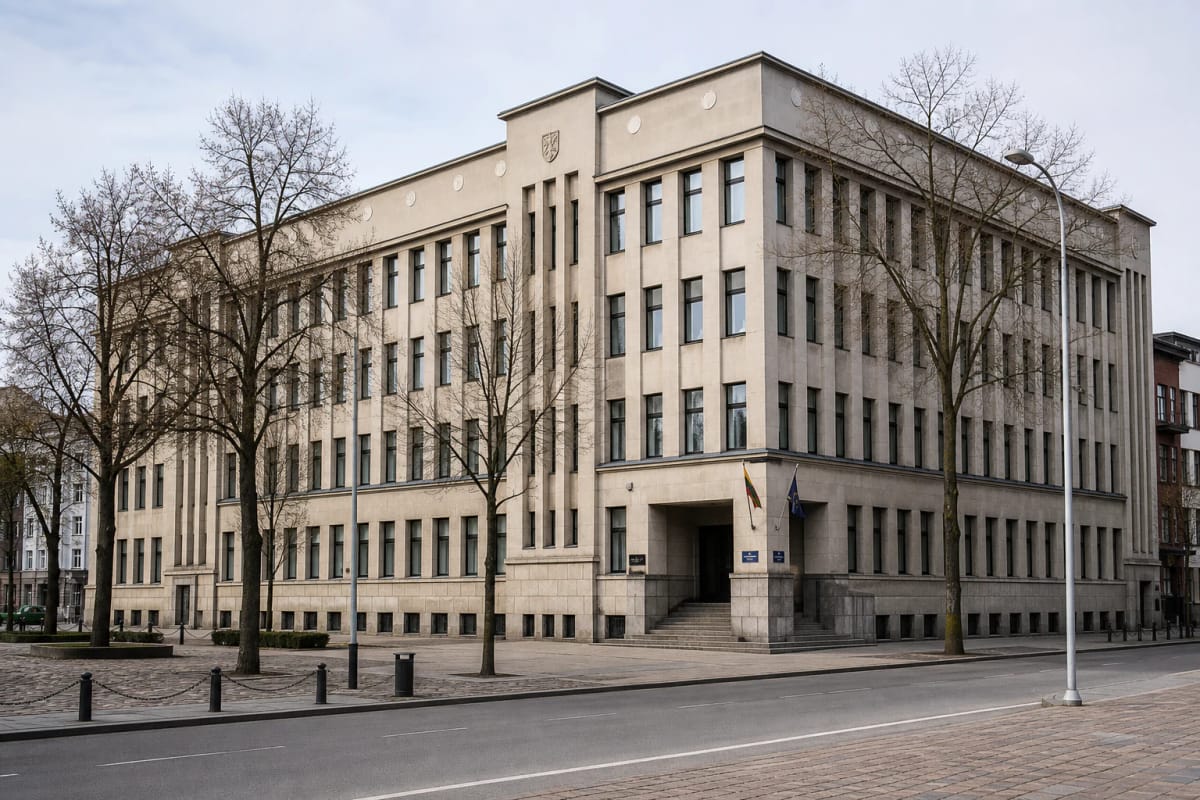
From the street the Land Bank Palace looks massive but not pompous. The long light facade has an orderly rhythm of vertical windows, a raised entrance with broad steps, a roof hidden by a parapet, and small decorative reliefs.
AUTC quotes Reisonas himself explaining that the parapet almost covers the roof and that the colour of the sheet metal should blend with the sky, so the roof would not spoil the calm view of the bank palace and museum. This is a very modernist argument: aesthetics come from visible volume, relation to surroundings, and a practical solution.
Light, air, and hygiene
AUTC recalls 1935 press texts that stressed how bank work premises should be bright and have enough air and heat. Today that wording may sound ordinary, but in the interwar period it meant a new view of the modern institution.
The building no longer relies only on decorative prestige. It shows that a good bank should be comfortable to work in, easy to maintain, clean, and rationally planned. AUTC also connects the rejection of ornament with hygiene and economy.
Modernized historicism
AUTC keywords include both modernized historicism and modernism. This helps explain the building more precisely: the Land Bank is not as radical as the Research Laboratory, but it is not a traditional historicist palace either.
It stands in a transitional zone. The facade symmetry, monumentality, and reliefs still recall representation appropriate to a bank, while the flat-roof treatment, window rhythm, clear volume, and arguments about rational premises lead toward modernist thinking.
KTU central building
Today the address K. Donelaičio g. 73 is connected with Kaunas University of Technology. In OSM/Nominatim data, the building is marked as Kaunas University of Technology, and the KTU Museum is also listed nearby.
For visitors this means a simple rule: the building is not freely visitable as a tourist object just because it has heritage value. Interior access should be linked with KTU activity, museum or event information, while an independent route most reliably stays with the exterior.
Vienybės Square context
The Land Bank Palace is best seen not only as a single facade. AUTC's reference to the view of the bank palace and museum reminds us that the building was designed beside an important representative ensemble. Its calm tone was meant to fit the institutions of the square rather than compete with them.
The best viewing is slow: start from Vienybės Square, compare the Land Bank with the War Museum and Čiurlionis Museum, then walk toward the Bank of Lithuania Palace. In a few minutes you can see how different state functions chose different architectural languages.
UNESCO modernism context
The Land Bank Palace is part of the modernist heritage of Kaunas Naujamiestis, connected with the UNESCO World Heritage property Modernist Kaunas: Architecture of Optimism, 1919-1939. The most accurate description is to call it a building in this urban modernism context.
This page does not publish an individual KVR code for the building because one could not be reliably checked in the public sources used. Still, the building belongs to the broader heritage logic of Kaunas Naujamiestis and the UNESCO-recognized modernist city.
How to visit today
The exterior is freely visible from K. Donelaičio Street and the approaches to Vienybės Square. It is best to step back across the street or toward the square to see the long facade, corner entrance, window rhythm, and upper parapet band.
The interior is not a permanent tourist exhibition. If you are interested in interiors or the KTU Museum context, check official KTU information and events. Even without special access, the object is worth a stop as one of the clearest signs of the transformation of interwar Kaunas economic architecture.