- Place
- Palanga City Municipality
- Region
- Palanga
- Type
- free, approximately 1.45-kilometre pedestrian and cycling promenade between J. Basanavičius Street and Birutė Park
- Address
- Meilės Avenue, Palanga
- Coordinates
- 55.91451, 21.05396
Meilės alėja, Palanga Love Avenue, Laisvės Avenue, Darius and Girėnas Avenue
Where Love Avenue begins and what the Maps pin represents
Love Avenue runs north to south parallel to the sea, though not on the beach itself. Its northern end meets J. Basanavičius Street and Jūratė and Kastytis Square, while the southern end reaches Birutė Park and the approach to Birutė Hill. The full route is about 1.45 kilometres, a relaxed 25-40-minute walk in one direction.
The Google Maps listing at 11 Meilės Avenue and coordinates 55.914506, 21.0539557 marks one central point on the promenade, not a building or its only attraction. It is more useful to begin navigation at either end and treat the avenue as a linear walk rather than search for a single street number.
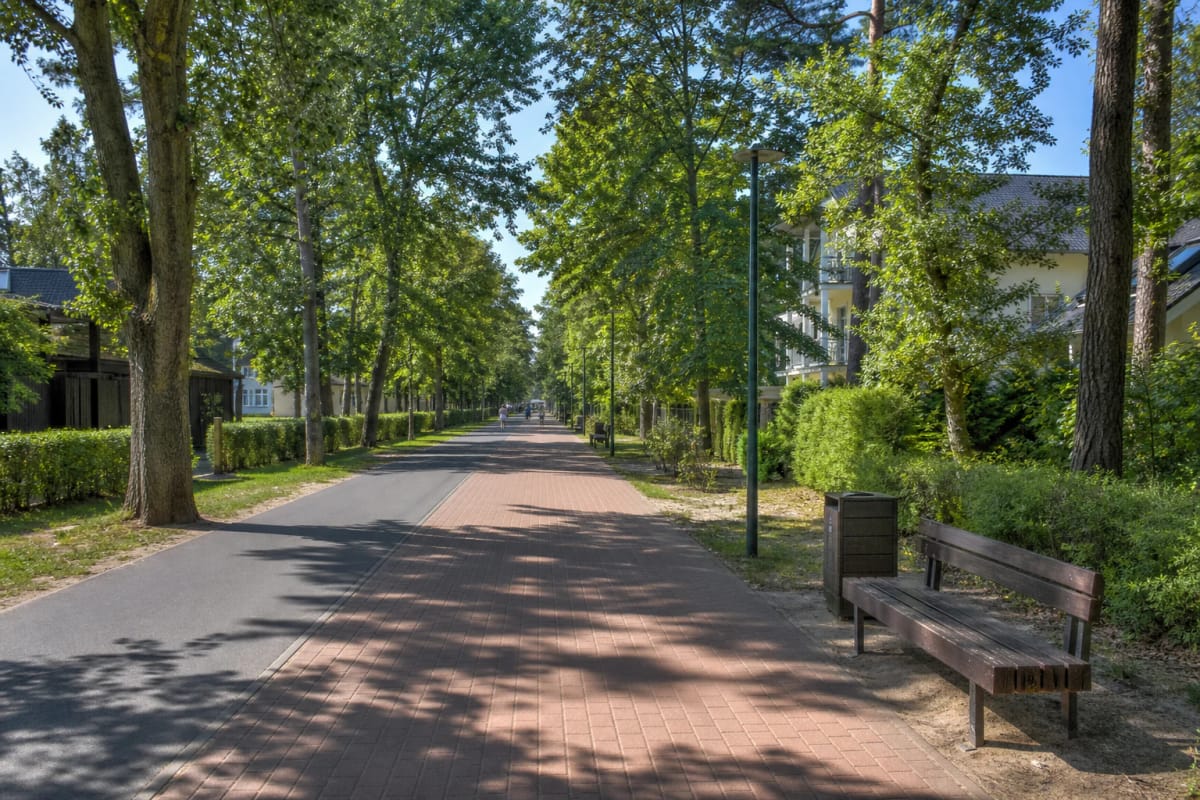
For much of the way, the sea remains behind the protective foredune and trees, so this is not a promenade with an uninterrupted horizon. Its character instead comes from mature deciduous trees and pines, shelter from beach winds, benches, resort villas, and several short crossings towards the sand.
A name for Palanga's admirers, not an old romance legend
A 1913 plan labels the present route Palanga Lovers Avenue, in Polish Aleja Miłośników Połągi. It honoured a society of admirers or friends of Palanga, making the original meaning people who loved the resort. Stories that it was named from the outset for romantic couples and their meetings are later interpretations rather than the documented origin.
After Palanga returned to Lithuania in 1921, the route became Freedom Avenue. In 1933, after Steponas Darius and Stasys Girėnas crossed the Atlantic, it was renamed for the two aviators. Names changed again in the Soviet period, when both Love and Peace were used, before Meilės alėja was ultimately restored.
During the interwar era, a narrow and damp coastal lane was rebuilt as a broader resort avenue. Its evolution reflects Palanga's transition from the Tiškevičiai estate into a modern Lithuanian summer resort, where a landscaped coastal walking route mattered alongside the park, beach, and villas.
Jūrapilis and the architectural layers of the resort
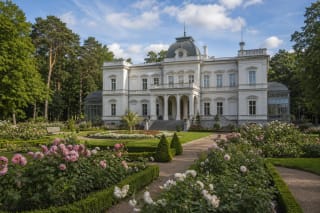
The route's principal historic building is Jūrapilis at 5 Meilės Avenue, now also known through the Komoda hotel and restaurant. It was built around 1895-1900 for Count Feliksas Tiškevičius and is associated with architects Marijan Tołwiński and Pranas Morkūnas. It is one of the relatively few surviving masonry resort villas in Palanga.
The Lithuanian Catholic youth organisation Ateitininkai acquired the building between the wars and named it Jūrapilis. The villa had suffered damage during the First World War and underwent major repairs in 1933. Its surviving massing, turret, decorative brickwork, and coastal location evoke the era when affluent summer residences formed a new Palanga skyline.
Other buildings have changed condition and purpose, so the avenue is best read as a sequence of resort layers rather than one coherent open-air museum. Historic villas stand beside Soviet-period holiday buildings, contemporary apartments, and simple planted spaces. Private properties should be viewed only from the public promenade.
The 2011 reconstruction and movement today
The promenade received its present appearance in 2011, when a project costing more than LTL 3 million renewed the surface and stormwater system and installed lighting, benches, bins, clocks, and bicycle stands. Coloured concrete was selected as a visual continuation of J. Basanavičius Street, producing the warm red-brown paving seen today.
The reconstruction more clearly separated an approximately three-metre-wide cycling section from pedestrian space. Observe current signs and markings because paths draw closer at crossings, entrances, and the busiest points. Walking groups should not occupy the full width, while cyclists and scooter riders need to slow around pedestrians.
The firm, nearly level surface suits pushchairs and many wheelchair users, and benches provide rest points. Kerbs, windblown sand, or root-related irregularities may still appear beside buildings, side streets, and paths over the dunes. No published step-free audit of the entire route was found, so anyone requiring assistance should assess the current conditions rather than assume every connection is barrier-free.
A free route, the best extensions, and a 4.9 rating
Love Avenue is a free public urban space without gates or fixed visiting hours. Lighting makes an evening walk possible, but wet leaves may be slippery and the smaller exits towards the dunes are not equally lit after dark. Check toilets, cafés, and other services separately because they do not belong to the avenue and some operate seasonally.
Leave a car only in signed streets or car parks inland, as the promenade itself is not visitor parking. Palanga's parking zones and charges vary by season, so follow the signs and the municipality's current information on the day. A bicycle conveniently links central Palanga with Birutė Park here, although in the summer crowd by J. Basanavičius Street it is considerate to dismount.
The shortest rewarding route begins at Jūratė and Kastytis Square, follows Love Avenue past Jūrapilis, and ends on Birutė Hill. Return through Birutė Park and Vytautas Street for a loop. In June 2026, the specific Google Maps listing showed 4.9 out of 5 from 21 reviews, although that modest count represents one pin more than every experience along the full 1.45 kilometres.