- Place
- Klaipėda City Municipality
- Region
- Klaipėda
- Type
- university campus in a former barracks complex
- Address
- H. Manto g. 84, Klaipėda
- Coordinates
- 55.72426, 21.12489
Klaipėda barracks building complex, Red Barracks, Former Klaipėda barracks
From the Red Barracks to a university
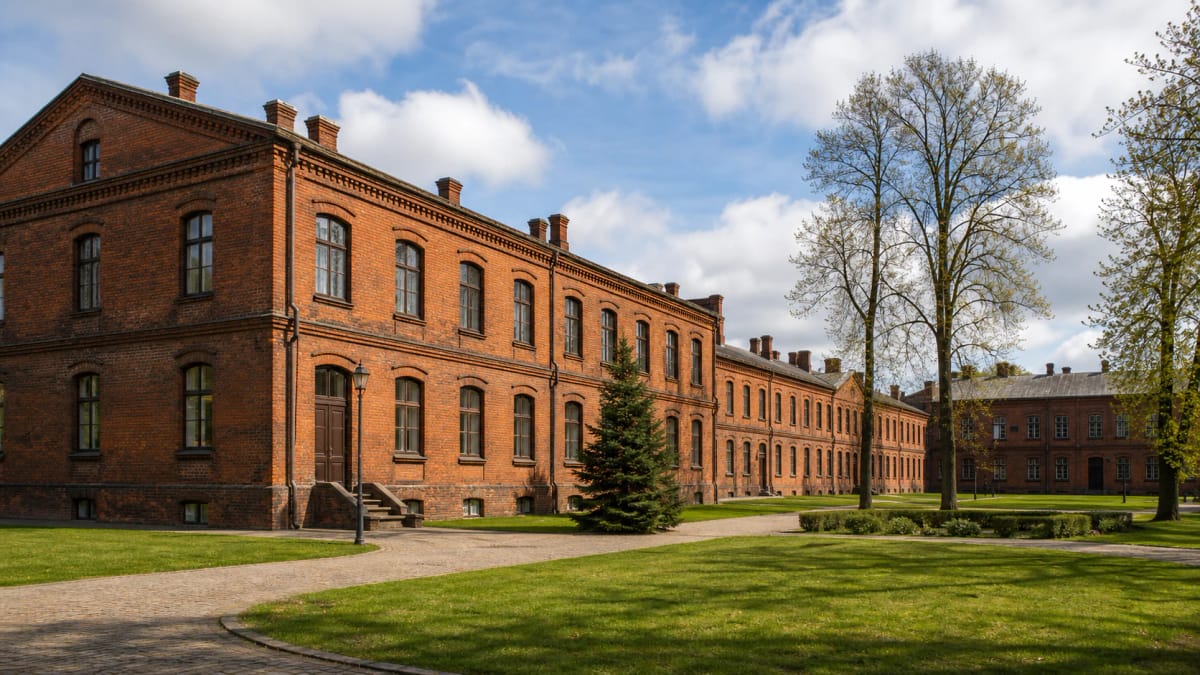
Klaipėda University Campus at H. Manto g. 84 occupies a former barracks complex - one of Klaipėda's clearest examples of military architecture adapted for academic and public use. Because of its red-brick masonry, the ensemble was known in the city as the Red Barracks.
The canonical Cultural Heritage Register name is the Klaipėda barracks building complex (code 15844), protected as a monument. So visitors should look not at one building but at the structure of the whole quarter, whose composition, according to the register, remains unchanged to this day.
Construction in 1904-1907 and Heimatstil architecture
The barracks complex was built in 1904-1907 at the northern end of present-day H. Manto Street. The register links the ensemble's architecture with a neo-Gothic variant of Heimatstil (the homeland style), in which red-brick masonry, rooflines, and details create a coherent military campus at the edge of the city.
According to the Encyclopedia of Lithuania Minor, this was a large barracks town with six ornate masonry buildings of various sizes - residential blocks for soldiers and officers, a chapel and canteen, an armoury - and a drill field. In the German Empire such barracks were meant, even by their appearance, to stress the power of the state in a border region.
The layout and blocks of the complex
As described by the historian Jonas Tatoris, the core of the ensemble was three symmetrically arranged blocks: two for soldiers to live in, and behind them, at the centre, a lower single-storey building with a tower and clock that served religious needs and as a canteen. This symmetrical arrangement is classicist.
The other three two-storey blocks are arranged more freely, with their side facades turned to H. Manto Street. They held the headquarters, the guardhouse, and officers' quarters, and one housed an ammunition depot. The whole quarter thus worked as a self-contained military town with living, service, and sacred parts.
Adaptation for Klaipėda University
After the Second World War, Soviet army units occupied the old barracks, and after 1990 the complex was handed to Klaipėda University. The adaptation of the former barracks for academic use took place in 1994-2013, so the site joins the city's military past with a new institution of independent Lithuania.
The first building of the complex (code 23548) has a rectangular plan with central projections on the north and south facades, two storeys with a mansard; it was restored in 1999-2002 (restoration project by Vytautas Šliogeris, reconstruction by Danutė Januševičienė). This shows that the quarter was renewed not all at once but building by building.
Klaipėda University
Klaipėda University was founded on January 1, 1991, on the basis of the former Klaipėda evening faculty of Kaunas Polytechnic Institute and the Klaipėda music and pre-school faculties. At first it had three faculties and about 3,000 students, and in 1993 the Klaipėda University Botanical Garden was established.
Today the university has faculties of Marine Technology and Natural Sciences, Social Sciences and Humanities, and Health Sciences, along with the Institute of Baltic Region History and Archaeology and the Marine Research Institute. The university even has its own research fleet, so the campus symbolically shows how, after 1990, Klaipėda grew not only as a port but also as a centre of science.
How to see the campus
The exterior can be viewed as an urban architecture site, but this is an active university, so access to interiors and some areas depends on university rules, events, or open days.
The campus is easy to combine with the Klaipėda University Botanical Garden or with a northern Klaipėda route toward Melnragė and Memel Nord. That way, one outing can connect the academic, military, and seaside sides of the city.