
Lithuanian traditional foods
Bulvinės bandos
Bulvinės bandos are a Dzūkija and Suvalkija dish: flat cakes shaped from grated-potato mass are baked on cabbage leaves in a bread oven. In the Lazdijai region, this is a certified living culinary heritage tradition.
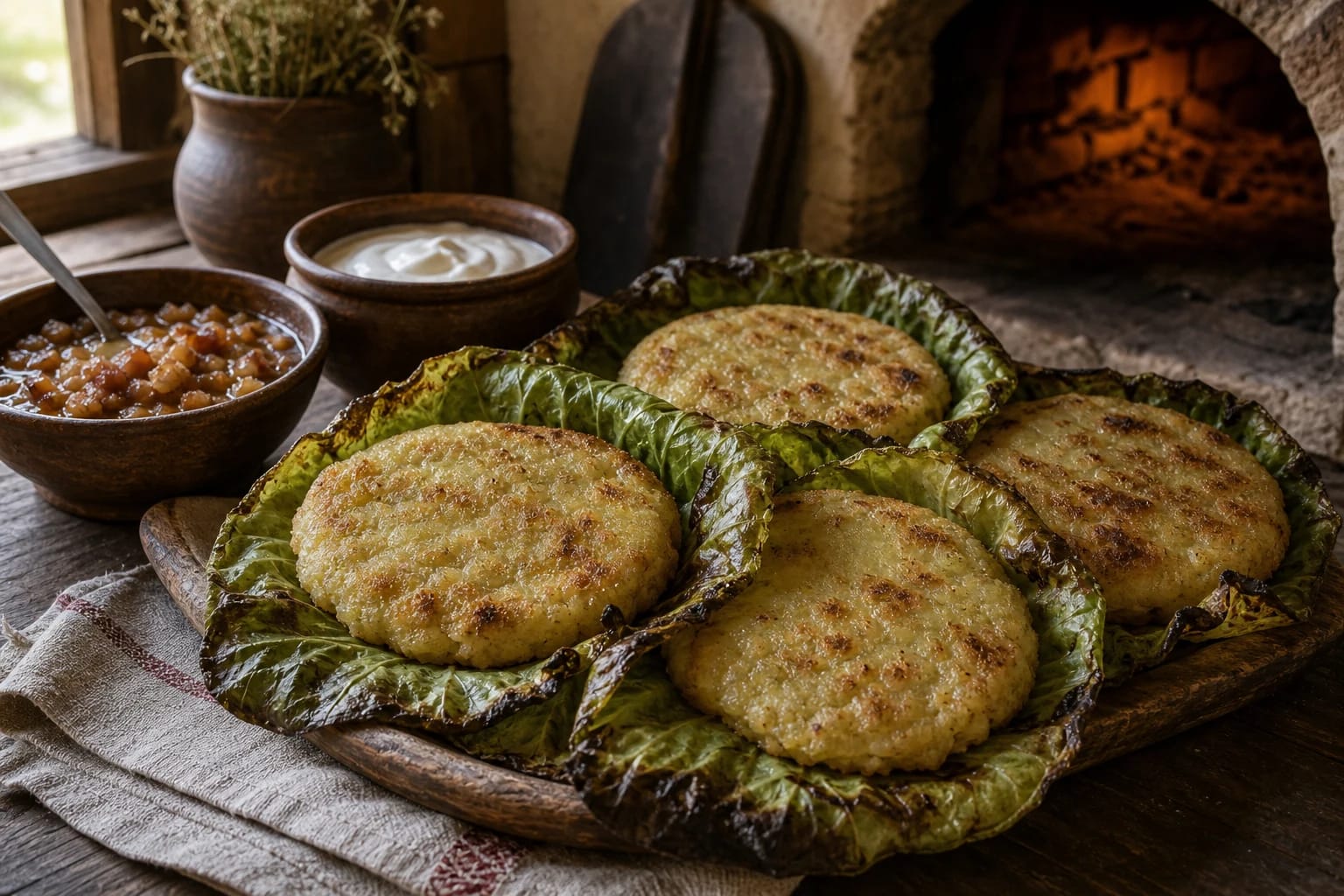
Food and heritage context
- Category
- Potato dishes
- Type
- grated-potato bandos baked on cabbage leaves in a bread oven
- Heritage status
- regional tradition
- Context
- Grated potatoes, cabbage leaves, bread oven, buttermilk, Dzūkija, Suvalkija, Lazdijai region, culinary heritage
Names and variants
Dzūkian bandos, Potato bandos, Bandos on cabbage leaves
What are bulvinės bandos?
Bulvinės bandos are a Dzūkija and Suvalkija dish: round flat cakes shaped from grated-potato mass and baked not in a pan or a dish, but directly on cabbage leaves in a heated bread oven. The Universal Lithuanian Encyclopedia's overview of Lithuanian foods notes that Dzūkijans and Suvalkijans liked potato bandos baked on cabbage leaves in a bread oven, which sets bandos apart from other potato dishes.
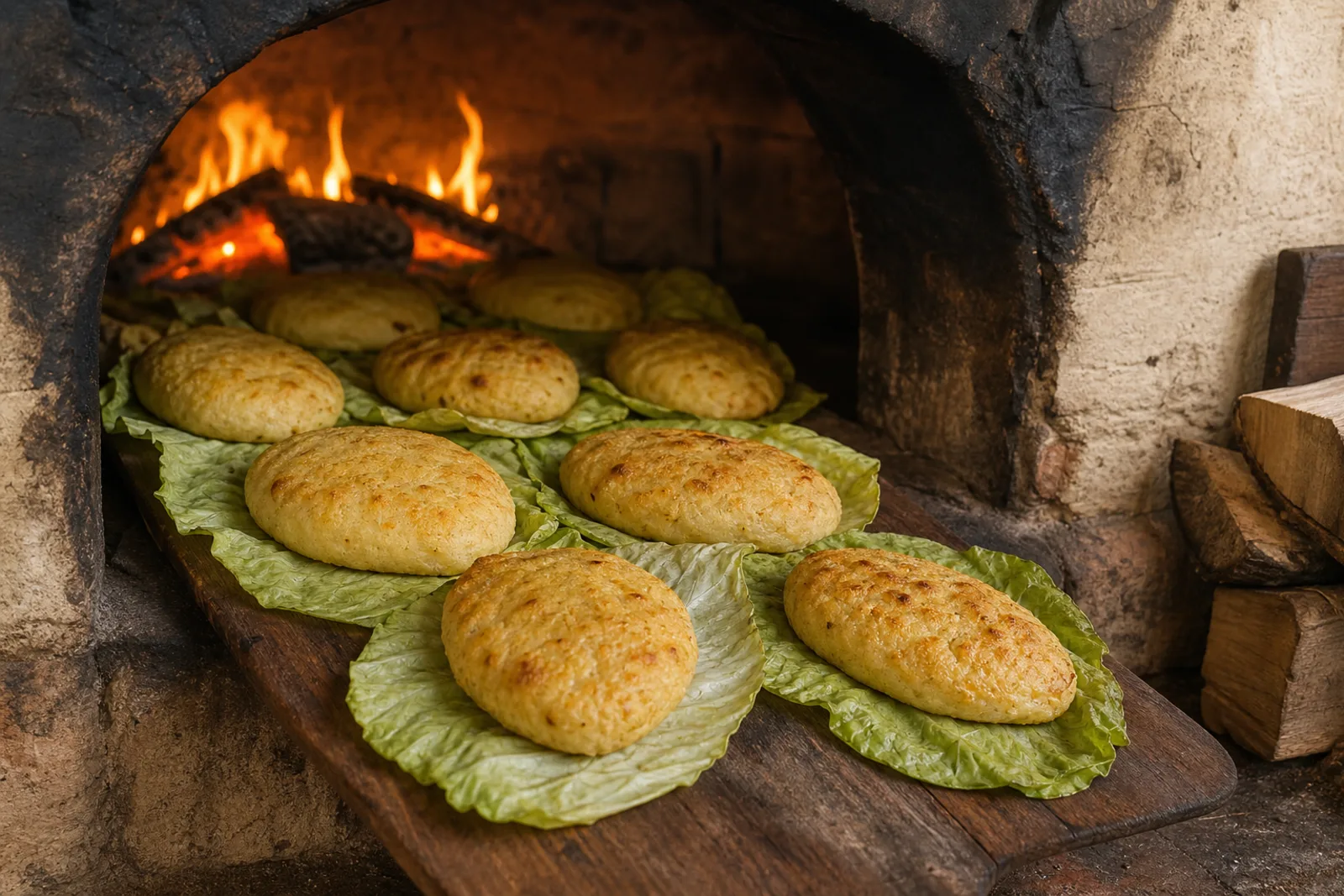
In Lithuania, the word banda marks a baked flat cake or small loaf; buckwheat and flour bandos are also known. A potato banda is thinner and wider than kugelis, but thicker and more bread-like than a pan-fried pancake. Its character is shaped by the baking environment: dry oven heat and a leaf instead of fat.
Origins and Place in Dzūkija Cooking
Bandos arose from two cores of Dzūkija household life: potatoes and the bread oven. Potatoes were brought to Lithuania at the end of the 17th century, spread widely in the 19th century, and, as the Universal Lithuanian Encyclopedia notes, potato dishes are abundant throughout Lithuania. In Dzūkija's sandy fields, the potato became a foundation of the everyday table, which is why a rich potato-dish tradition developed there.
A banda is a direct companion of bread baking: when the housewife finished baking bread, the oven still held heat for a long time, and foods that needed no separate firing were placed inside: flat cakes, turnips, and bandos. This thrifty use of oven heat explains why a banda is baked on a leaf rather than in a frying pan with fat.
The Universal Lithuanian Encyclopedia's overview of Lithuanian foods mentions that Dzūkijans baked bandos, pancakes, and casseroles from buckwheat flour, and also lists small potato buns with braised cabbage or mushroom filling among potato dishes. Bandos are thus part of a broader Dzūkija family of flat cakes and buns, whose potato version has remained the most alive.
Buttermilk as a Dzūkija Way to Mix Dough
One distinctive feature of Dzūkija bandos is mixing the dough with buttermilk. Buttermilk is a by-product of churning butter, a tangy and nutritionally valuable dairy drink. The Universal Lithuanian Encyclopedia's article on buttermilk states directly that Dzūkijans mixed flour bandos with buttermilk, so buttermilk was an everyday household liquid for binding dough.
Buttermilk gives a banda light acidity and softness, much like cultured milk or kefir in modern recipes. This is not a sign of luxury but of household economy: churning butter always left buttermilk, and it went into dough, soups, and potato soup. Today home cooks often replace old farm buttermilk with cultured milk or store-bought buttermilk.
How a Banda Is Baked: Cabbage Leaf and Bread Oven
The essential element of banda technique is the cabbage leaf. The oven floor or baking sheet is lined with the leaf, and the potato mass is placed on top. The leaf replaces both fat and a baking form: it protects the underside from scorching, allows moisture to escape, and gives the baked banda a gentle aroma. The Lazdijai heritage entry describes a banda as a grated-potato pancake baked on dried cabbage leaves in a bread oven.
Bandos bake for a long time in dry oven heat, so they form a fragrant crust while the inside stays soft. This differs fundamentally from quick pan frying: a banda does not fry in fat, so its flavor is closer to potato bread than to a pancake.
In modern kitchens, an oven replaces the bread oven, and fresh or briefly soaked cabbage leaves replace old dried leaves. The traditional step is to put bandos into the oven immediately after bread, while the oven is still hot and does not need separate firing.
A Certified Lazdijai Region Tradition
The baking of potato bandos in the Lazdijai region is entered into the Inventory of Intangible Cultural Heritage Values managed by the Lithuanian National Culture Centre. The value is registered as the tradition of baking potato bandos on cabbage leaves in the Lazdijai region; the submitters are the Lazdijai Region Museum and the Ethnic Culture and Self-Expression Club Bitinė (2025). This allows the banda to be called part of certified culinary heritage.
According to the inventory entry, the living tradition of baking bandos in the Lazdijai region is now preserved by at least 13 families in Kapčiamiestis, Šeštokai, Šventežeris, Žagariai, Avižieniai, Varnėnai, Verstaminai, Teizai, Krikštonys, Šadžiūnai, and Lopiškės. Baking bandos is regarded there as a symbol of local cultural identity, and preparing the dish by a distinctive local recipe from home-grown products is a sign of an authentic Dzūkija village way of life.
The inventory also emphasizes the social role of bandos: they are baked for celebrations, especially on Sundays, when the whole family prepares a shared lunch together from early morning. Eating bandos together maintains and strengthens mutual bonds, so a banda is not only food but also a Sunday ritual.
How Bandos Are Eaten
The traditional way of eating is communal: once the housewife pulls out the fragrant banda and places it on the table, family members tear off pieces by hand. A banda is usually eaten with dipping sauces, such as darycinis, a curd and cream sauce, cracklings, a sour cream and butter seasoning, or with milk to drink.
There is also a richer Dzūkija serving style: the baked banda is torn up, put into a clay pot, covered with crackling sauce and sour cream, and returned to the oven for another half hour before serving. In this form the banda absorbs the sauce and becomes almost a separate stew.
Bandos have also become a dish for educational programs and tastings. Baking lessons are popular with culinary heritage enthusiasts, students, and tourists. Experienced cooks bake good bandos for special occasions and representative hospitality, showing Dzūkija generosity.
How Bandos Differ from Pancakes and Kugelis
Bandos are easy to confuse with other grated-potato dishes, but the cooking method sets them apart. Bulviniai blynai are fried in oil in a pan and become thin and crisp; kugelis, or potato pudding, is baked in a dish or tray and forms a thick, unified casserole. A banda is in between: a flat cake baked on a leaf in a bread oven, without frying fat, with a bread-like crust.
The dough composition and environment also differ. Buttermilk acidity and a small amount of flour are typical of a banda, while its character is shaped not by the frying pan but by dry oven heat and the cabbage leaf. For that reason a banda is not a quick everyday dish so much as a more festive food connected with the oven and bread baking.
The banda belongs to the same family of potato dishes as cepelinai, kugelis, vėdarai, and sklindžiai, but it is distinctly regional: its home is Dzūkija and Suvalkija, especially the Lazdijai region.
How to Make Bandos Today
At home, a banda can succeed without a true bread oven. Grate starchy potatoes, drain them well and return the settled starch, then mix in a little flour, salt, and buttermilk or cultured milk. Place the shaped bandos on a baking sheet lined with cabbage leaves and bake in a well-heated oven until the top browns and the inside cooks through.
To come closer to authentic flavor, use buttermilk or cultured milk for the dough and bake on real cabbage leaves; they replace fat and add aroma. Serve hot, best with cracklings and sour cream or curd and cream sauce, as is customary in the Lazdijai region.
Recipe
How are bulvinės bandos baked?
A traditional Dzūkija banda is a flat cake of grated raw potatoes, often mixed with buttermilk and a little flour, baked on cabbage leaves in a bread oven. At home it can be baked in an oven or on a sheet pan. The leaf protects the underside from scorching and gives the banda aroma.
Ingredients
Method
- Finely grate the potatoes and squeeze firmly through cloth to remove liquid. Let the liquid settle and return the starch from the bottom.
- Mix flour, salt, and buttermilk into the potato mass. It should be thick, sticky, and able to hold its shape. If too wet, add an egg or more flour.
- Line a baking sheet or bread-oven floor with cabbage leaves. With wet hands, form round bandos about 2-3 cm thick and place them on the leaves with space between them.
- Bake in a well-heated bread oven, or at about 200-220 °C in a regular oven, until the top browns and the inside cooks through, about 40-60 minutes depending on size and oven.
- Put the baked banda on the table; the cabbage leaf can be left underneath or removed. Serve hot with cracklings, sour cream, or curd and cream sauce.
Notes
Traditionally bandos were put into the bread oven right after bread, while the oven still held heat.
A Dzūkija serving style: tear the baked banda into pieces, put it in a clay pot, pour over crackling sauce and sour cream, and return it to the oven for another half hour.
Related pages about Bulvinės bandos
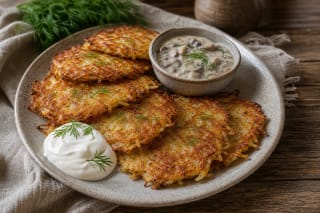
Bulviniai blynai
The same grated-potato base, but pancakes are fried in a pan while bandos are baked in a bread oven.
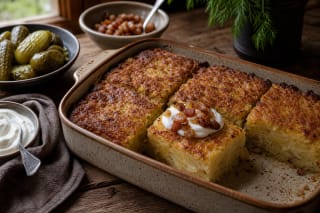
Kugelis / potato pudding
Kugelis is a baked grated-potato casserole; a banda is a thinner flat cake baked on a leaf.
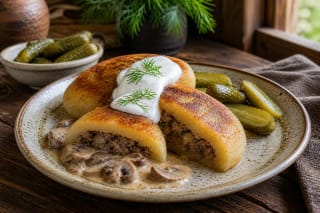
Žemaičių blynai
Another regional potato dish that helps place bandos within the family of potato foods.
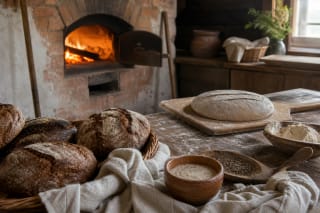
Bread baking
Bandos are baked in the same bread oven, often immediately after bread.

Buttermilk
Dzūkijans mixed bandos dough with buttermilk left from churning butter.
Bulvinės bandos: frequently asked questions
How are bulvinės bandos different from potato pancakes?
Potato pancakes are fried in oil in a pan and become thin and crisp, while bandos are baked without fat on cabbage leaves in a bread oven or oven. Dry oven heat gives a banda a more bread-like crust and soft inside.
How are bandos different from kugelis?
Kugelis, or potato pudding, is baked in a dish or tray and is a thick, unified casserole, often with bacon. A banda is a thinner round flat cake baked on a leaf; the dough is often mixed with buttermilk.
Why are bandos baked on cabbage leaves?
The cabbage leaf is placed under the banda instead of fat: it protects the underside from scorching, lets moisture escape, and gives a gentle aroma. Dried leaves were used in the past; fresh leaves work today.
Why is buttermilk added to the dough?
Buttermilk is the by-product of churning butter and was always left in a Dzūkija farm. The Universal Lithuanian Encyclopedia notes that Dzūkijans mixed bandos with buttermilk. It gives light acidity and softness and can be replaced with cultured milk.
Are bulvinės bandos certified heritage?
Yes. The tradition of baking potato bandos on cabbage leaves in the Lazdijai region is entered in the Inventory of Intangible Cultural Heritage Values (LNKC). The submitters are the Lazdijai Region Museum and the Bitinė club (2025).
Where in Lithuania are bulvinės bandos made?
Bandos are typical of Dzūkija and Suvalkija, especially the Lazdijai region. According to the inventory, the baking tradition is preserved today by at least 13 families in Kapčiamiestis, Šeštokai, Šventežeris, Žagariai, and other villages of the region.
What are bulvinės bandos eaten with?
The baked banda is torn by hand and eaten with darycinis, a curd and cream sauce, cracklings, sour cream and butter seasoning, or with milk. It can also be torn up, covered with sauce, and returned to the oven.
Can bandos be baked in a home oven without a bread oven?
Yes. Place the shaped bandos on a baking sheet lined with cabbage leaves and bake in a well-heated oven at about 200-220 °C until the top browns and the inside is cooked. A real bread oven gives more oven aroma, but an oven gives a close result.