
Lithuanian traditional foods
Pamario žuvies patiekalai
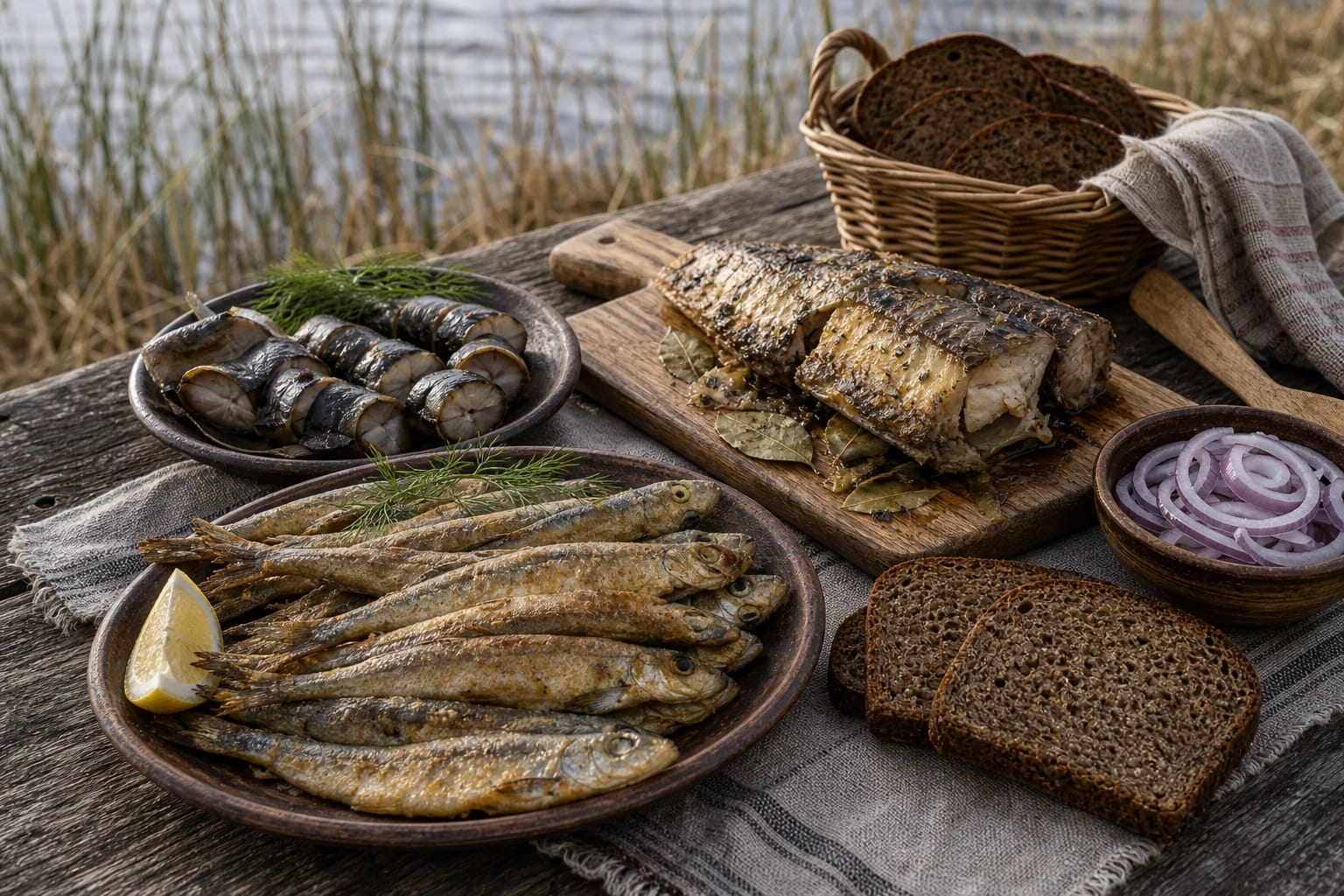
Pamario žuvies patiekalai are the cuisine of the Curonian Lagoon and coastal region, where the fishing catch - eel, smelt, flounder, and other lagoon and sea fish - is salted, smoked, fried, or marinated. Its best-known signs are cold-smoked Curonian Lagoon eels and fish baked on a board in the oven.
Food and heritage context
- Category
- Fish dishes
- Type
- fish-dish tradition of the Curonian Lagoon and the coast
- Heritage status
- regional tradition
- Context
- Curonian Lagoon, Lithuania Minor, Pamarys, Curonians, fishers, cold-smoked eel, smelt, flounder, fish baked on a board
Names and variants
Curonian Lagoon fish dishes, Fisher cuisine of Lithuania Minor, Coastal fish dishes
What are Pamarys fish dishes?
Pamario žuvies patiekalai are not one dish but the cuisine of the Curonian Lagoon and coastal region, formed where fishing was the main livelihood. This is the table of Lithuania Minor and the Pamarys fishers, including Curonian and Lietuvininkai communities, where fish was everyday food rather than an occasional item.
The Universal Lithuanian Encyclopedia's overview of Lithuanian foods notes that fish was eaten most by residents of the lagoon, coastal, and lake-rich regions of Lithuania. This geographic boundary is what separates Pamarys cuisine from the rest of Lithuania, where fish was more often a fasting or holiday food.
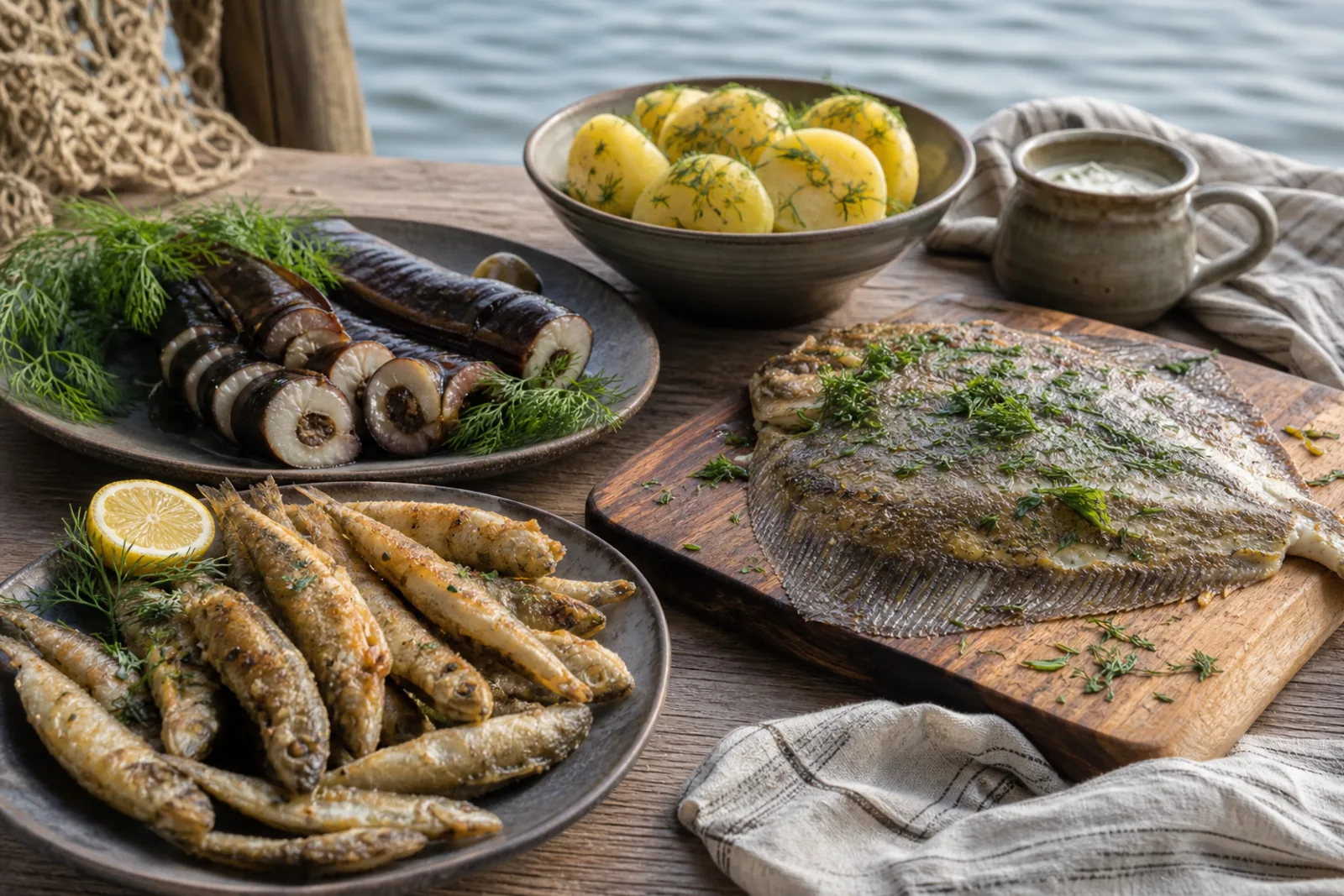
The best-known signs of this tradition, named directly in the same overview, are cold-smoked Curonian Lagoon eels and fish baked in the oven on a board. Alongside them were abundant small lagoon fish: smelts, flounders, bream, vimba, and others that fed entire fishing villages.
Lagoon and sea fishing culture
The Curonian Lagoon is a shallow freshwater lagoon separated from the Baltic Sea by the Curonian Spit. This position created unusual fish abundance: sea fish move into the lagoon and lower Nemunas to spawn, while freshwater species live in the lagoon itself. A Pamarys fisher therefore dealt with very different catches during the year.
Fishing here was a communal craft with its own boats, called kurėnai, nets, and seasonal order. The catch had to be processed quickly, so salting, smoking, and frying became not only flavors but preservation methods; without them, large catches could not have been eaten or sold.
Both dishes and their festive side grew from this everyday life. Today the living Pamarys fishing tradition is remembered by events in Nida and other coastal places, including the winter Stintapūkis smelt festival, where fried smelts become a symbol of the whole region.
Cold-smoked Curonian Lagoon eels
Cold-smoked eel is the most famous Pamarys delicacy. The overview of Lithuanian foods names it directly: Curonian Lagoon cold-smoked eels were famous. The eel's long, fatty flesh suits smoke especially well, so smoked eel became the calling card of the whole region.
Cold smoking means long treatment in cool smoke: the fish is not cooked by heat but slowly takes in smoke and dries. Fatty eel prepared this way develops a dense, buttery texture and a dark golden surface; it is sliced and eaten with bread, without any additional sauce.
For accuracy, it is worth noting that eel does not have a separate encyclopedic description as a dish, so the specific preparation steps here are conveyed from the ethnographic Pamarys tradition rather than from one precise source. What is firmly documented is that Curonian Lagoon cold-smoked eels were widely known and valued.
Smelts: the lagoon fish with a cucumber smell
Smelt, Osmerus eperlanus, is a small fish of the smelt family with a distinctive cucumber-like smell. According to the Universal Lithuanian Encyclopedia, three smelt forms live in Lithuania: the lagoon form in the Curonian Lagoon and sometimes the Nemunas Delta, a lake smelt in cold-water lakes, and the larger Baltic smelt along the Lithuanian coast, which swims into the Curonian Lagoon and lower Nemunas to spawn.
Smelts are very common: the encyclopedia states that in 2011 Lithuania caught 115,440 kg of larger smelts and 7,748 kg of lake smelts. Such abundance explains why smelt became a mass, inexpensive Pamarys food; many are caught quickly, and the season is short.
In the kitchen, smelts are simply salted, dredged in flour, and fried in a pan until crisp. Small fish have soft bones and are eaten almost whole. Fried smelts are often also marinated, becoming cold fish that have absorbed onion, vinegar, and spices.
Flounder and other sea and lagoon fish
Flounder is a flat fish of the flounder family, with both eyes on one side of the body. According to the Universal Lithuanian Encyclopedia, Baltic Sea flounder is common along the Lithuanian coast, usually caught at 35-40 cm, while Baltic river flounder, up to 45 cm and usually 20-30 cm, often enters the Curonian Lagoon and lower Nemunas.
The flat, dense flesh of flounder suits frying and smoking especially well. On the coast it is fried in a pan or on a grill and smoked with other fish; its white, lean flesh separates easily from bones, so flounder is valued as both everyday and guest food.
Beside eel, smelt, and flounder, the Pamarys table was also filled by freshwater fish from lagoons and ponds. The Lithuanian foods overview notes that peasants raised carp and crucian carp in ponds, while Samogitians baked carp stuffed with apples, showing how coastal and neighboring fish cuisines blended.
Fish baked on a board and other methods
The second symbol of Pamarys cuisine named directly in the Lithuanian foods overview is fish baked in the oven on a board. The fish is placed on a wooden, usually hardwood, board and baked in heat so the wood gives a light aroma and the underside does not dry out. It is an old, simple, but very characteristic local method.
Alongside it, all main fish-processing methods were used in the Pamarys region: salting to keep the catch, cold and hot smoking with alder smoke and sometimes juniper for aroma, pan-frying and grilling, and boiling for fish soup. The same smoke and salt described in the broader smoked-fish tradition were applied here to lagoon and sea species.
These methods do not replace one another but complement each other: fatty eel is best shown by cold smoke, small smelt by quick frying, flat flounder by frying or grilling, and on a tiring day a fisher was fed by hot fish soup made from whatever came into the net.
How Pamarys fish is eaten and served
Pamarys fish dishes are usually served without complicated sauces; the fish itself and its smoke or frying aroma matter most. Cold-smoked eel is sliced and eaten with bread, fried smelts are piled on the table and taken by hand, and fish baked on a board is served with potatoes and onions.
Classic accompaniments are black rye bread, boiled or fried potatoes, onions, dill, and sometimes lemon or pickled vegetables. This serving style reflects fisher everyday life, where fish was a filling main part of the meal, not a luxury addition.
Cold marinated smelts and leftover smoked fish often become appetizers and spreads, so Pamarys fish suits both everyday and festive tables. Coastal inns still serve it as a regional calling card.
Place in Lithuanian fish cuisine
Pamarys fish dishes differ from the general smoked-fish tradition not by technique but by place and fish species. General smoked fish includes all coastal and lake regions and fish such as bream or vimba; the Pamarys tradition is focused on the Curonian Lagoon and sea, on cold-smoked eel, smelt, flounder, and fish baked on a board.
This region differs from stuffed pike or fish soup because here fish is everyday and abundant, not occasional or a single specific dish. Stuffed pike is a festive freshwater-fish dish, fish soup is a boiled catch, and the Pamarys tradition covers the whole fisher's year with its salting, smoking, and frying.
Today Pamarys fish dishes survive as living regional cuisine and as a sign of tourism and festivals. Smelt and fish festivals in Nida and the Klaipėda region, coastal smokehouses, and inns keep alive the flavor that was once simple fisher everyday food.
Recipe
How are fried Pamarys smelts prepared?
Fried smelt
Fried smelts are the simplest and most recognizable Pamarys fish food: small lagoon smelts are salted, dredged in flour, and quickly fried in a pan. Because of their cucumber-like smell and soft bones, they are eaten almost whole, with rye bread or potatoes. For marinated smelts, still-warm fried fish are covered with an onion, vinegar, and spice marinade and left overnight to absorb it.
Ingredients
Method
- Scale, gut, and behead the smelts, then rinse well and dry. Small smelts may be left with their soft bones.
- Salt and leave for 10-15 minutes so the fish absorbs the salt.
- Dredge in flour and shake off the excess.
- Fry in hot oil for 2-3 minutes on each side, until a golden crust forms.
- Eat hot smelts right away with rye bread, onions, and potatoes.
- For the marinated version, layer the fried smelts with sliced onions, cover with cooled marinade made from water, vinegar, salt, sugar, bay leaf, and pepper, and keep cold for at least one day.
Notes
Small lagoon smelts have soft bones and, when well fried, are eaten almost whole.
When marinating, the fish must be well fried and the marinade cooled; only then does it keep cold and take on a sour flavor.
Related pages about Pamario žuvies patiekalai
Smoked fish
Smoked fish explains the broader salting and smoke technique for which the Pamarys region is especially vivid.
Stuffed pike
Stuffed pike shows a festive freshwater-fish direction beside everyday lagoon fish.
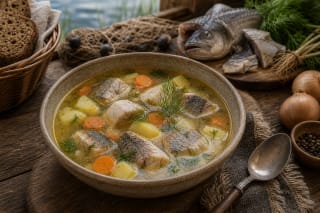
Žuvienė
Žuvienė is another side of Pamarys fisher cuisine: a boiled catch rather than smoked or fried fish.
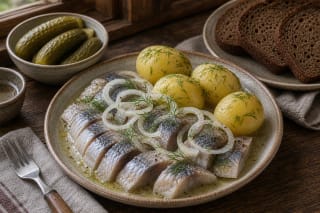
Herring with potatoes
Herring with potatoes recalls that on the coast fish was both everyday and fasting food.
Pamario žuvies patiekalai: frequently asked questions
How do Pamarys fish dishes differ from general smoked fish?
Smoked fish is a broader coastal and lake tradition including bream, vimba, and other fish. Pamarys fish dishes are a narrower local tradition focused on the Curonian Lagoon and the sea: cold-smoked eel, smelts, flounders, and fish baked on a board.
Why are Curonian Lagoon eels so famous?
Eel is fatty and therefore especially suited to cold smoking, gaining a dense, buttery texture and deep smoke flavor. The Lithuanian foods overview directly states that cold-smoked Curonian Lagoon eels were famous, so they became a symbol of the whole Pamarys region.
Why do smelts smell like cucumbers?
It is a natural trait of smelt. According to the Universal Lithuanian Encyclopedia, smelt has a distinctive cucumber-like smell. In fresh smelt this is a sign of quality, not a defect.
What are the lagoon smelt, lake smelt, and Baltic smelt?
They are three smelt forms living in Lithuania: one in the Curonian Lagoon and sometimes the Nemunas Delta, one in cold-water lakes, and the larger Baltic smelt in the Baltic Sea, from which it swims into the lagoon and lower Nemunas to spawn.
How is flounder different from other Pamarys fish?
Flounder is a flat fish of the flounder family, with both eyes on one side of the body. In the Pamarys region, Baltic Sea flounder and Baltic river flounder are common; the latter enters the Curonian Lagoon and lower Nemunas. Its white, dense flesh suits frying and smoking.
What is fish baked on a board?
It is an old Pamarys method: fish is placed on a wooden board and baked in the oven, formerly in a bread oven. The wood gives a light aroma and the fish stays juicy. The Lithuanian foods overview mentions this method directly.
What is the simplest way to prepare Pamarys fish at home?
The easiest way is to fry smelts: salt them, dredge in flour, and fry quickly on both sides in a pan. Small smelts have soft bones and are eaten almost whole with rye bread or potatoes.
What are Pamarys fish dishes eaten with?
Most often with black rye bread, boiled or fried potatoes, onions, and dill, sometimes with lemon or pickled vegetables. Sauces are usually unnecessary because the fish and its smoke or frying aroma are central.
Is the Pamarys fish tradition still alive?
Yes. It survives as regional coastal cuisine and as a sign of festivals and tourism, for example the winter Stintapūkis smelt festival in Nida, coastal smokehouses, and inns that still preserve the taste of cold-smoked eel and fried smelts.