- Genre
- Mythological sakme
- Source status
- folkloric
- Motifs
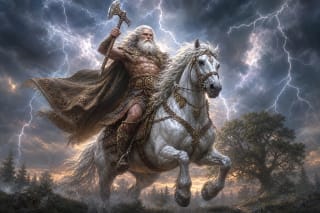
- Perkūnas pursues Velnias, overturned turf, search for a hiding place, storm taboos, plowing
The sakme
Velnias once asked Perkūnas where he could hide from his strike. He said he would crawl under a house, into a tree, under a stone, under a hill, into a bathhouse, even into a church.
Each time Perkūnas answered that he would strike there too. Velnias was left with no place, neither high nor low, neither sacred nor everyday.
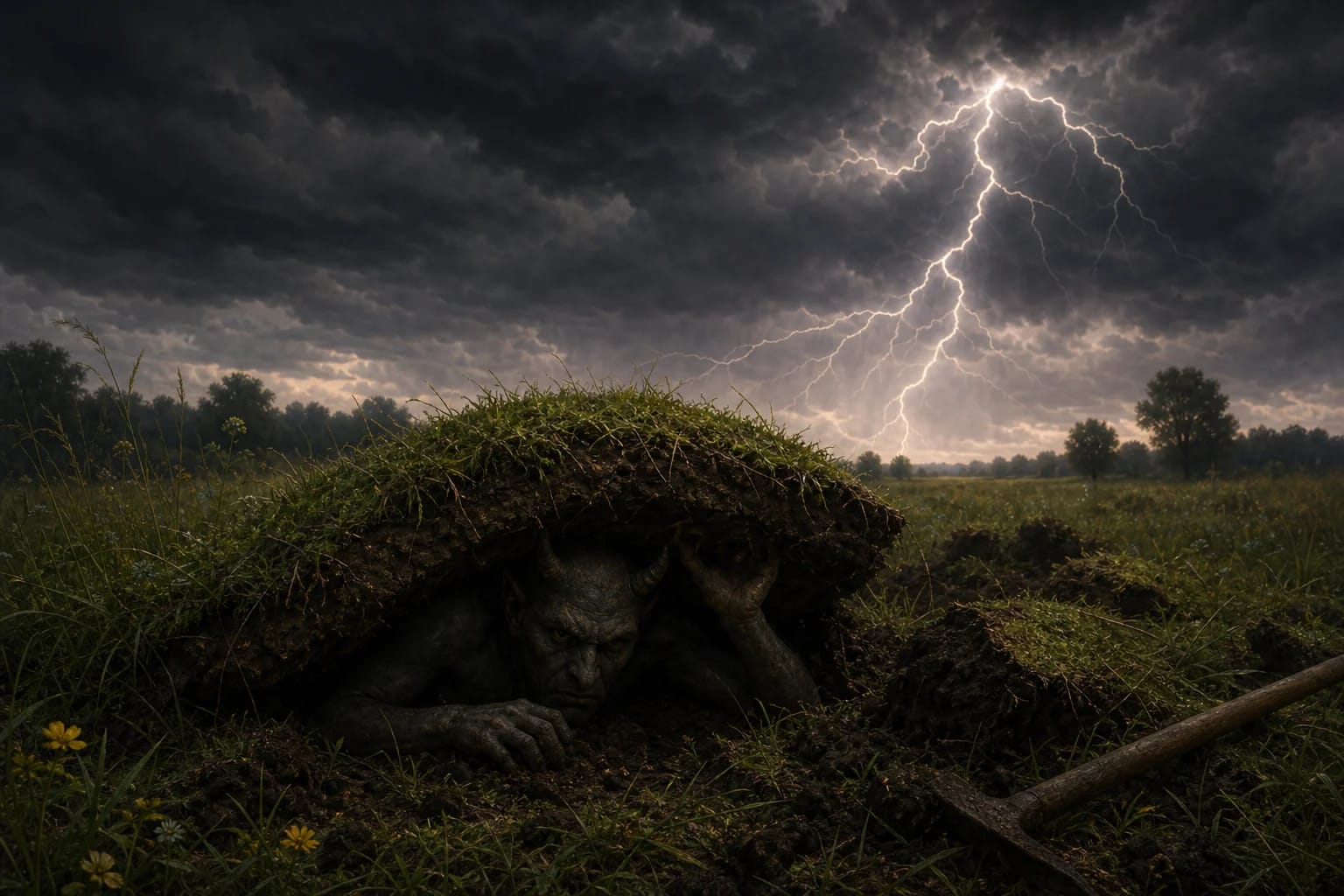
At last Velnias said he would crawl under a strip of earth’s turf turned back on itself. Perkūnas answered that there he would not strike. Since then Velnias hides under such turf.
For this reason, ploughmen used to take care that the turf did not turn back. The account also ends with a belief about clothing: as a thunderstorm approached, women lowered their tucked-up skirts and unrolled their sleeves so that the devil pursued by Perkūnas could not hide in the folds.
Interpretation: what does Velnias under the turf mean?
The closing detail about clothing connects fear of the storm with the image of a hiding place. What matters is the fold of a raised skirt or rolled sleeve where the story’s devil might hide.
Overturned turf is a sign of reversed order. Earth that should lie in its proper way turns the opposite direction and becomes a hiding place for Velnias.
Perkūnas acts here as a guardian of order, but even his strike has a limit. Velnias finds shelter not in the strongest place but in the smallest crack in order.
The source variant
Vaikams.lt: „Velnias po velėna“, complete legend text. An editorial retelling of the specific cited variant, checked against its complete source narrative. This is not a literal transcript.
Storm and the farmer’s world
For a farmer the storm was both danger and condition of harvest. Perkūnas could bring rain, but his lightning could destroy.
The sakme helps explain why a storm was read as a system of signs: tree, stone, turf, clothing, or eaves might not be neutral places.