
- Genre
- Fate sakme
- Source status
- folkloric
- Motifs
- three allotting voices, newborn’s fate, threat of Perkūnas, stone wall, cabbage leaf
The sakme
A wealthy father had a son. That night voices were heard allotting the child’s future. One said the child would grow large and be rich. The second said he would die young.
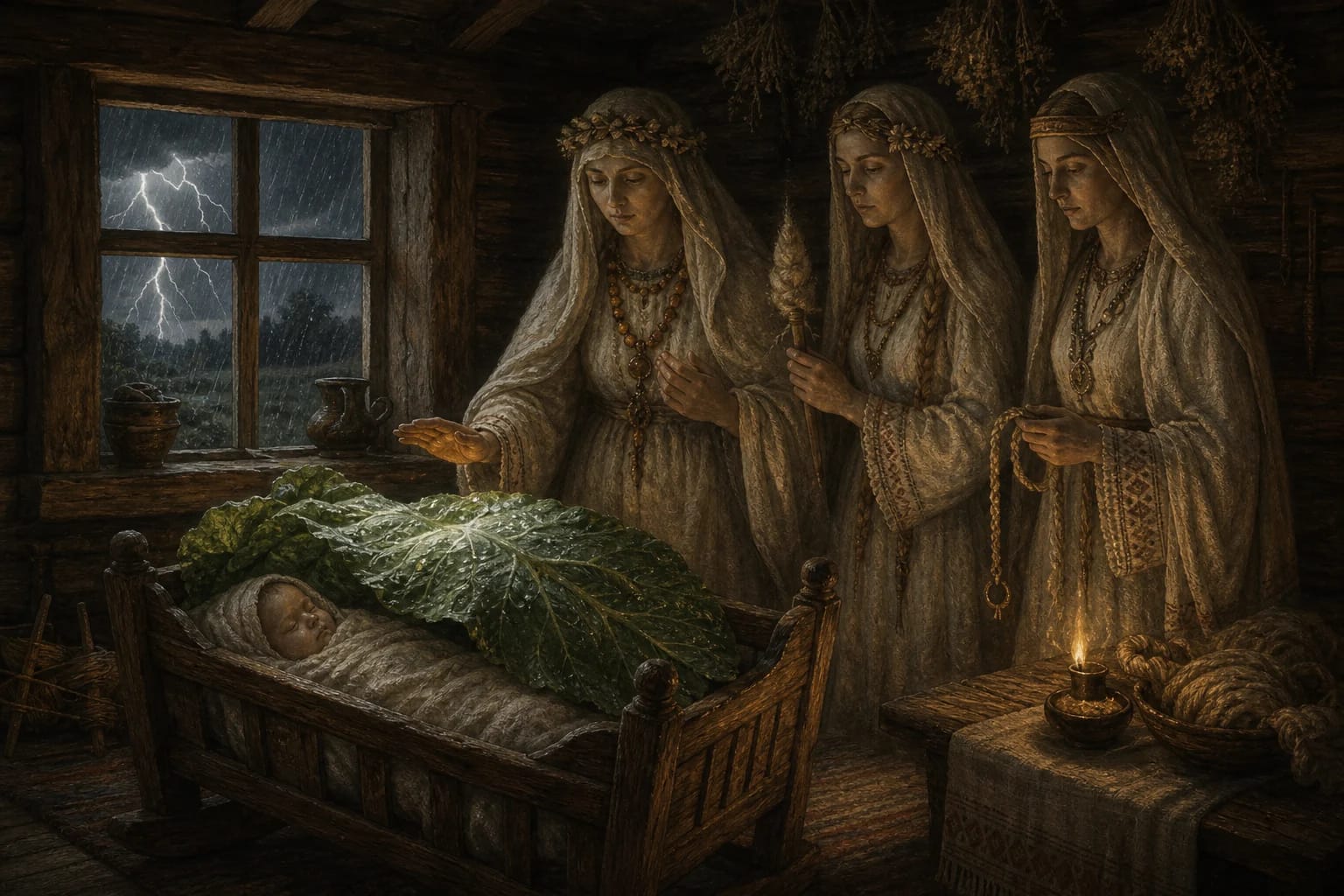
The third voice allotted otherwise: the child would live to a certain age, and on the appointed day Perkūnas would kill him.
The father feared that day. When it approached, he ordered a thick stone wall to be built and wanted to hide his son inside it. But the son ran into the cabbage garden and hid under a leaf.
A black cloud came. Perkūnas struck the wall and shattered it, but the child under the cabbage leaf remained alive.
Interpretation: what does the Laimės’ foretelling mean?
The sakme asks whether fate is unchangeable. The voices seem to draw the course of life beforehand, yet the father’s fear and the child’s accidental choice create another ending.
The stone wall symbolizes a human attempt to protect by force. Yet Perkūnas destroys precisely that fortress, while the fragile cabbage leaf becomes the true shelter.
This is a paradoxical fate sakme: humans cannot control heaven, but sometimes rescue comes through something small, unplanned, and everyday.
The source variant
Lietuvių tautosaka, IV (1967), no. 559, p. 557: „Laimių lėmimas“. An editorial retelling of the specific cited variant, checked against its complete source narrative. This is not a literal transcript.
The cabbage leaf and the stone wall
One of the most beautiful images in this sakme is the cabbage leaf that protects better than a wall. It shows that life is not guarded by power and wealth alone.
The sakme also reminds us that stories about fate often work not as dogma, but as a way of thinking about human limits.