- Genre
- Mythological sakme
- Source status
- folkloric
- Motifs
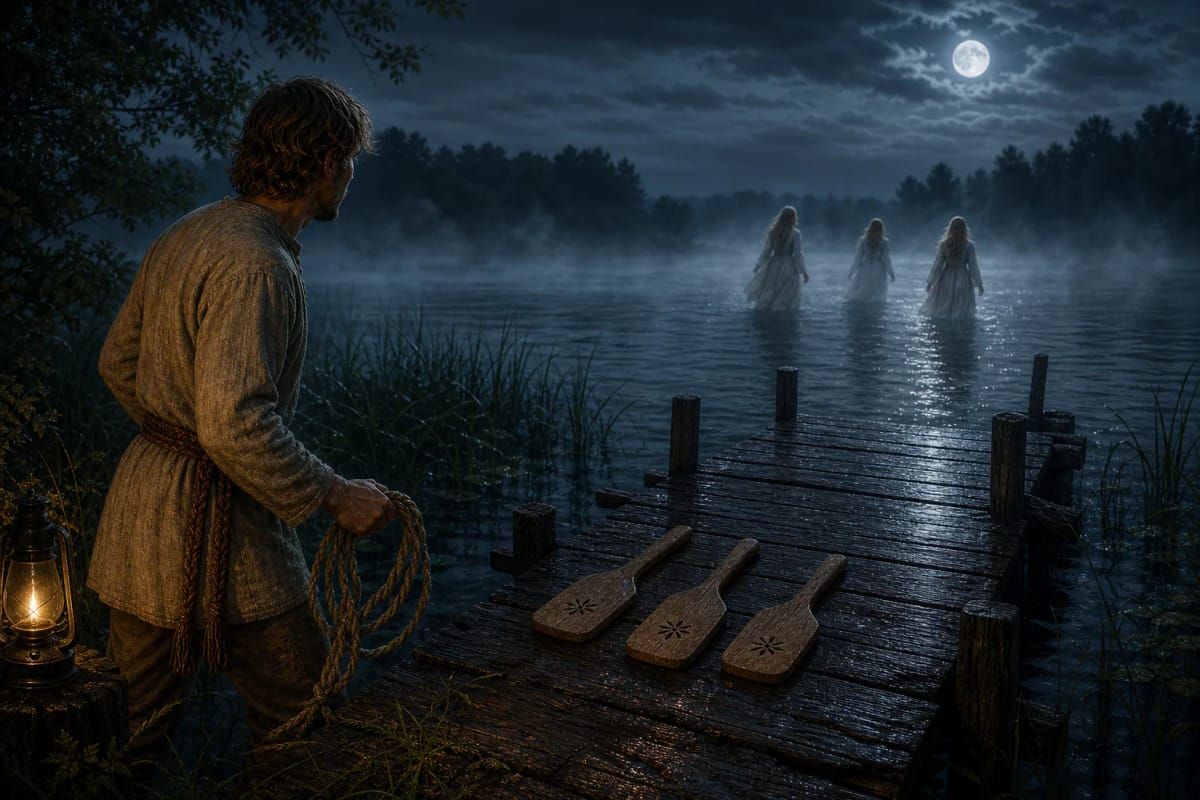
- Laumės as washers, Thursday evening, lake footbridge, backward-twisted whip, three washing paddles
The sakme
A hardworking housewife, saving daylight hours, took the baby’s swaddling cloths to wash on a lake footbridge in the evening. It happened to be a Thursday evening.
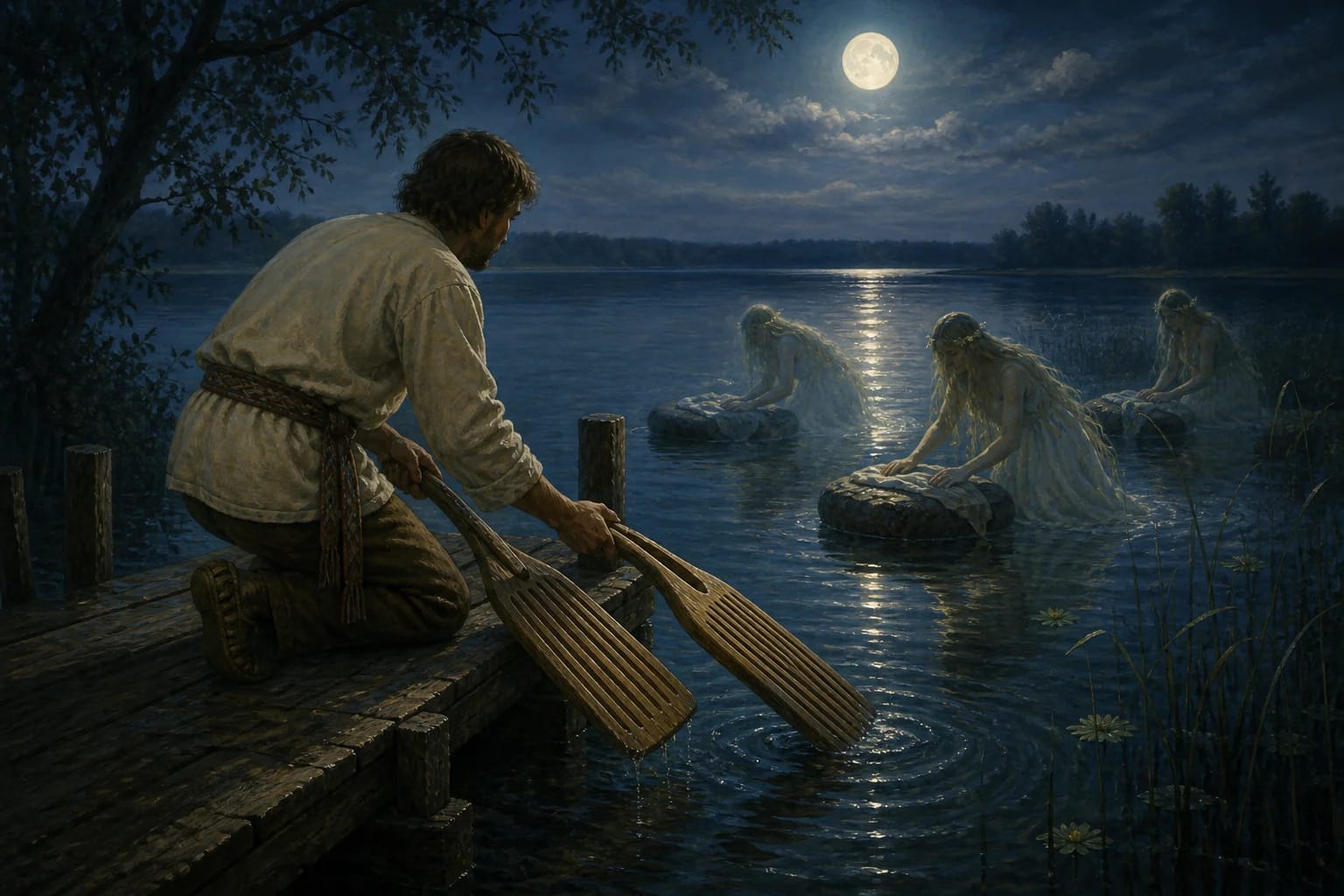
From the next Thursday onward, after sunset, Laumės began washing by the bridge. The sound was so strong and eerie that the people in the house became uneasy.
An old man advised them to twist a fiber whip backward and go to the bridge when the washing was heard again. The housewife’s brave brother Jakamas did so: although he saw nothing, he struck across the bridge and found three Laumės’ washing paddles.
For several Thursdays the Laumės begged him to return their paddles. They said they would no longer wash there. Jakamas took pity and carried the objects back. From then on the bridge was silent.
Interpretation: what do the Laumės’ washing paddles mean?
The sakme speaks about boundaries of time and place. Thursday evening, the lake footbridge, and a child’s laundry create a space where human work intersects with Laumės’ activity.
The backward-twisted whip shows magical reversal. To affect invisible beings, one must act not in the ordinary way but in reversed order.
The washing paddles are the Laumės’ work tools. Once they are taken, the Laumės cannot repeat the washing that frightens the household. Yet their request to have the tools returned reminds us that even a dangerous being has a claim to its own implements.
The source variant
Lietuvių tautosaka, IV (1967), no. 551, p. 552–553: „Laumių kultuvėlės“. An editorial retelling of the specific cited variant, checked against its complete source narrative. This is not a literal transcript.
Work, fear, and agreement
The sakme ends not with the destruction of the Laumės but with an agreement: the human returns the objects, and the Laumės do not come back to wash.
It is therefore not only about victory over a supernatural force. It is a story about setting boundaries between the human world and another world.