
- Genre
- Mythological sakme
- Source status
- folkloric
- Motifs
- Giltinė, poisonous tongue, shears, stopping death, old man’s trick
The sakme
Long ago people began dying in great numbers. One old man felt that his own end was near. He called his children, relatives, and neighbors to his bed.
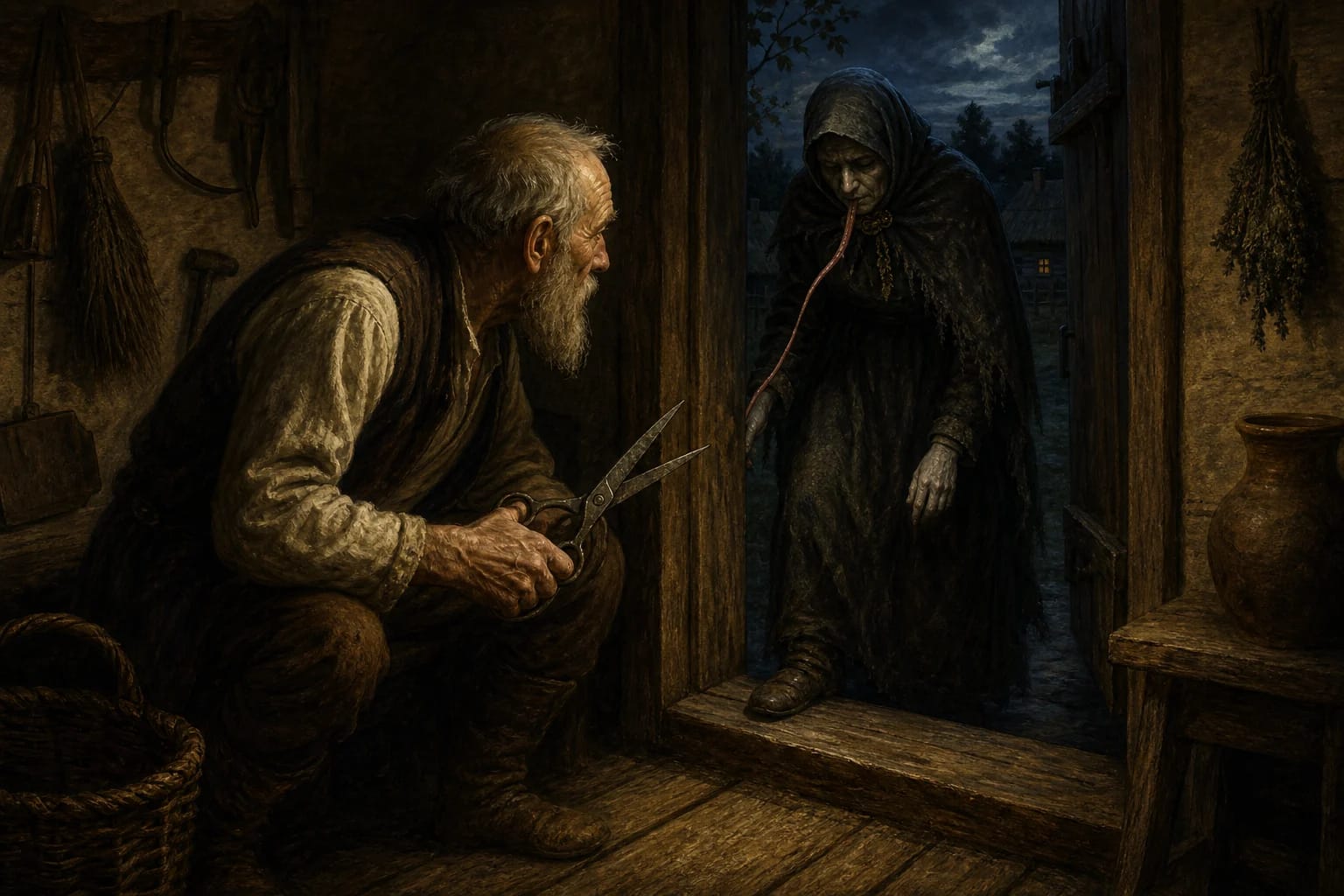
He said he could feel Giltinė’s poison in his heart. He was not angry about his own death, because he was old, but he could not forgive Giltinė for destroying young people.
The old man asked that after he died sheep shears be placed at his side. His relatives kept asking what they were for, and at last he explained: when Giltinė came close to strengthen herself and put out her poisonous tongue, he would cut it off with the shears.
So it was done. After the old man’s death the terrible dying ceased, as if Giltinė had lost her weapon.
Interpretation: what does Giltinė’s tongue mean?
Here Giltinė acts not with a scythe but with her tongue. Death comes as poison, a lick, an invisible touch against a human life.
The shears are a very ordinary tool, but in the sakme they become a weapon against death. This is typical of folklore: everyday objects can briefly gain supernatural force.
The old man does not seek immortality for himself. His trick is aimed against mass death, so the story has a communal dimension.
The source variant
Lietuvių tautosaka, IV (1967), no. 439, p. 482–483: „Mirties liežuvis“. An editorial retelling of the specific cited variant, checked against its complete source narrative. This is not a literal transcript.
Death as a bodily being
In this sakme death has a body, a tongue, and even a vulnerable place. That lets a person, at least in story, meet death face to face.
For that reason the sakme is not only frightening. It gives comfort: even before the strongest boundary, one can keep intelligence, dignity, and care for others.