- Place
- Semeliškės, Elektrėnai Municipality
- Region
- Dzūkija
- Type
- active timber Catholic church built in 1783-1786, with a separate bell tower, Baroque interior, and fifteenth-century bell
- Address
- 22 Užupio Street, Semeliškės, Elektrėnai Municipality
- Coordinates
- 54.66650, 24.65206
- Visit duration
- 30-50 minutes for the church, bell tower, and churchyard; 1-2 hours with the old part of Semeliškės
- Best time
- Sunday Mass for the best chance of seeing the interior; clear daylight for the timber facades and separate bell tower
Semeliškės Church, St Lawrence Church in Semeliškės, Semeliškės Wooden Church
A timber ensemble beside the Strėva
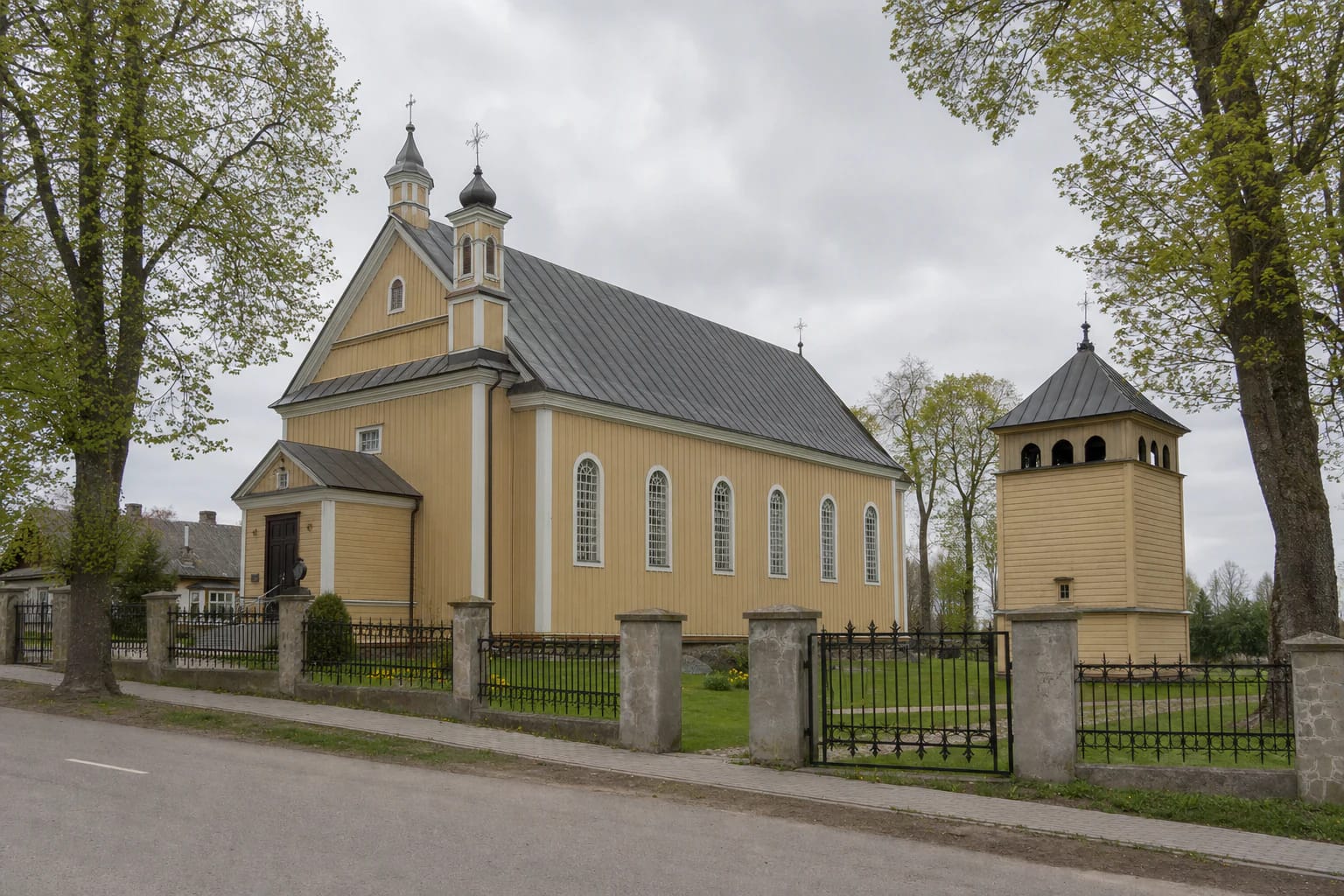
The church stands at 22 Užupio Street on the left bank of the River Strėva. The coordinate 54.6664979, 24.6520586 marks the main entrance side. A post fence with metal grilles encloses the churchyard and a separate timber bell tower stands beside the church.
This is a rectangular vernacular sacred building covered by a high gabled roof. A projecting vestibule and choir volume on the main facade ends in a triangular pediment, two small turrets rise above the roof, and tall arched windows divide the side walls into an even rhythm.
The church is part of a wider townscape. The protected old part of Semeliškės has a linear plan, winding streets, and many timber houses from the first half of the twentieth century, so the sanctuary is best visited as the centre of a walk through the historic settlement rather than as an isolated building.
From Alexander's foundation to the building of 1783-1786
Grand Duke Alexander of Lithuania endowed the first church in Semeliškės in 1501 or 1502. It stood apart from the settlement and manor of the period, on the left bank of the Strėva. The sanctuary was timber, roofed with shingles, and supported by endowed land.
The church burned during the war of 1655-1661. Parish inventories record rebuilding in 1664, another fire in 1699, and a subsequent renewal. These dates describe a long local tradition of timber church building, not one structure surviving continuously from the sixteenth century.
The present church was built in 1783-1786 when its predecessor had become unsafe. A beam at the junction of nave and presbytery retains the inscription 'AD 1783'. VLE records alterations in 1912 and 1953, while the more detailed local history describes the work of 1949-1953 as a major repair.
Three aisles and art from several periods
Restrained outside, the church opens into a broad three-aisled interior. The central nave and presbytery read almost as one hall, sacristies and service rooms occupy the ends of the side aisles, and open galleries rise above them.
The high altar was transferred to Semeliškės from Žiežmariai church in 1975. Its retable is a work of the mid-eighteenth-century Baroque. The first tier contains an image of St Roch brought from the Barboriškės filial church closed by the imperial authorities in 1867. VLE dates it to the early nineteenth century, while Elektrėnai Municipality gives the late eighteenth century, so the turn of the eighteenth and nineteenth centuries is the safest description.
Local devotional tradition regards the St Roch image as miraculous, but that is a religious attribution rather than a verifiable historical claim. Another rare treasure is an early and fairly close copy of Our Lady of Trakai. A Rococo organ case, an eighteenth-century processional altar, and timber sculptures from several centuries also survive.
The Peace Bell of 1442
The detached bell tower contains a bell cast in 1442, one of the oldest in Lithuania. It is entered in the Cultural Heritage Register as 10210. Municipal and heritage accounts describe it as the country's second-oldest bell and one of only a few fifteenth-century bells to survive in Lithuania.
The date is not its only significance. A Gothic inscription asks the king to come in peace, which is why historical writing calls it the Peace Bell. The words frame the medieval casting as a liturgical instrument, a communal signal, and rare early writing preserved on metal.
A bell cast by Antanas Apanavičius in 1779 and another smaller bell are also recorded beside the old instrument. The oldest bell is cracked, so visitors should not expect to hear it ring. View the bell tower from outside unless the parish explicitly grants access.
Mass, access, and respectful visiting
On 27 July 2026, the Diocese of Kaišiadorys listed Sunday Mass at 10:00. Arrangements may change for the feasts of St Lawrence and especially the traditional St Roch indulgence, so check the official parish page before making a dedicated journey.
This is an active church, not a museum with fixed daily opening hours. The churchyard and exteriors can be viewed independently, but the doors may be locked outside services. There is no regular admission ticket and parish donations are voluntary.
Park only where permitted and do not obstruct the churchyard gates. Inside, silence your phone, do not touch altars or paintings, and avoid flash photography. If a particular artwork or the bell tower interior is essential to your visit, contact the parish in advance about access.