- Place
- Onuškis, Trakai District Municipality
- Region
- Dzūkija
- Type
- late-Neoclassical Catholic church
- Address
- 2A Mokyklos Street, Onuškis, Trakai District Municipality
- Coordinates
- 54.48372, 24.59410
- Visit duration
- 30-60 minutes
- Best time
- a dry morning, when the six-column portico and old-square perspective are clear
Onuškis Church, Church of St Philip and St James in Onuškis
A six-column façade closing the town-square view
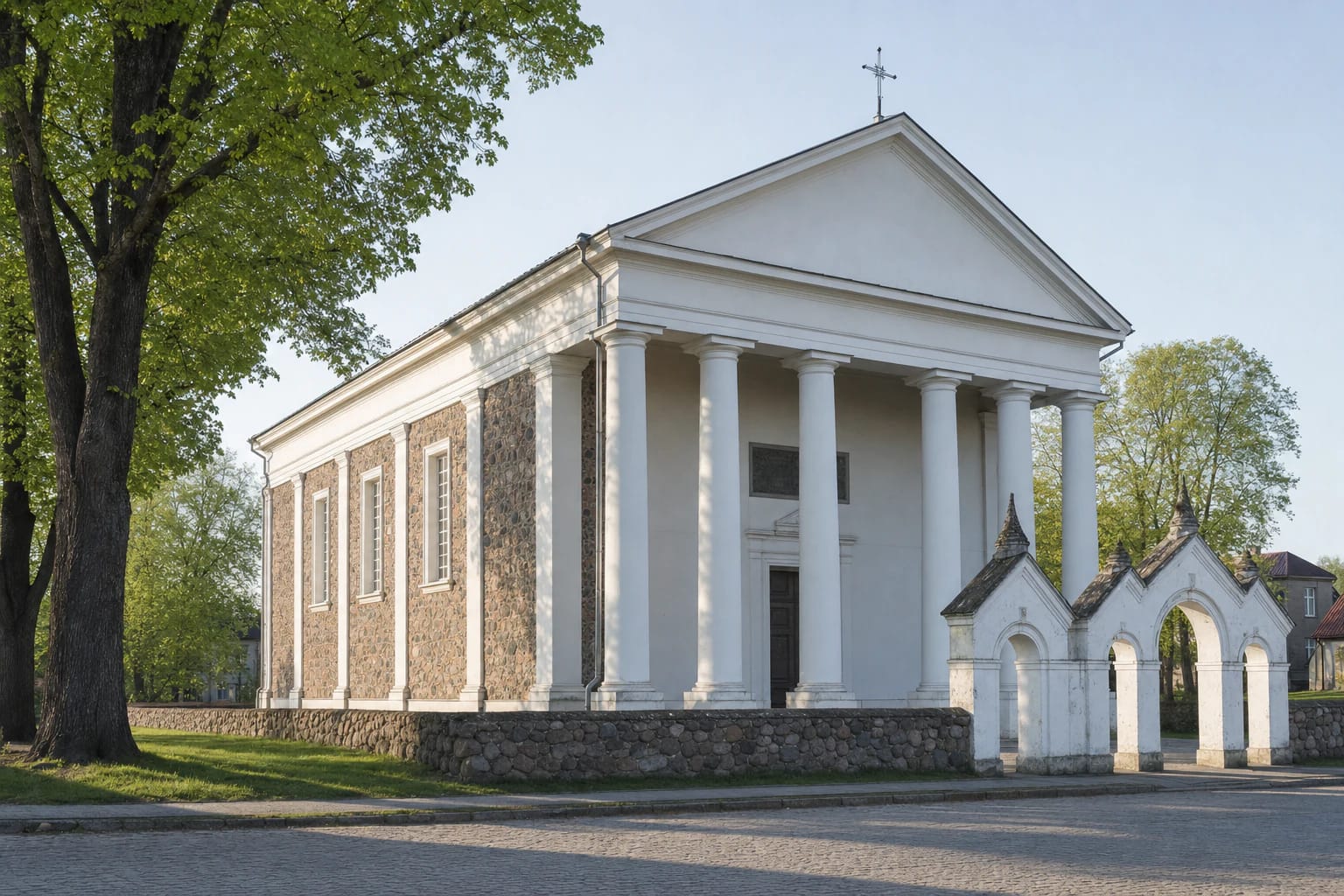
The church stands in the southern part of Onuškis beside the historic square. Its broad white front and portico of six slender Doric columns form a clear architectural termination to the square. A restrained triangular pediment completes the composition. The Latin inscription De tuis donis tibi Domine offero means From your gifts I offer to you, Lord.
The building changes character when seen from the side. White plastered architectural elements give way to walls made from whole and dressed fieldstones, packed with small pieces of dark stone. This marriage of a classical portico and local stonework is one of its clearest Romantic late-Neoclassical traits.
From a sixteenth-century parish to the 1829 church
A church in Onuškis is documented from 1526. Earlier timber buildings burned and were rebuilt more than once, and by the end of the eighteenth century the existing church was dilapidated. It collapsed in 1823, prompting construction of the present masonry building on the same site.
Landowners Kazimieras and Teresė Šetkevičius funded the work in 1823-1829. Drawing on an 1828 visitation record, architectural researchers associate both the design and construction supervision with Dominykas Kulakauskis. The church was completed and blessed in 1829, then repaired in 1891-1895, 1902, and 1976.
A three-aisled hall and its artworks
The rectangular hall church is divided into three aisles. Four pairs of columns carry the barrel vaults. Its fieldstone masonry, classical order, and wide hall create a markedly different experience from the vertical, tower-led composition of Lithuania's Gothic Revival churches.
VLE highlights the nineteenth-century paintings The Descent of the Holy Spirit and Saint Roch, a nineteenth-century wooden Saint George, and a Baroque silver chalice dated 1720. View the interior only when the church is open, without disturbing worship or photographing people without consent.
The churchyard and Donatas Malinauskas
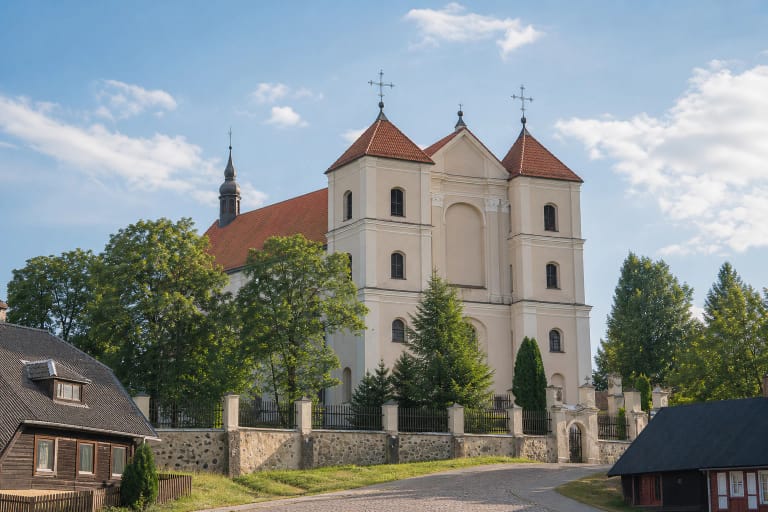
A fieldstone wall surrounds the churchyard, and nineteenth-century triple-arched gates repeat pointed historicist gables. A timber belfry stands separately. Gate, wall, planting, and church are worth reading as one ensemble rather than treating the portico as an isolated façade.
On 14 June 1993 the remains of February 16 Act signatory Donatas Malinauskas, his wife, and his sister were reinterred here after being brought back from the Altai. VLE identifies Malinauskas as a public figure, diplomat, and advocate of Lithuanian culture. Treat the grave as a memorial, not a decorative photo backdrop.
Worship, visitor etiquette, and the current rating
On 27 July 2026 the Diocese of Kaišiadorys listed Sunday Mass at 11:00. Schedules, feast-day services, and interior access can change, so check the diocesan page or contact the parish before making a special journey. The exterior and historic square can still be appreciated when the church is closed.
During services, remain quiet, dress respectfully, and do not photograph the liturgy without permission. On 27 July 2026 the Google Maps listing showed 4.5 out of 5 from 414 reviews; these figures change over time.