- Place
- Kaunas City Municipality
- Region
- Kaunas
- Type
- bronze historic monument on a granite pedestal
- Address
- Square at the junction of Laisvės Avenue and Sapiegų Street, Kaunas
- Coordinates
- 54.89798, 23.90596
- Visit duration
- 15-30 minutes for the monument and square; longer if you continue along Laisvės Avenue
- Best time
- daylight or early evening, when the monument can be viewed from several Laisvės Avenue perspectives
A 1990 reconstruction near Laisvės Avenue
Vytautas the Great Monument stands in a small square at the junction of Laisvės Avenue and Sapiegų Street. It is an independent historic monument, not Vytautas the Great Church, the War Museum, or Laisvės Avenue as a whole. The site is easy to reach on foot and works well as part of a longer central-Kaunas route.
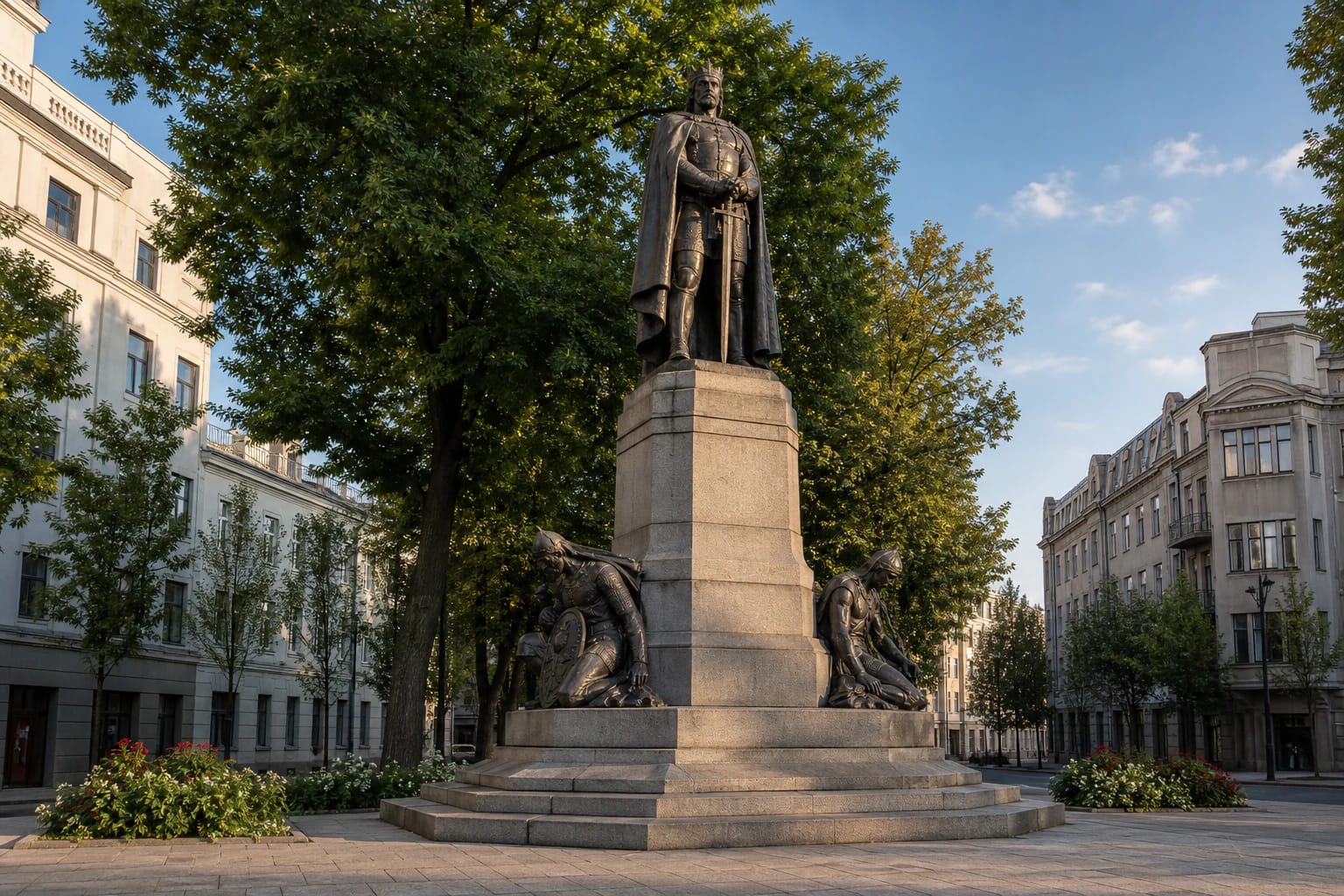
LIMIS describes the present monument as reconstructed in 1990 according to architect Jurgis Bučas's project. A bronze figure of Vytautas stands on a granite pedestal; together with the lower sculptural part, the monument is described as approximately 8.1 m high. View it from several sides because one angle emphasizes the ruler and another reveals more of the pedestal composition.
The history of Vincas Grybas's 1932 work
The Ąžuolynas Library's historical data says that the monument created by Vincas Grybas was unveiled on 7 September 1932 in Aukštoji Panemunė, in the courtyard of the Military School and Vytautas the Great Higher Officers' Courses. That was an interwar state and military memory site, not the present Laisvės Avenue location.
On the orders of the Soviet authorities, the monument was pulled down and destroyed in 1952. The object now seen on Laisvės Avenue is therefore not the continuously surviving 1932 original. It belongs to a reconstruction history in which Grybas's lost interwar work, the destroyed monument, and the later implementation must be kept distinct.
The 1989-1990 decision to reconstruct it
LIMIS records that individuals and organisations began reconstruction initiatives in 1989, led by Gediminas Kostkevičius, chairman of the Aukuras club. A competition held that year selected the square by Laisvės Avenue and Sapiegų Street because the original Military School site was no longer suitable for reconstruction.
The monument was reconstructed in 1990 and ceremonially unveiled on 15 July, marking the 560th anniversary of Vytautas the Great's death and the 580th anniversary of the Battle of Grunwald. This explains why the present object became a public memory marker of the national revival: it joins an interwar symbol with a historical narrative renewed during the return to independence.
The sculpture and its symbolic layer
The LIMIS description places Vytautas's bronze statue above four defeated warriors: a Russian, a Pole, a Tatar, and a Teutonic knight whose sword is broken. This is specific interwar monument iconography. Today it should be read as the political language of its period, not projected onto contemporary peoples.
From farther along the square, the vertical ruler and the mass of the granite pedestal dominate the view; close up, the lower sculptural details become clearer. The relationship between monumental height and the small urban square is central to the experience. The exact pedestal inscription can be difficult to read because it appears differently in photographs.
Visiting as part of a city-centre walk
The monument stands in an open urban space, so there is no ticket or museum timetable to arrange. It remains a memorial place: do not climb the pedestal, touch the bronze, cover the sculpture with event decorations, or block the Laisvės Avenue footway while taking photographs.
The coordinates 54.8979754, 23.9059634 mark the monument in the square, not the beginning of the whole avenue. From the square, continue on foot towards the avenue, but expect narrower access when events occupy the space.