- Place
- Kaunas City Municipality
- Region
- Kaunas
- Type
- Gothic Latin-cross-plan church beside the Nemunas
- Address
- Aleksoto g. 3, Kaunas
- Coordinates
- 54.89500, 23.88670
Vytautinė, Vytautas Church, Church of the Assumption of the Blessed Virgin Mary
The oldest Kaunas church beside the Nemunas
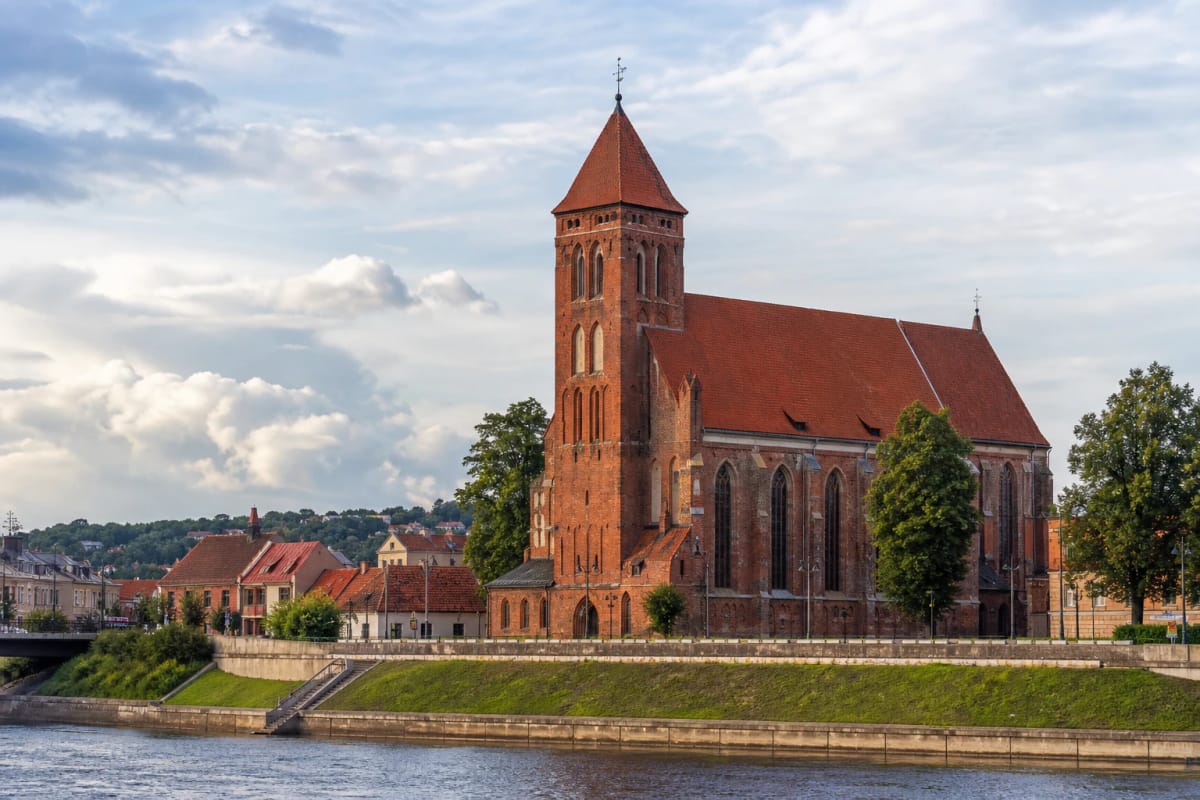
Vytautas the Great Church stands on the right bank of the Nemunas, near Aleksotas Bridge and the edge of Kaunas Old Town. Visuotinė Lietuvių enciklopedija calls it the oldest Gothic monument in Kaunas, while AUTC notes that it is the only Gothic Latin-cross-plan church in Lithuania. That unusual plan makes it stand apart from the country's other Gothic sacred buildings.
Kaunas residents often call the church simply Vytautinė. The name was popularized in the early twentieth century by Canon Juozas Tumas-Vaižgantas, who connected the church with the memory of Vytautas the Great. It should not be confused with another Franciscan church in Kaunas, St George the Martyr.
Vytautas' foundation: history and legend
The church's foundation documents have not survived, so the exact construction date is unknown. Historians mention 1400, 1409, and 1430, while VLE and the archdiocese give around 1400. Tradition links the foundation with Vytautas the Great: according to the Jesuit historian Albertas Vijūkas-Kojalavičius, the duke narrowly escaped death at the Battle of the Vorskla in 1399 and, in gratitude, built a church and monastery for the Franciscans around 1400. This connection is best treated as an important tradition, not as a document-proven fact.
The church first appears in written sources in 1439, when the Council of Basel allowed the Kaunas Franciscans to hear confessions, administer sacraments, and bury merchants from Prussia and Livonia who came to Kaunas. This shows that the church was tied early on to the international merchant community on the Nemunas.
Gothic forms and flood marks
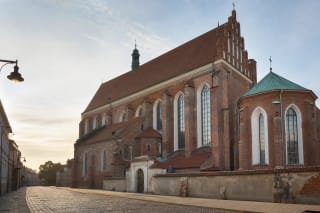
The church is built of red brick. It is a hall church with three naves, a Latin-cross plan, and a tall octagonal tower above the western facade. Massive buttresses, pointed-arch windows, and niches divide the side facades, while star vaults survive in the presbytery. The tower spire was restored in 1982 according to an old engraving by Tomas Makovskis.
Because the church stands so close to the Nemunas, floods have damaged it more than once. On the tower wall near the main door, one mark records that on March 24, 1946 the water rose as high as 2.90 m; during the 1829 flood, water inside the church reached more than 70 cm. These marks are among the site's most memorable details.
From Orthodox church back to Vytautinė
In the nineteenth century, Russian imperial policy changed the church's fate. In 1845 the church and monastery were closed, and in 1850-1853 the church was converted into the Orthodox Church of St Nicholas. During the First World War, after German forces occupied Kaunas in 1915, the roof was stripped off and the building was used as a warehouse, leaving only blackened walls.
In 1919 the church was returned to the Catholic Church. From 1920, its rector Canon Juozas Tumas-Vaižgantas energetically led the restoration and elevated the cult of Vytautas; the church was consecrated on Assumption Day in 1920. Tumas-Vaižgantas served here until his death in 1932 and is buried in the church wall. In 2019 a sculpture dedicated to him was unveiled in the churchyard. The last major restoration took place in 1978-1989.
How to visit Vytautas the Great Church
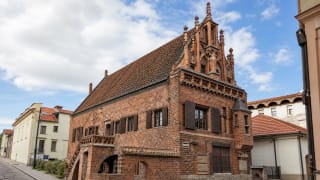
The church is easy to include in a Kaunas Old Town route with the House of Perkūnas, Town Hall Square, and the Nemunas riverfront. Most visitors need 20-40 minutes: walk around the red-brick Gothic volume, find the flood marks, and step inside if access is available.
This is an active rectorate church, so entry is usually free, and visiting is best planned around service times. Check the current visiting and Mass schedule on the official Kaunas Archdiocese page before travelling, because it can change.