- Place
- Kaunas City Municipality
- Region
- Kaunas
- Type
- national military-history museum and interwar memorial ensemble
- Address
- K. Donelaičio g. 64, Kaunas
- Coordinates
- 54.89985, 23.91219
War Museum, VDKM, Karo muziejus, Vytautas the Great Military Museum
A museum that built state memory
Vytautas the Great War Museum is more than halls of weapons. It is one of Lithuania's oldest museum institutions and a very visible attempt to establish modern state memory in the temporary capital.
VLE states that the museum was founded by order of Lithuanian army commander Pranas Liatukas on December 15, 1919 and solemnly opened on February 16, 1921. The date linked the museum immediately with Lithuanian Independence Day and the statehood narrative.
From Military-Historical Museum to Vytautas' name
The early museum began before the present palace. VLE lists earlier names: in 1940-1941 and 1944-1956 it was called the Military-Historical Museum, and in 1956-1990 the Kaunas State Historical Museum. These changes show how political regimes tried to rewrite the museum's identity.
The name of Vytautas the Great belongs to interwar state representation. The 1930 jubilee of Vytautas helped shape the idea of a new museum complex, and the 1936 opening of the new palace established the museum as a major centre of national memory.
The 1936 palace and shared museum architecture
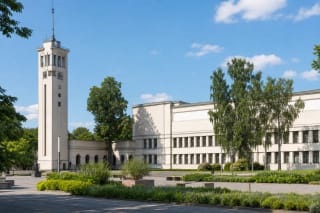
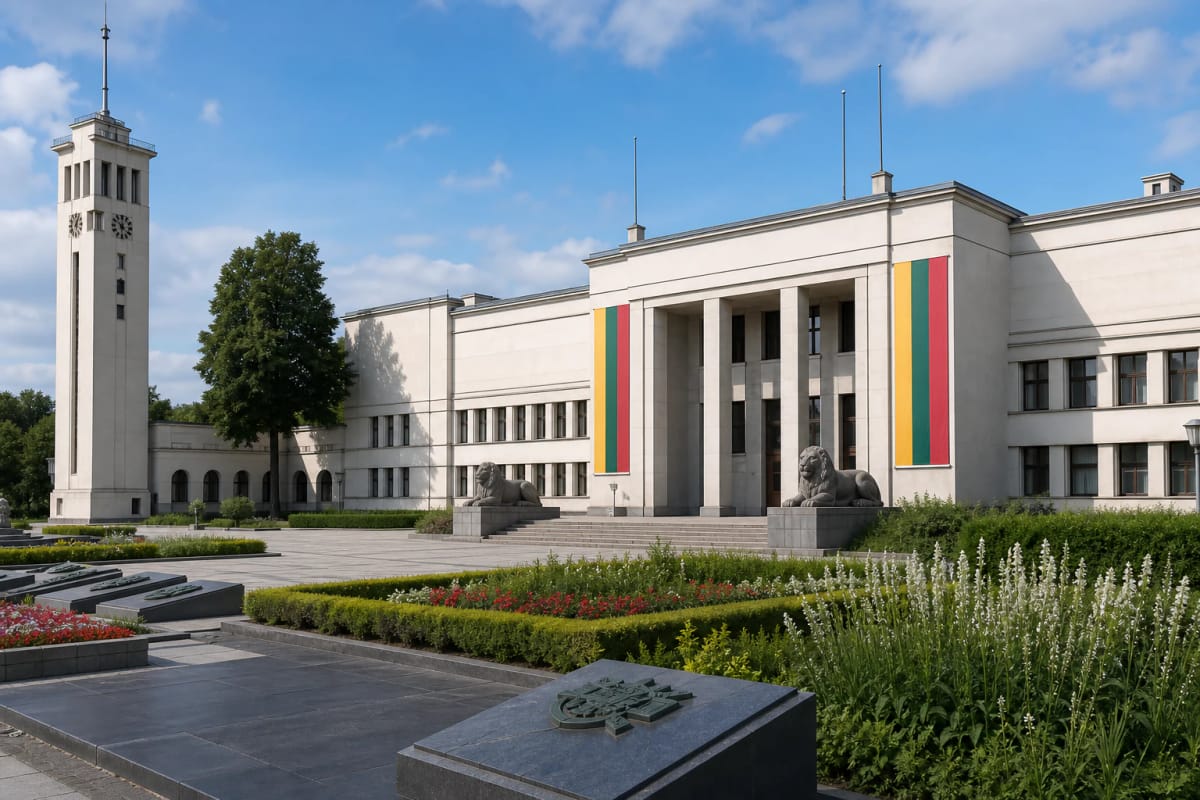
The present building is not only one museum facade. AUTC describes it together with the National M. K. Čiurlionis Museum of Art, because both belong to the same Vytautas the Great Museum complex. The project was prepared by Vladimiras Dubeneckis, Karolis Reisonas, and Kazimieras Kriščiukaitis, with construction in 1929-1936.
AUTC stresses that this was one of the most important interwar architectural events in Kaunas. The buildings connected state representation, museum function, the memorial garden, and the shaping of a city square.
A protected ensemble
In the Lithuanian Register of Cultural Property, the wider object is the Kaunas Vytautas the Great Museum building complex, code 16946, protected by the state and of national significance. The main War Museum and Čiurlionis Museum buildings have a separate code, 1125.
The protected ensemble also includes the tower with clock and carillon, Freedom Monument, memorial to those who died for Lithuanian freedom with the Tomb of the Unknown Soldier, and the Book Smuggler and Sower sculptures. These are not decoration around the museum but a state-memory infrastructure.
What to see inside
VLE states that in 2024 the museum held 324,127 exhibits. Collections include weapons, archaeology, numismatics, printed material, art, historical objects, photographs, negatives, digital material, and military technology. Such a scope lets the museum tell not only about battles, but also about everyday army life, symbols, technologies, and society.
For visitors, the useful structure is thematic: Lithuanian military prehistory and Grand Duchy times, independence wars, the interwar army, occupation periods, anti-Nazi and anti-Soviet resistance, and the restoration of the Lithuanian armed forces. One of the strongest emotional themes is the material connected with the Lituanica flight.
Lituanica and the emotion of military history
The museum is strongest when objects go beyond dry chronology. The Lituanica story becomes not just an aviation episode but part of interwar Lithuanian self-understanding: technological courage, diaspora connection, and tragic ending.
The same is true of the independence wars, resistance, and army restoration displays. A good visit means reading the objects, maps, uniforms, awards, photographs, and memorial signs slowly.
The War Museum Garden
The museum garden is one of the site's most important elements. It concentrates signs of statehood, freedom struggles, and memory: the Tomb of the Unknown Soldier, Freedom Monument, book-smuggler memory, sculptures, and ceremonial space.
See the garden before or after the exhibitions. If you begin outside, the inside makes more sense; if you begin inside, the garden becomes a civic continuation of the museum.
Tower, clock, and Liberty Bell
VLE notes that on February 16, 1922, the Liberty Bell, donated by Lithuanian Americans, was placed in the museum tower, and in 1937 the Kaunas carillon was installed. The tower and carillon remain visual and acoustic signs of the complex.
The museum publishes separate information about tower visits, but this access is seasonal and condition-dependent. Do not assume the tower is always open; check the official notice and ticket information before travelling.
The military-technology exhibition is elsewhere
A practical detail matters: the military-technology exhibition is not in the K. Donelaičio g. 64 building. It operates at a separate address, K. Baršausko g. 91, with separate visiting conditions.
If you want both the central museum and the technology exhibition, plan them as two different stops. The central museum is best for historical and memorial narrative, while the technology exhibition focuses on larger military objects.
How to visit today
The main address is K. Donelaičio g. 64, Kaunas. Because the museum updates practical information regularly, check opening hours, tickets, discounts, and cash-desk rules before travelling, especially if you want the tower, an educational programme, or a special exhibition.
The best route is to give at least an hour and a half to the exhibitions, then walk through the museum garden and Vienybės Square. If you also visit the Čiurlionis Museum the same day, allow more time: the two museums share a historic complex but tell very different stories.