- Place
- Kaunas City Municipality
- Region
- Kaunas
- Type
- late interwar state finance and administration palace
- Address
- Laisvės al. 96 / L. Sapiegos g. 2, Kaunas
- Coordinates
- 54.89828, 23.90646
State Savings Banks Palace, Central Palace of the State Savings Banks, Kaunas City Municipality building, Former State Savings Bank building in Kaunas
The last major Laisvės aleja accent
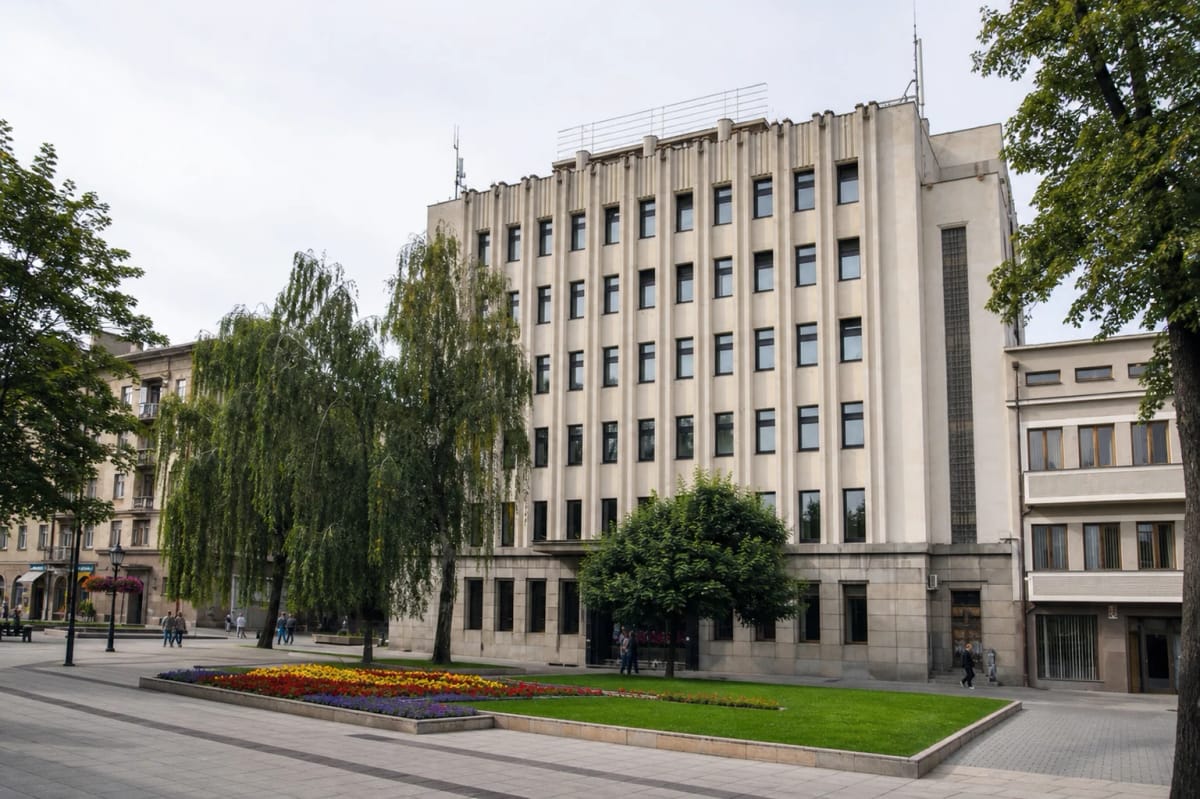
The State Savings Bank Palace stands at Laisvės al. 96, where Laisvės aleja meets L. Sapiegos Street. It is one of those Kaunas modernist buildings that can be passed as present-day administration, but its original theme was wider: state finance infrastructure, the savings system, and the growing bureaucracy of the temporary capital.
The Money Museum calls it the functionalist central palace building of the State Savings Banks and stresses that the six-storey skyscraper became the last vivid interwar architectural accent on Laisvės aleja. The word skyscraper here is a metaphor of period scale, not a modern high-rise definition.
Why the savings bank needed a palace
The State Savings Banks began operating in Lithuania in 1919, as the young state was creating financial institutions to collect residents' savings. The Money Museum states that their official aim was to accept deposits and help people increase savings; they were subordinate to the finance minister, and the state was responsible for their obligations.
At first the savings banks worked in poorly equipped premises, often beside treasury, bank, or postal offices. New central premises on Laisvės aleja therefore meant more than convenient offices. They showed that a savings institution had moved from a temporary and scattered system into an official state finance mechanism.
The 1938-1940 project
The Money Museum states that the palace rose in 1938-1940. It was designed by Arnas Funkas, Adolfas Lukosaitis, and Bronius Elsbergas. This is a late stage of interwar Kaunas modernism, when Pazanga, Pienocentras, the Central Post Office, and other representative buildings already stood on Laisvės aleja.
The date matters because of the rupture it carries. The building was never opened before the Soviet occupation. The State Savings Bank Palace therefore remained a symbol of Kaunas modernization that was completed but not allowed to start in its original function: the ambition was built, while the first purpose ended at a historical border.
More than a bank
The palace was planned not only for the State Savings Banks. The Money Museum notes that the Trade Department, Statistics Bureau, and various other state institutions were also intended to operate here. The building was therefore planned as a finance and administration centre, not only as a customer service hall.
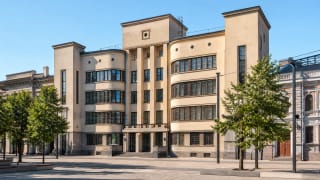
That fits its scale. A three-wing scheme, six- and five-storey volumes, and a semi-enclosed courtyard allowed many different functions to fit into one urban block. The Laisvės aleja facade was representative, while the internal organization was dense, bureaucratic, and practical.
Facade: a vertical rhythm of late modernism
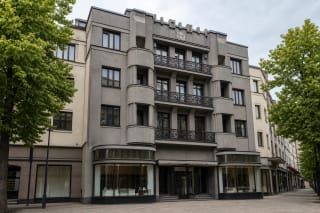
From Laisvės aleja the palace reads as a light, strict, almost monumentally vertical facade. Narrow windows and the vertical profiles rising between them create a rhythm that makes the building seem taller than it would by floor count alone.
This facade differs from the earlier curved corner of Pienocentras or the compositional play of Pazanga Palace. The State Savings Bank Palace is drier, firmer, and more state-like. Functionalism here approaches the language of representative administration: less display-window elegance, more strict order.
Plan structure and technical ambition
The Money Museum states that the building consists of three six- and five-storey wings forming a semi-enclosed courtyard. This is one of the key facts for visitors: looking only at the facade shows the official side, while the real logic of the palace lies in a large, multi-wing administrative structure.
Sources also point out technical details: a pneumatic post operated in the building, a safe was placed in the basement, and the revolving doors at the main entrance were considered the only such doors in interwar Kaunas. These elements show that the building was meant to be modern not only outwardly, but also in work organization.
Arnas Funkas and shared authorship
VLE presents Arnas Funkas as an architect whose interwar Kaunas work had an important functionalist direction. The State Savings Bank Palace is often associated with Funkas, but it is more precise to speak of shared authorship: the Money Museum lists Adolfas Lukosaitis and Bronius Elsbergas alongside him.
That distinction is worth keeping because the building is not only one person's stylistic signature. It looks more like late interwar office and design culture, where a large state project required architectural composition, construction logic, technology, and institutional needs to work together.
Occupation and later functions
Because the palace was not opened before the occupation, its original history ended before it had truly begun. After the Second World War, the Kaunas executive committee and communist party committees moved into the building. That changed its meaning radically: a palace of state saving and finance became an address of Soviet city authority.
Today the building houses Kaunas City Municipality. The official municipal website gives the administration address as Laisvės al. 96, LT-44251 Kaunas. When visiting, it is important to separate two layers: the historic State Savings Bank architecture and the current function as active municipal administration.
Interior: much is lost, but the theme remains
The Money Museum notes that few original interior elements have survived. This means the building is not as strong an interior experience as some other interwar sites with better-preserved staircases, halls, or finishes.
Even so, the interior theme is important because the modern work technology was concentrated inside: pneumatic post, safes, customer and institutional flows, offices, and administrative connections. Even if today's visitor mainly sees the facade, the building's meaning comes from that internal organization.
UNESCO modernism context
The State Savings Bank Palace is part of the Kaunas Naujamiestis modernism story connected with the UNESCO World Heritage property Modernist Kaunas: Architecture of Optimism, 1919-1939. The precise wording matters: this building should not be called an individually inscribed UNESCO site, but it stands in the urban and architectural context for which Kaunas was recognized.
The building shows the core of the UNESCO story well: in a short time the temporary capital created not only individual attractive facades, but an entire system of modern public, financial, and administrative buildings. In the western part of Laisvės aleja, the State Savings Bank Palace is one of the strongest signs of that system's final stage.
How to view it
The easiest place to stop is at the junction of Laisvės aleja and L. Sapiegos Street. From here you can see the main volume, light facade, vertical rhythms, and relationship with the square's greenery. If you approach from the Central Post Office or Pazanga Palace, the building naturally continues the interwar institutional chain of Laisvės aleja.
This is not a museum with regular exhibition hours. Because it operates as Kaunas City Municipality, the main tourist experience is the exterior and urban context. Go inside only for specific municipal services or officially announced special events.