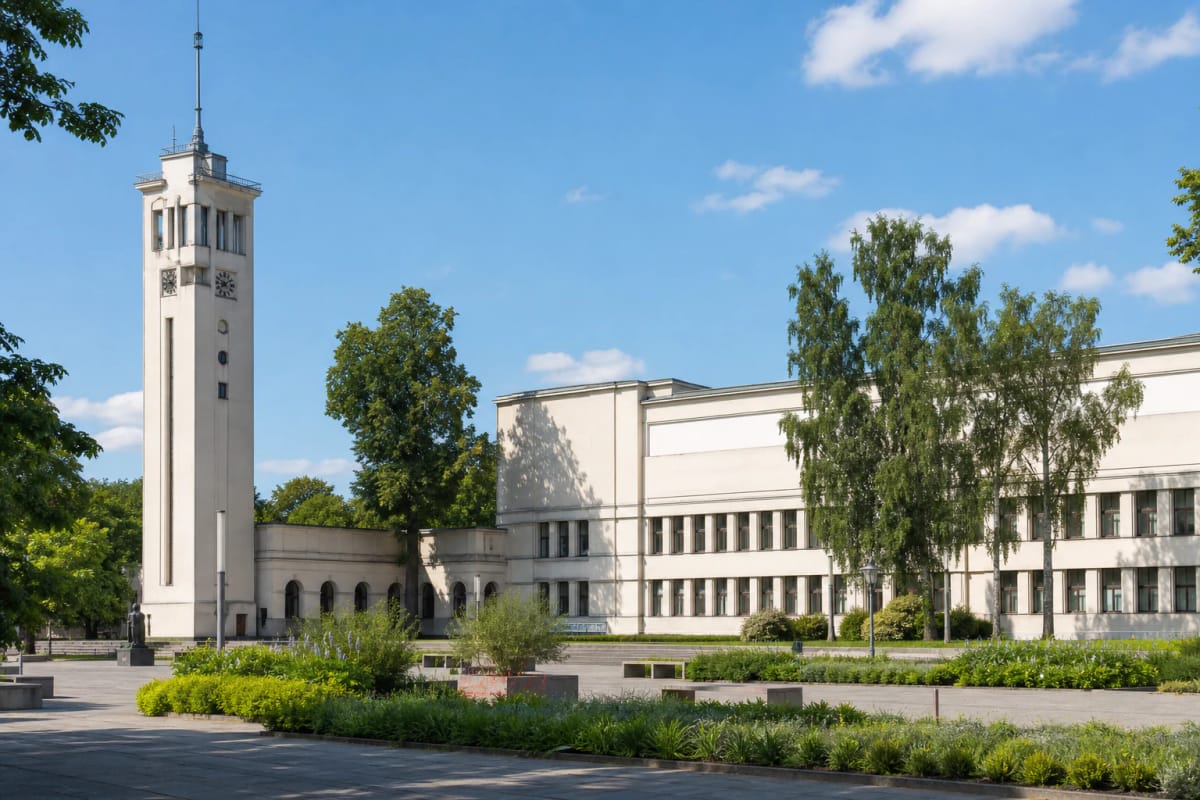
- Place
- Kaunas City Municipality
- Region
- Kaunas
- Type
- national art museum and part of the interwar museum complex
- Address
- V. Putvinskio g. 55, Kaunas; korespondencijai - K. Donelaičio g. 64, Kaunas
- Coordinates
- 54.90024, 23.91201
Čiurlionis Museum, National Čiurlionis Museum, M. K. Čiurlionis National Museum of Art, Vytautas the Great Culture Museum
The home of Čiurlionis' work in Kaunas
The National M. K. Čiurlionis Museum of Art is one of Kaunas' most important cultural places, but it should not be understood only as a memorial hall for one artist. VLE describes it as the largest state art museum in Lithuania, preserving, researching, restoring, and presenting art collections.
Still, the core of the museum is M. K. Čiurlionis' work. The official museum history clearly states that the institution itself began from the need to preserve Čiurlionis' legacy. The best visit here is therefore double: first look closely at Čiurlionis' works, then read the building and museum history as an interwar Lithuanian cultural project.
The 1921 gallery law
The museum history page connects the beginning with December 14, 1921, when Lithuanian President Aleksandras Stulginskis proclaimed the law establishing the M. K. Čiurlionis Gallery. It was a political and cultural decision: Čiurlionis' works were to become a state-protected part of national culture.
In 1922 the Ministry of Education bought 193 M. K. Čiurlionis works from Sofija Čiurlionienė. The official museum text gives the sum as 65,000 auksinai and stresses that this purchase became the basis of the future museum collections.
Temporary gallery and Paulius Galaunė
The beginning was not smooth. The official history mentions a 1923 artists' protest in which Justinas Vienožinskis, Ignas Šlapelis, Petras Kubertavičius, and Paulius Galaunė criticized official indifference to culture. In 1924, 190,000 litas were allocated for the gallery's construction, and Vladimiras Dubeneckis prepared the project.
That same year Paulius Galaunė, who had museum knowledge from the Louvre School in Paris, became gallery director. In September 1925 an exhibition marking the 50th anniversary of M. K. Čiurlionis' birth was held in the unfinished building, and the official gallery opening took place on December 13, 1925. At that time it held almost 4500 exhibits.
The Vytautas the Great Museum complex
The museum's present urban role emerged in the interwar period. AUTC writes that construction of the Vytautas the Great Museum was one of the most important architectural events in the temporary capital, while the representative complex of Vienybės Square began to form already in 1921 with the War Museum and the monument to those who died for Lithuania's freedom.
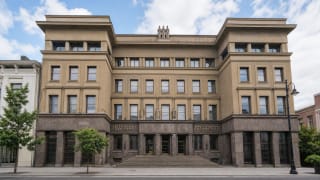
The 1930 jubilee of Vytautas the Great created an opportunity for a new museum palace project. AUTC states that the complex was designed by Vladimiras Dubeneckis, Karolis Reisonas, and Kazimieras Kriščiukaitis, with construction in 1930-1936. It was meant not only as one museum, but as a broader museum of museums, where the Čiurlionis Gallery also found its place.
Architecture between classicism and functionalism
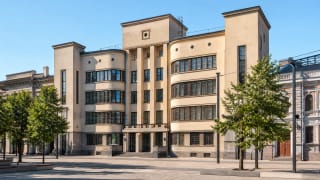
AUTC classifies the complex as early functionalism, but also stresses that a classical language of representation is still felt in its composition. On site this is easy to see: long horizontal blocks, restrained rhythm, clear square scale, and the vertical of the tower create not a decorative but a state-oriented city centre.
The object's KVR code is 16946. The register protects the broader Vytautas the Great Museum building complex, so the Čiurlionis Museum is best understood together with the War Museum, tower, square, and memorial surroundings. This is one of the Kaunas sites where architecture works not as a single facade but as a whole representative ensemble.
What to see in the exhibitions
The first priority is the M. K. Čiurlionis exhibition. It helps explain why Čiurlionis in Lithuanian culture is not merely a famous painter or composer, but a distinct point where symbolism, music, vision, and modern national self-awareness meet.
The official museum also presents other exhibitions and temporary shows, so check the current programme before visiting. Contemporary interpretation forms, including digital or virtual-reality experiences, can offer another pace for approaching Čiurlionis' work.
Collections and the museum network
VLE states that in 2025 the museum collections held more than 355,000 works. This explains why the National M. K. Čiurlionis Museum of Art is not just exhibition halls on V. Putvinskio Street, but a large institution for preservation, research, restoration, publishing, education, and digitization.
The museum network includes several well-known branches: the M. K. Čiurlionis House-Museum in Druskininkai, the A. Žmuidzinavičius Creations and Collections Museum, often called the Devils' Museum, Kaunas Picture Gallery, M. Žilinskas Art Gallery, V. K. Jonynas Gallery, Juozas Zikaras House, and other memorial museums.
Occupations, names, and defending the art
The museum's history also reflects the political ruptures of the twentieth century. The official history states that during the Soviet occupation in 1940, the name of Vytautas the Great was removed; during the Nazi occupation it returned; and after the second Soviet occupation in 1944, the museum was renamed the Kaunas State M. K. Čiurlionis Art Museum.
Especially important is the 1950 so-called trial of Čiurlionis' work, when Soviet ideology tried to accuse his art of formalism and decadence. The official museum text stresses that Čiurlionis' work was defended. This episode helps explain why the museum preserves not only paintings, but also the history of how art itself was judged.
National status and updates
VLE states that since 1997 the museum has had national museum status. This confirmed its role as Lithuania's leading art-heritage institution, not only a Kaunas cultural body.
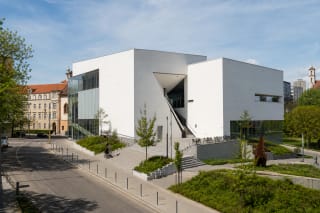
VLE also mentions the 2016 reconstruction, when a library, archive storage, digitization centre, reading room, and exhibition hall were installed. Today visitors see not only historic palaces, but also a museum working with collection protection, research, and contemporary presentation.
Practical visiting: hours and tickets
The museum is at V. Putvinskio g. 55, and its palace is part of Kaunas interwar modernist architecture, inscribed on the UNESCO World Heritage List in 2023. At the time of research, the museum was open Tuesday, Friday, Saturday, and Sunday 10:00-18:00; Wednesday and Thursday 11:00-19:00, with visitors admitted until 30 minutes before closing. On the last Sunday of the month, visiting was free. A bracelet issued with a ticket allowed same-day exit and re-entry.
Because hours, prices, and exhibition programmes change, check the official museum page before travelling. The same site combines well with the nearby Vytautas the Great War Museum and the memorial ensemble of Vienybės Square.
How to plan a visit
The visitor entrance is at V. Putvinskio g. 55, while the official museum page gives K. Donelaičio g. 64 as the correspondence address. Since hours, tickets, and specific exhibitions may change, check the official visitor-information page before going.
If time is short, plan at least 1.5 hours for the Čiurlionis exhibition and the building surroundings. To understand the whole museum, allow two or three hours: Čiurlionis, temporary exhibitions, Vienybės Square, the tower, the War Museum surroundings, and the modernist Kaunas route around V. Putvinskio Street.