- Place
- Kretinga District Municipality
- Region
- Samogitia
- Type
- homestead-museum of stones, crosses, wooden sculptures, and alternative memory
- Address
- Plungės g. 18, Gargždelė village, Imbarė Eldership, Kretinga District
- Coordinates
- 56.04600, 21.58600
Orvidai Homestead-Museum, Orvidai Homestead Museum
Why Orvidai Homestead is different
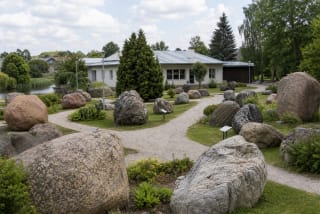
Orvidai Homestead is not a tidy exhibition museum with clear chronological rooms. It is a dense, layered environment where stones, wooden crosses, shrine posts, sculptures, old metal objects, and paths create a distinctive spiritual landscape. In the Register of Cultural Values it is protected as a national-significance monument, the 'Vilius Orvidas creative and collection site', code 2750.
The Kretinga encyclopedia writes that the whole homestead is composed as an enormous regular-triangle Eye of Providence, encircled by channels and ramparts of stones and earth and clearly visible only from an aircraft. The comparison captures its structure well: not only the detail but the whole sense of arrangement matters. The central part is entered through low stone gates, an opening about 130 cm high left under a large pile of stones.
Vilius Orvidas and the family's work
The homestead's name is primarily associated with sculptor Vilius Kazimieras Orvidas (1952-1992). VLE presents him as a folk artist, stone sculptor, and Franciscan friar who entered the Order of Friars Minor in 1989, taking the monastic name Gabrielius. He learned stone carving from his father Kazimieras Orvidas (1905-1989), who had learned the craft from his own father Jonas Orvidas.
Vilius Orvidas founded the homestead-museum at his parents' birthplace in Gargždelė in 1973. The Kretinga encyclopedia states that during land-reclamation works he saved boulders, old oaks, stones from demolished homesteads, and crosses removed from cemeteries, using cranes, trucks, and bulldozers to bring them from the Salantai area and compose them into a mythological and religious whole. This is therefore not only a folk-art collection but a lived, worked, and created place where stones and sacred signs became part of a personal worldview.
Soviet-period context
The meaning of Orvidai Homestead deepened during the Soviet period, when religious signs, crosses, and an independent spiritual stance were sensitive matters. VLE states directly that during Soviet occupation the authorities tried several times to destroy the museum. The Kretinga encyclopedia adds that the homestead became a symbol of resistance to the occupation regime and a meeting place for nonconforming people, especially youth; even the then Soviet leader M. Gorbachev visited it.
For that reason it should not be visited as a collection of curiosities. It is a trace of an alternative stance. In 2009 Orvidai Homestead-Museum was recognized as a Lithuanian national value in the category 'Phenomenon that makes Lithuania known'. Much here looks rough, uncomfortable, even chaotic, but that roughness is part of the place's authenticity.
What to see
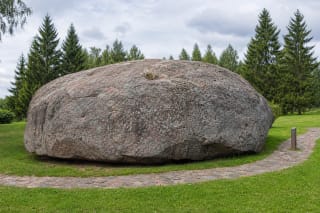
Large boulders and wooden crosses placed among them draw attention first. But smaller details are just as important: carvings, shrine figures, old mechanisms, metal remains, path directions, and the relationship between plants and stones.
The homestead works as a slow route. Walk without hurry, because many details open only close up. In one place you may see folk-sculpture tradition, in another found-object composition, in another simply the strong material experience of stone and wood.
How to visit respectfully
This is a private and memorial-type space, so follow local rules, do not climb on objects, do not move stones or small details, and behave calmly. Some objects look solid but are part of fragile compositions.
It is tempting to photograph a lot, but the place works best when you do not get stuck only on images. Orvidai Homestead is strongest when you let yourself feel its scale, strange rhythm, and not fully explainable atmosphere.
Practical tips
The homestead is in Gargždelė, Imbarė Eldership, by the Plungė-Skuodas road, near Salantai, in Salantai Regional Park. VLE's article on Salantai Regional Park, established in 1992, separately mentions Orvidai Homestead-Museum among its sites. It combines well with Mosėdis, Salantai, and other Samogitian places.
The Kretinga encyclopedia states that the homestead is private and maintained by the sculptor's sister, official owner Palmira Beniušienė; the official website gives visiting and ticket information. Because much of the visit is outdoors among stones and paths, wear comfortable shoes. After rain, stones and wooden parts may be slippery, and some areas are not suitable for fast running or strollers.
What to see nearby
The most natural combination is Mosėdis Stone Museum, Barstyčiai Stone, and the Salantai-region route. This shows how the same material, stone, can become geology, museum collection, art, or spiritual space.
If you travel by sacred-heritage theme, Orvidai Homestead is very different from basilicas and monasteries. It shows not an official sanctuary but a personal, irregular, and deeply Samogitian form of faith and creativity.