- Place
- Plateliai, Plungė District Municipality
- Region
- Žemaitija National Park
- Type
- Žemaitija National Park town and cultural centre
- Coordinates
- 56.04200, 21.81500
Plateliai town
Plateliai: centre of Žemaitija National Park
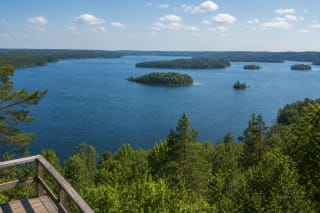
VLE places Plateliai in Plungė District, on the western shore of Lake Plateliai, 15 km north of Plungė. It is the centre of an eldership and parish, with 713 residents in 2021. The town lies inside Žemaitija National Park, and the park directorate and Plateliai visitor centre are based here, making it the starting point for many park trips.
On this page Plateliai matters not as one more lake view, but as the cultural and practical axis of the park. Information, accommodation, manor history, church, local-history and Užgavėnės exhibitions, and roads toward Plokštinė, Paplatelė, and other park sites all meet here. Lake Plateliai has its own page; this one focuses on the town's heritage.
Radial-plan town and 1792 Magdeburg rights
VLE notes that Plateliai has a radial town plan and origins reaching the 15th century. In the first half of that century, 15 people by Lake Plateliai were granted to the Samogitian elder Mykolas Kęsgaila; in 1451-1485 the holding passed to Jonas Kęsgaila, and from the mid-16th century Plateliai became a manor of the Grand Duke of Lithuania and was called an eldership. By 1551 Plateliai was already called a town.
VLE states that in 1787 the town received the privilege of two fairs, and in 1792 it received Magdeburg rights and a coat of arms; from 1797 the estate passed to the de Choiseul nobles. Plateliai square therefore carries not only everyday town life but also the memory of self-government in an old Samogitian centre shaped by lake, manor, and national park.
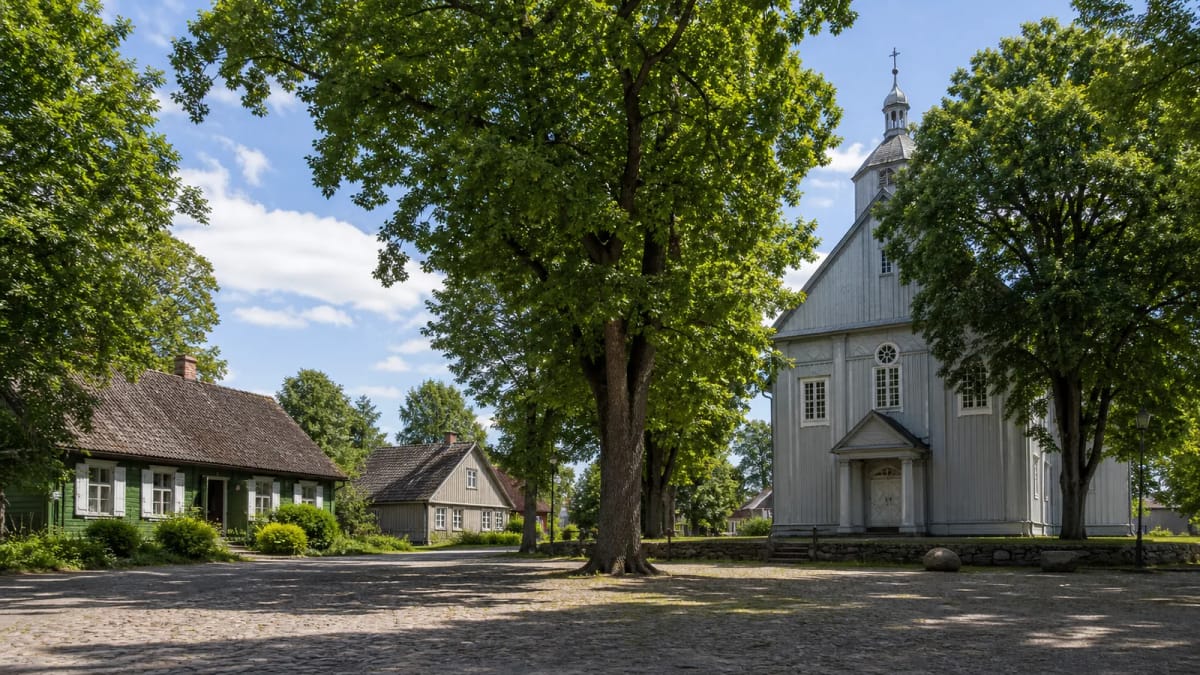
The wooden Church of St Peter and St Paul
The town's clearest landmark is the wooden Church of the Apostles St Peter and St Paul. VLE dates its construction to 1654-1744 and describes a Latin-cross plan with a high hipped roof; inside are six altars, including a Baroque high altar, a pulpit decorated with Rococo ornaments, and paintings including St Anne from the 18th century and the Holy Family from the 19th. The first church in Plateliai was built before 1523.
Beside the church stands an 18th-century wooden belfry with a bronze bell cast in 1648 by master M. Dormann. The church matters not only architecturally but also visually: by the square and green spaces, it makes Plateliai recognizable as an old Samogitian settlement.
Manor estate and the Witch's Ash, Lithuania's thickest ash tree
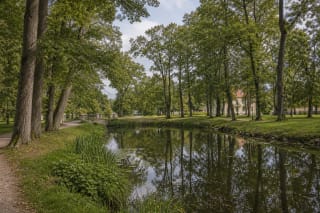
VLE notes that Plateliai Manor Estate, dating from the 19th to early 20th centuries, preserves a barn, cellar, granary, stable, and servants' house, with part of a mixed-plan 19th-century park around it. Official Žemaitija National Park sources add that the granary was restored in 2011 and the so-called cellar in 2014; park exhibitions and a gallery operate in them.
The park's natural monument is Raganos uosis, the Witch's Ash. VLE gives it as 20 m high and 3.2 m thick, formed from four fused trunks, and the thickest ash in Lithuania. The manor buildings and greenery show that Plateliai was long more than a shore village: it was an administrative and cultural centre.
Plateliai and the Užgavėnės mask tradition
Plateliai is famous for its Samogitian Užgavėnės tradition. Žemaitija National Park sources state that the Užgavėnės Mask Exhibition, founded in 1996, operates in the Plateliai manor stable. It is the only museum of its kind, with several hundred masks collected across decades from Samogitia. The masks are presented as living craft and part of winter-expulsion ritual, not merely as objects in cases.
Užgavėnės in Plateliai is associated with costumed performers, the burning of Morė, and the fight between Lašininis and Kanapinis. The town has become one of Lithuania's main places for this tradition. Visitors should distinguish the living festival, held at the end of winter, from the permanent exhibition, which can be visited at other times of year.
Visiting rhythm and practical planning
Allow 1-2 hours for the town itself if you want to walk the centre, church surroundings, and manor-estate spaces. If Plateliai is your base for the day, plan ahead for places with tickets or opening hours, because museums and exhibitions in the granary and stable do not function like public outdoor spaces.
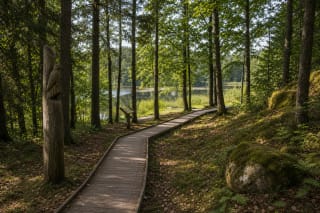
In season Plateliai receives many visitors, so plan parking and lunch early. In autumn the town is quieter, while the manor park, Witch's Ash, and lakeshore suit a slower walk. From Plateliai it is easy to reach Plokštinė, the Paplatelė trail, and the longer cycling route around the lake.