- Place
- Plungė District Municipality
- Region
- Plungė
- Type
- Neo-Renaissance palace, park, museum, and Oginski cultural-heritage ensemble
- Address
- Parko g. 3A, LT-90113 Plungė
- Coordinates
- 55.91820, 21.84463
One of Samogitia's strongest manor ensembles
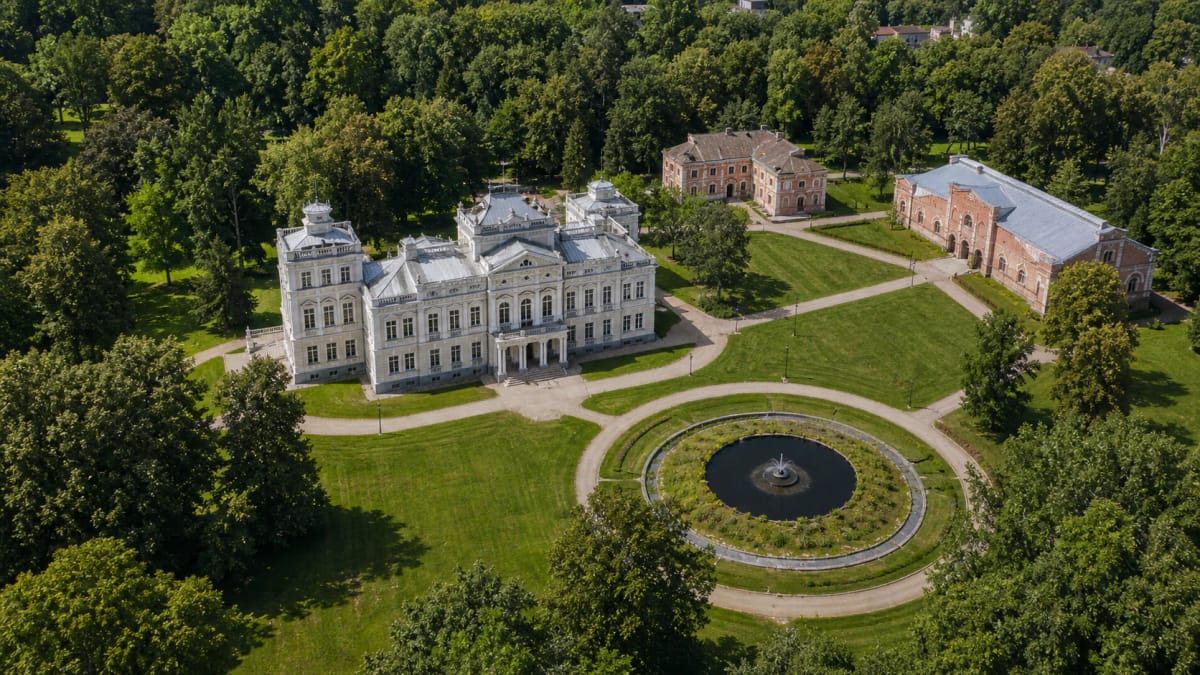
Plungė Oginski Manor is not just a palace with a museum. It is a large ensemble read in several layers: the representative Neo-Renaissance palace, two service wings, Neo-Gothic stables, the clocktower-orangerie, park gates, ponds, the landscape of the Babrungas River, and the exhibitions of the Žemaičiai Art Museum.
The Žemaičiai Art Museum states that the Plungė manor estate covers 58.3 ha of parkland and preserves ten monumental buildings. That means the best visit is not only to enter the palace but to explore the whole estate.
From Gondinga and the Zubovs to the Oginskis
The museum's official manor history connects Plungė with the nearby past of Gondinga. In the sixteenth century a new settlement grew by the confluence of the Babrungas and Plungė streams, and in 1567 Grand Duke Sigismund Augustus granted administrative district rights to Plungė Manor.
In the seventeenth and eighteenth centuries Plungė was held by different noble families. In 1779 it passed to Vilnius bishop Ignotas Masalskis, and in 1806 Count Platon Zubov acquired the county. The Zubov period added important park and architectural layers, including the clocktower-orangerie.
Mykolas Oginskis and the manor's golden age
In 1873 Prince Mykolas Mikalojus Oginskis bought Plungė Manor, the town, and its dependent farms from the Zubovs. In Žemaičiai Art Museum texts he is presented as the last descendant of the famous Oginski family, coming from Rietavas Manor.
At the age of 24 he chose Plungė as his residence and, from 1873 to 1886, shaped one of Lithuania's most impressive manor complexes here. Oginskis was known not only for wealth but for education, music, Lithuanian press support, social initiatives, and agricultural modernisation.
Karl Lorenz's Neo-Renaissance palace
The present palace ensemble was built in cooperation with the German-born architect Karl Lorenz. The Žemaičiai Art Museum says the palace was solemnly consecrated in 1879 and that the fashionable Italian Neo-Renaissance style was chosen for the central building. VLE dates the palace to 1879, built on Mykolas Oginskis's initiative to K. Lorenz's design, notes restoration in 1972, and mentions the monumental Neo-Renaissance gates with warrior sculptures.
VLE describes the palace as one of Lithuania's most beautiful Historicist buildings: a brick, two-storey Neo-Renaissance structure with Neoclassical traits, four corner risalits, and a sculptural exterior; a pool and viewing area stand in front. Since 1994 the palace has housed the Žemaičiai Art Museum, which collects work by Samogitian artists and the heritage of the Oginski family and Plungė Manor.
Čiurlionis and the musical tradition
Plungė Manor is especially important in the biography of M. K. Čiurlionis. Mykolas Oginskis founded an orchestra school at the manor, where the young Mikalojus Konstantinas Čiurlionis studied, played the flute, and began his first creative experiments.
The museum's biographical material notes that Oginskis later supported Čiurlionis's studies in Warsaw. For that reason Plungė Manor should be seen not only as an architectural site but as one of the early stations of Lithuanian professional music and of Čiurlionis's path.
Service wings, stables, and the clocktower-orangerie
The ensemble's logic is clear from the palace approaches: the centre is formed by the palace, two service wings, and the Neo-Gothic stable. The eastern service wing related to manor administration and the kitchen; the western wing in Oginski times contained guest rooms and rooms used as an orphanage.
The stable was intended for horses of different breeds, especially the Žemaitukai. Today the former stable hosts the international Mykolas Oginskis Classical Music Festival, so the building keeps its link with the manor's musical tradition.
The clocktower-orangerie is the oldest surviving manor building and the oldest brick building in Plungė. The museum notes the date 1846 on a foundation stone and says this small castle is a miniature copy of Florence's Palazzo Vecchio. It was restored in 2012, and the Plungė District Municipal Public Library now occupies the building.
Park, ponds, and the Perkūnas Oak
The Oginski palace park is a mixed eighteenth- and nineteenth-century park, laid out on the site of an old Samogitian sacred grove, or alkas. Since 1986 the park has had the status of a protected natural monument of national importance.
On Prince Mykolas Oginskis's orders seven cascading ponds were dug, joined by stone bridges and sluices, while the Babrungas River shapes the distinctive landscape. In the park, look for the Perkūnas Oak, the Weeping Linden, and the Five-Trunk Ash.
The Perkūnas Oak is presented as one of Lithuania's oldest and largest oaks; VLE lists it as a natural monument with a trunk diameter of 1.65 m and a height of 25 m. Legends connect it with Perkūnas's thunderbolt and an extinguished sacred fire, so the park has both natural and mythological layers.
How to visit Plungė Oginski Manor
The Žemaičiai Art Museum is at Parko g. 3A, Plungė, and the site's coordinates are 55.918201, 21.844629. If this is your first visit, begin with the palace and museum, then follow the park axes toward the ponds, clocktower-orangerie, and Perkūnas Oak.
The palace and nearest parterre alone can take 1.5-2 hours, but the full manor ensemble and park deserve half a day. Before travelling, check museum opening hours, tickets, guided tours, and the events calendar.