- Place
- Rykantai, Trakai District Municipality
- Region
- Vilnius
- Type
- Renaissance Catholic church and wall-painting ensemble
- Address
- 8 Bažnyčios Street, Rykantai, Trakai District Municipality
- Coordinates
- 54.71531, 24.98201
- Visit duration
- 30-60 minutes
- Best time
- Sunday morning for a chance to see the interior, or a bright afternoon for the Renaissance façade
Rykantai Church, Church of the Holy Trinity in Rykantai
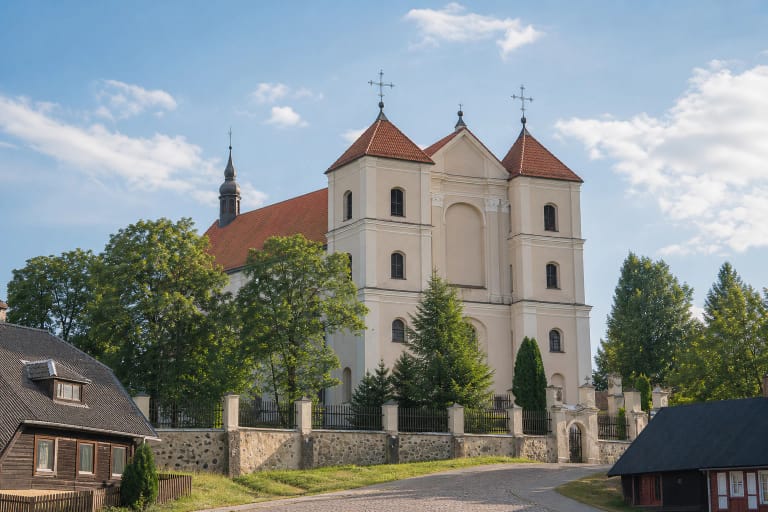
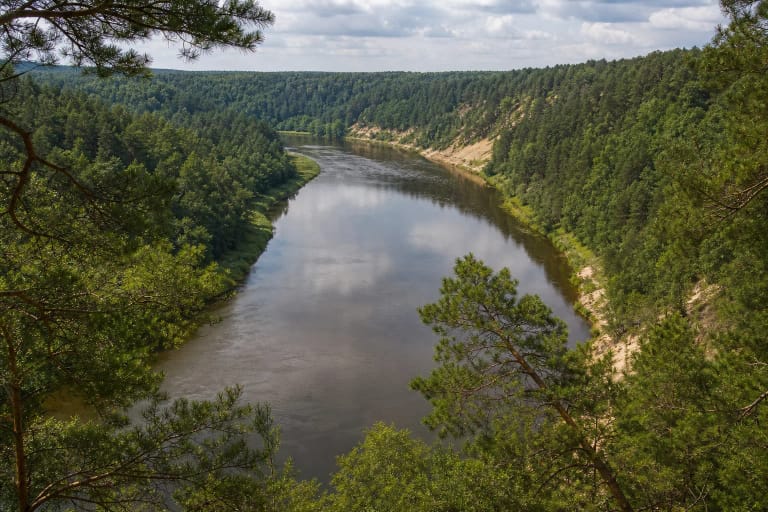
A Renaissance façade above the Neris valley
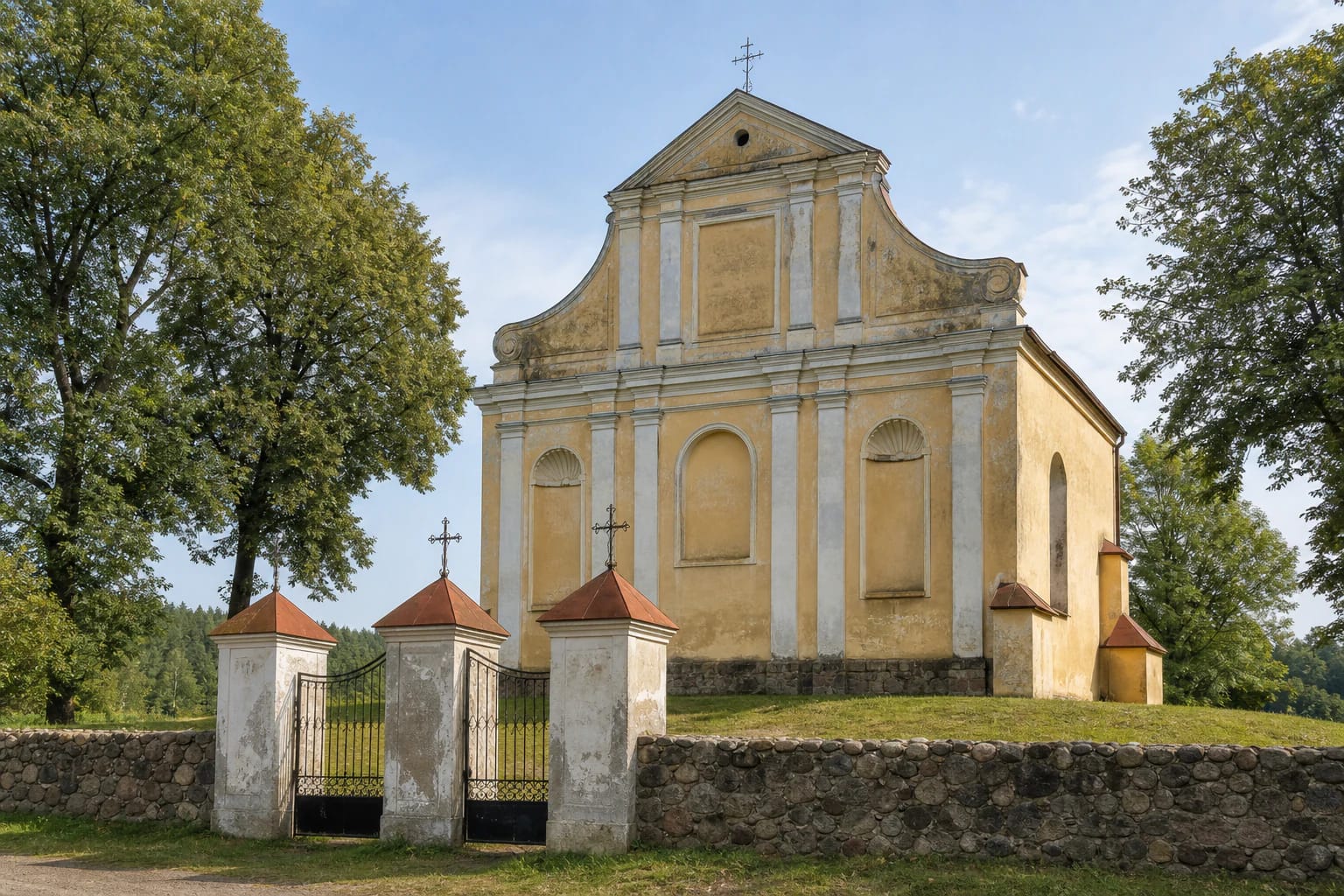
Rykantai church occupies an open hill, making the small towerless building appear unexpectedly monumental. Its western front is filled by a high Renaissance gable: cornices divide it horizontally, pilaster strips divide it vertically, and niches of different sizes create a dense rhythm. An image of Saint George survives in the central niche, although the detail visible from outside depends on light and the painting's condition.
Walk around the building to compare the decorative front with the plainer side walls. A three-sided apse closes the three-aisled interior, a rectangular sacristy adjoins the south side, and a crypt lies beneath the presbytery. The structure retains a Gothic building tradition while its outward architectural language is Renaissance.
From the early Reformation to the masonry church of 1585
A timber Reformed church is thought to have stood in Rykantai by the mid-sixteenth century. The Italian Reformation figure Pier Paolo Vergerio mentioned the place and its congregation in 1555, tying Rykantai to the earliest phase of the Reformation in the Grand Duchy of Lithuania.
In 1585 the Rykantai estate owner Adomas Tolvaiša built the present masonry church for the Reformed congregation. It is therefore best understood not as a later Catholic church erected from scratch, but as one historic building whose use and interior changed with the region's religious and political transformations.
The 1655 devastation, the Ogińskis, and the Trakai Dominicans
The church was damaged and plundered during the mid-seventeenth-century war with Muscovy. After Rykantai passed to the Catholic Ogiński family, Marcjan Aleksander Ogiński, Chancellor of the Grand Duchy of Lithuania, supported its repair. In 1688 he transferred the church and Rykantai estate to the Dominicans of Trakai.
That confessional turn is most legible inside: a sixteenth-century Reformed house of worship was adapted for Catholic liturgy and furnished with Dominican imagery. The church underwent restoration in the twentieth century, and an independent Rykantai parish was established in 1921.
The Passion cycle and Dominican saints
The most valuable layer of the interior is its late-seventeenth-century wall painting. Fourteen scenes from the Passion fill the presbytery, while nine Dominican saints appear on the organ-gallery parapet. Portraits of Marcjan Aleksander Ogiński and his wife also survive, recording the donors' role in the church's restoration.
Because of the incised signature IAN CIANO 1688, the paintings have traditionally been associated with Jonas Jonavičius. It is safer to treat this as a scholarly attribution rather than an incontrovertibly proven authorship. Paintings of Saint Dominic, Saint Vincent Ferrer, and the Flagellation were restored in 1980-1981; the first two are also valued as Rococo works.
Opening times, worship, and respectful visiting
On 27 July 2026 the Archdiocese of Vilnius listed the church as open on Sundays from 08:00 to 09:30, with Mass at 08:30 in Polish and Lithuanian. The schedule, feast-day services, and interior access can change, so check the official page or contact the parish before making a special journey.
The parish page did not list a separate tourist ticket. Treat the building as an active place of worship: remain quiet, do not touch the wall paintings, and never photograph a service without permission. On 27 July 2026 its Google Maps listing showed 4.6 out of 5 from 246 reviews; these figures change.