- Place
- Trakai, Trakai District Municipality
- Region
- Trakai
- Type
- perimeter-type masonry castle remains with a Dominican monastery
- Address
- Kęstučio g. 4, Trakai
- Coordinates
- 54.64590, 24.93600
Peninsula Castle, Trakų pusiasalio pilis
Trakai Peninsula Castle: not the Island Castle
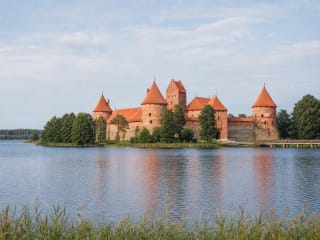
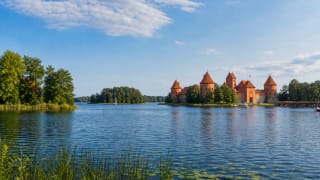
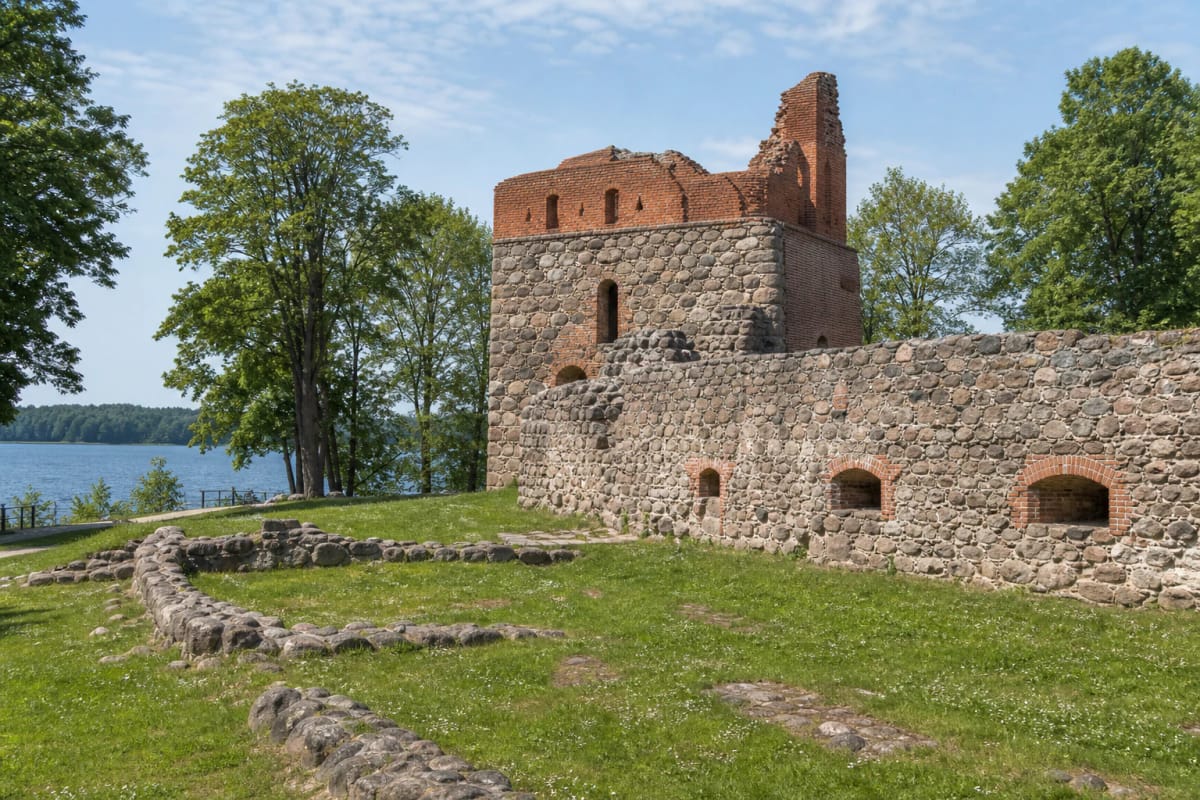
Trakai has two different castles, and it is worth separating them clearly. The famous red-brick castle most often seen in photos stands on an island in Lake Galvė: that is Island Castle. Peninsula Castle is an older, partly preserved castle on a land peninsula between Lakes Galvė, Bernardinai, and Totoriškės, beside the Dominican monastery.
Peninsula Castle was one of the largest perimeter, or enclosure-type, masonry castles in Lithuania and covered about 4 ha. At one time it was even more important and larger than Island Castle because it held the first defensive line against the Teutonic Order.
Construction in the times of Kęstutis and Vytautas
Construction began in the second half of the fourteenth century. Trakai History Museum distinguishes two main building stages: 1362-1382, under Kęstutis, and 1414-1430, under his son Vytautas. Kęstutis began the castle, and Vytautas later expanded and strengthened it.
After the Battle of Žalgiris in 1410, wooden and earthwork defensive parts were rebuilt in masonry. The castle controlled an important route and protected Trakai and Vilnius from crusader attacks, so for a long time it was one of the most important defensive sites in the region.
Towers, walls, and what survives
The castle had about 11 towers of different sizes; the front part was surrounded by a defensive wall with six towers. Only part of that former scale survives and has been restored: the south tower was partly conserved in 1953 according to architect S. Mikulionis' project, while three other towers and defensive walls were restored in 2012.
When visiting, do not underestimate the site because only some towers remain. This was once one of the country's largest castles. Defensive ditch traces are visible in the area. Archaeological research from 1951-1954 and later from 1992-2010 revealed a cultural layer up to 3.6 m thick, with fourteenth- to sixteenth-century weapons, tools, jewellery, and coins; the finds are kept in Trakai History Museum.
The Dominican monastery inside the castle
When the castle's defensive role declined, Dominicans settled in its territory in the eighteenth century. Two Dominican monastery buildings survive today; since 1990 they have housed the administration of Trakai History Museum, and in 2012 the buildings were fully repaired.
A sacral-art exhibition is installed in the monastery chapel and basement, so Peninsula Castle today is not only a defensive-architecture ruin but also a museum space. The Dominicans had also begun building a large church, but it was never completed.
How to visit Peninsula Castle
Peninsula Castle is easy to visit together with Island Castle and the wider town, creating a half-day or full-day Trakai route. For the castle and monastery area itself, 30-60 minutes is usually enough. Since 1999, a medieval festival has been held here, the site's most vivid seasonal event.
The castle and sacral-art exhibition are managed by Trakai History Museum. Current opening times and ticket prices should be checked on the official museum page because they may change.