- Place
- Šventežeris, Lazdijai District Municipality
- Region
- Dzūkija
- Type
- wooden Historicist church rebuilt in 1882 from a relocated 1822 chapel, with a four-column portico, two-stage tower, and separate belfry
- Address
- 15 Liepų Street, Šventežeris, LT-67203, Lazdijai District
- Coordinates
- 54.24117, 23.64566
- Visit duration
- 35-60 minutes for the four-column facade, stepped massing, separate belfry, and interior when the church is open
- Best time
- daylight for the architecture; arrive before a published Mass to see inside, but always recheck the latest diocesan schedule
Šventežeris Church, Church of the Nativity of the Blessed Virgin Mary in Šventežeris, Šventežerio Švč. Mergelės Marijos Gimimo bažnyčia
The full sequence of volumes matters more than the tower alone
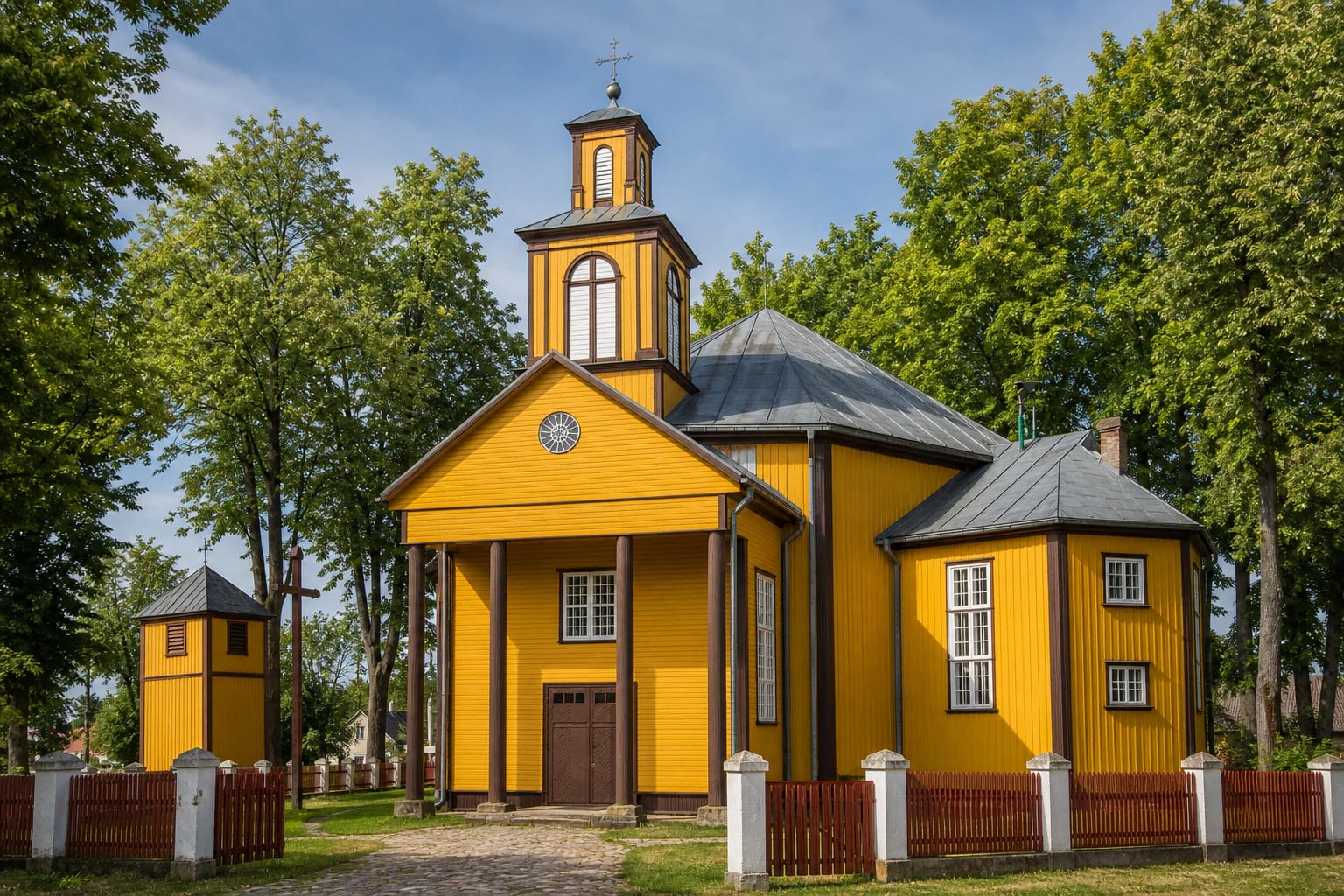
Šventežeris church is painted a rich ochre yellow, while wall corners, cornices, columns, and window frames are picked out in dark brown. White small-pane windows provide a third clear colour layer. This scheme makes the timber construction immediately legible.
Three volumes stand on one axis and become progressively lower. The tallest central body is nearly square, with clipped corners and a broad low pyramidal sheet-metal roof. Rectangular volumes at the front and rear differ from one another, so the church rewards a complete circuit rather than a single facade photograph.
Four slender timber columns support a triangular pediment with a circular radial window. A two-stage tower with tall arched acoustic openings and white louvres rises behind it. The small single-volume belfry in the churchyard is a separate building, not another stage of the church tower.
The present church grew from a relocated Šlavantai chapel
Sacred history at Šventežeris predates the current building by centuries. The Radvila-owned town gained an Evangelical Reformed church in 1598, and it passed to Catholics in the seventeenth century. A later Catholic sanctuary deteriorated, underwent repairs, and burned in the nineteenth century.
A masonry church design was approved in 1863 and stone was gathered, but construction never began. After the old church burned in 1871, services briefly moved to the rectory barn. That building also burned with the church property on 8 September of the same year. This sequence explains why the community turned to a movable timber structure.
In 1880, an 1822 family chapel was brought from the cemetery of Šlavantai Manor. Under priest Motiejus Bujauskas, it was enlarged with a portico, sacristy, and tower and became the present church in 1882. The date therefore does not mean that all its timber was first assembled on this site that year.
Lithuanian singing and societies extended the parish's role
During the Lithuanian press ban, curate Stasys Čėsna helped introduce singing in Lithuanian at Šventežeris. This important detail of local cultural self-awareness broadens the architectural story and shows that the language of worship then carried public significance.
Before the First World War, the parish hosted a branch of the Žiburys society and a reading-room library. A Lithuanian Catholic Temperance Society branch operated from 1911 to 1915, and a Pavasarininkai youth group existed by 1925. The church served not only liturgy but also education and community organisation.
The Encyclopaedia of Lithuania identifies Šventežeris as a parish and administrative centre beside the lake of the same name. Its church history is therefore best read alongside the changing town, not as a chronology isolated from the settlement.
The service schedule can help visitors see inside, but is not a tourist guarantee
On 27 July 2026, the Vilkaviškis Diocese page listed Mass at 09:00 and 13:00 on Sundays, at 09:00 on winter weekdays and 19:00 on summer weekdays, and by arrangement on Saturdays. The titular Nativity of Mary indulgence is associated with 8 September and transferred to the nearest Sunday.
Always recheck those times on the official page or with the parish before travelling. A worship schedule is not a guaranteed attraction opening time, and visitors arriving before Mass must not disrupt preparations. Photograph the interior only with permission.
No separate tourist ticket is published. Official sources give no complete description of a step-free entrance, accessible toilet, or reserved visitor parking. The cobbled path and entrance step may matter to people with limited mobility, so discuss conditions in advance.
The exact entrance point is on Liepų Street
The church stands at 15 Liepų Street on the town route between Lazdijai and Seirijai. Coordinates 54.2411748, 23.6456570 mark the principal entrance side. They do not guarantee a free parking space, so keep the churchyard gate and rectory access clear.
On 27 July 2026, the exact Google Maps entry with Place ID ChIJFzDkR7PB4EYRDtjucSd6ohg showed 4.6/5 from 87 reviews. The public average and count will change, and the rating is not a professional conclusion about conservation or accessibility.
Allow 35-60 minutes for the architecture and belfry, including a quiet interior visit when possible. Lake Šventežeris is a separate town feature, so do not treat the church coordinates as an official beach or water-access point.