- Place
- Kėdainiai, Kėdainiai District Municipality
- Region
- Aukštaitija
- Type
- museum of history, archaeology, manor culture, and cross-carving in a restored former Carmelite monastery
- Address
- 19 Didžioji Street, Kėdainiai
- Coordinates
- 55.28681, 23.97870
Kėdainių krašto muziejus, Kėdainiai Museum, Kėdainiai Local History Museum, Kedainiai Regional Museum
19 Didžioji Street is the main museum; six branches operate at other addresses
Kėdainiai Regional Museum is both the institution's name and the name of its main exhibition. This guide covers the building at 19 Didžioji Street, on a narrow pedestrian section of the old town at 55.286806, 23.978702. The Multicultural Centre, Radziwiłł Mausoleum, Arnetai House, Janina Monkutė-Marks Museum-Gallery, Vytautas Ulevičius Museum, and the 1863 Uprising Museum have separate addresses and visitor arrangements.
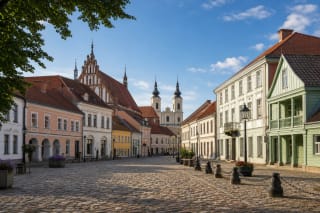
On the street, look for a long rendered facade in muted pink, rectangular windows with white surrounds, and a modest arched sign above the entrance. It does not resemble a ceremonial palace because its plan developed from monastic cells and service rooms, followed by nineteenth-century barracks alterations. Inside, surviving masonry vaults and exposed brick arches meet contemporary exhibition partitions.
Allow 1-2 hours for the main museum. To include the Radziwiłł coffins in the Reformed church, the Multicultural Centre on the Old Market, and Arnetai House on the same day, reserve at least half a day and verify each branch's schedule separately.
Imperial barracks replaced the 1709 monastery after the 1831 Uprising
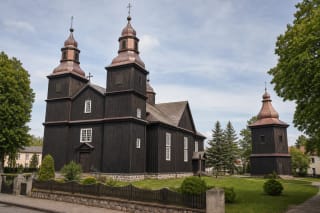
The Carmelites began establishing themselves in Kėdainiai in 1704, when the town's Catholic owner Charles III Philip Wittelsbach allowed the Old Observance order to build a chapel and monastery in a strongly Protestant town. VLE dates the masonry monastery to 1709. The friars later built the surviving wooden Church of St Joseph nearby in 1766.
After the 1831 Uprising, the Russian imperial authorities suppressed the monastery, confiscated its property, and transferred the premises to the army. Conversion into barracks in 1832 added a second floor above parts of the wings and replaced some timber ceilings with barrel and cross vaults. The building visitors see today is therefore not a pure reconstruction of an eighteenth-century monastery but an architectural record of successive regimes.
The monk's cell display turns that context into tangible objects. It includes monastic furniture, candlesticks, an eighteenth-century censer, nineteenth-century rosaries and scapulars, a chasuble from Father Stanislovas's collection, and a Kėdainiai Carmelite missal printed in Venice in 1769. The room is small but directly explains the building's original function.
The museum began in 1922 with one thousand antiquities donated by Vladas Rybelis
Vladas Rybelis, chairman of the Kėdainiai District Board, founded the museum in 1922 and gave it approximately 1,000 antiquities from his collection. Its first display occupied three rooms in what is now the Mikalojus Daukša Public Library, with five cases, three cupboards, and one shelf. A 1931 inspection already recorded that exhibits were packed so tightly into one room that a larger group could barely turn around.
The Regional Studies Society assumed responsibility in 1937, and the collection held approximately 1,800 objects by 1939. It was looted during the Nazi occupation, although keeper G. Bobelis saved part of it. The museum reopened after the war, but Soviet authorities turned its displays into ideological instruments; the history of interwar statehood, deportations, and resistance returned only during the national revival.
In 1991 the local history museum became the Regional Museum and acquired additional branches. It moved into the restored former Carmelite monastery in September 2000. According to VLE's 2025 figures, the institution's total collection had grown beyond 58,000 objects, while the main building contained 16 exhibition rooms and an education classroom.
Do not miss the Svirskis crosses and the Apytalaukis antler furniture
The Vincas Svirskis Cross Hall contains several-metre-high oak crosses and wayside shrines whose figures and reliefs were cut from the same trunk. Svirskis lived from 1835 to 1916, walked between villages in central Lithuania, and, by the museum's estimate, created approximately 250 crosses. Around 130 survive, with one of the largest groups preserved here. Walk around them because saints and narrative scenes occupy more than the frontal face.
The Apytalaukis manor room demonstrates a completely different craft. A suite assembled from the antlers of several deer species won a gold medal at the 1900 Paris Exposition, where Count Karol Henryk Zabiełło of Apytalaukis purchased it and brought it to Lithuania. Part of the furniture burned or was looted during the Second World War, and the surviving group entered the museum in 1947.
The archaeology rooms range from Stone and Bronze Age material to pottery excavated in the old town. Among the concrete urban finds, VLE highlights a hoard of 603 copper shillings of John II Casimir found in 2006 in the present library courtyard. These originals provide useful anchors among the screens: inspect each object first, then use the digital interpretation.
Interactive rooms explain why seventeenth-century Kėdainiai looked outward to Europe
In Town Owners, an interactive Radziwiłł family tree connects the dynasty's branches and other rulers of Kėdainiai. The neighbouring Kėdainiai's Connections with the World map shows the European cities involved in seventeenth- and eighteenth-century trade, where clergy and intellectuals arrived from, and where talented grammar-school pupils went to study. It is an effective introduction before visiting the Radziwiłł Mausoleum or the Bright Gymnasium.
Kėdainiai - a Multi-ethnic City of the Polish-Lithuanian Commonwealth centres on an interactive model of the seventeenth-century town. Seven characters describe key places, while 3D animation helps visitors understand how Reformed Protestants, Catholics, Jews, Scottish merchants, and other communities lived beside one another. This is not only a celebratory Golden Age narrative: the later Losses 1940-1953 room covers the Holocaust, deportations, and partisan war.
The Czesław Miłosz display introduces the Nobel Prize-winning writer born at Šeteniai in 1911 through biography, texts, visual material, and his relationship with Lithuania. It is contextual rather than a manuscript treasury. Visitors particularly interested in Miłosz should continue to Šeteniai, where the landscape supplies what a gallery screen cannot.
Admission is €3 in 2026, and the final Sunday of every month is free
On 13 July 2026, the museum's official website listed the main exhibition as open Wednesday-Friday 11 am-6 pm, Saturday 10 am-5 pm, and Sunday 10 am-3 pm, with Monday and Tuesday closed. Final admission is 30 minutes before closing, the museum shuts one hour earlier before public holidays, and it is closed on public holidays. Check the official site before travelling because hours can change.
The standard ticket published on that date was €3. School pupils, eligible full-time students, pension-age visitors under 80, and several other listed groups received a 50 per cent reduction. Preschool children, visitors aged 80 or above, disabled visitors and one companion, and other officially listed groups entered free. Permanent displays are free to everyone on the last Sunday of each month, although a date coinciding with a holiday may be moved.
The museum is adapted for visitors with reduced mobility and a lift reaches the upper floor; contact staff in advance for a particular route or assistance. On 13 July 2026, the Google Maps entry had 140 reviews averaging 4.7 out of 5. Google's timetable matched the official exhibition hours, but administrative office hours are different and should not be confused with public admission.