- Place
- Kaunas City Municipality
- Region
- Kaunas
- Type
- active Orthodox cathedral and interwar sacred-architecture landmark
- Address
- Vytauto pr. 38, Kaunas
- Coordinates
- 54.89062, 23.92690
- Visit duration
- 20-40 minutes; longer for a service or pre-arranged tour
- Best time
- in daylight and around the service timetable; during worship, the community's prayer takes priority
Annunciation Cathedral in Kaunas, Blagoveshchensky Cathedral, Kauno Apreiškimo Švč. Dievo Motinai soboras
Which Kaunas sobor stands on Vytauto Avenue
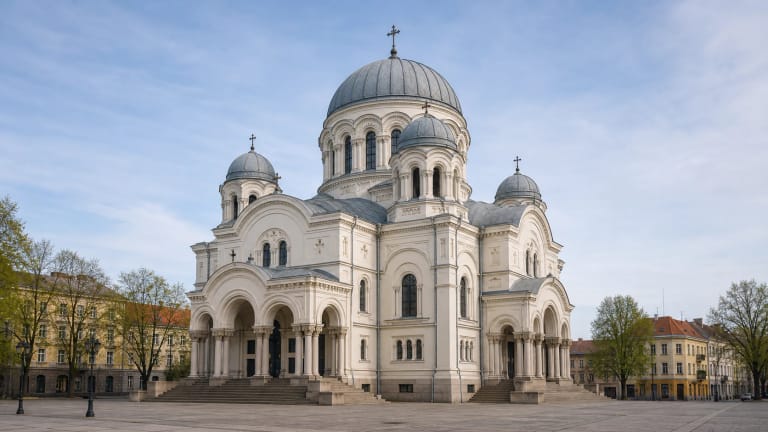
The Cathedral of the Annunciation stands at Vytauto pr. 38 in the wooded grounds of the former Karmelitai Cemetery, very close to Kaunas bus station. It is an active Orthodox cathedral. The word sobor denotes an Orthodox church of particular importance, usually a cathedral or a city's principal church.
Do not confuse it with St Michael the Archangel Garrison Church on Independence Square. In everyday Kaunas speech, that building is usually the one simply called the Soboras because it was built as an Orthodox church for the Russian imperial garrison. The Annunciation Cathedral is a separate, smaller five-domed building beside Ramybės Park and still belongs to the Orthodox community.
Why interwar Kaunas needed a new cathedral
The neighbouring Church of the Resurrection was built in 1862 and served as a cathedral after the First World War, but it became too small for the growing community. The parish's official history says that the authorities did not return the former military cathedral on Laisvės Avenue, instead allocating funds for a new church beside the older one. The Cabinet of Ministers provided 75,000 litas and believers donated the shortfall.
Construction began in 1932 and was completed in 1935. The design is associated with architect Edmundas Alfonsas Frykas. Detailed historical accounts explain that he combined ideas from his own competition entry and that of engineer P. Toročkov. The church was consecrated in 1935, and diocesan records counted 4,560 regular parishioners in 1937, explaining why a larger building had been needed.
Five domes and echoes of Vladimir-Suzdal architecture
The parish history describes the architecture as an interpretation of the Vladimir-Suzdal tradition. Five dark onion domes with gilded crosses crown the vertically articulated white volume. On the west side, a columned porch with three entrances projects from the main facade, while the rolling gable line and pointed portals lend the building the atmosphere of medieval Rus architecture.
Four columns carry the interior vaults. The sanctuary contains two altars: the principal altar is dedicated to the Annunciation to the Mother of God, and the right-hand chapel to the Vilnius Martyrs Anthony, John, and Eustathius. The iconostasis, gilded icons, candle stands, and liturgical space are not museum scenery. They remain in use for worship, so view them without interrupting services.
The Surdegis Icon of the Mother of God
The cathedral's foremost sacred object is the Surdegis Icon of the Mother of God. Church tradition says that its image appeared beside a spring in the town of Surdegis in 1530 and later became a relic of the Orthodox monastery established there. This account should be understood as a devotional tradition rather than an event verified by modern historical methods.
Official Church publications document the icon's later journey: it returned to Lithuania in 1921 after the First World War, began spending part of each year at the new Kaunas cathedral in 1936, and has remained here permanently since the Second World War. Believers venerate it as miraculous and pray before it, but a visitor guide should distinguish expressions of faith from verifiable dates and movements.
The Karmelitai Cemetery and Ramybės Park setting
The cathedral stands in the southern section of the former Kaunas Old Cemetery, commonly known as the Karmelitai Cemetery. It operated from 1847 to 1959 and was divided among the city's communities: the largest section was Catholic, the southern section Orthodox, the northern section Lutheran, and a separate corner Muslim. Places of worship for several faiths consequently appeared within the same wider ground.
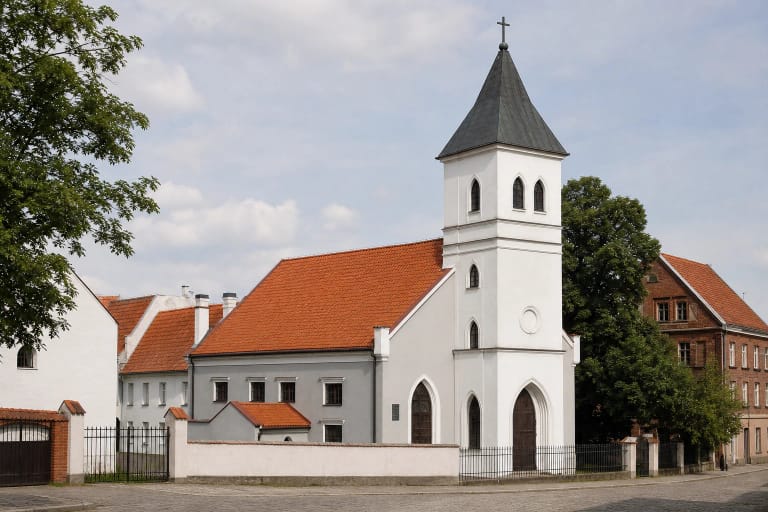
The Soviet authorities closed the cemetery and turned it into Ramybės Park, destroying or relocating many graves and memorials. Today the Kaunas Old Cemetery complex is listed in the Cultural Heritage Register at national significance level. The 1862 Church of the Resurrection still stands beside the Annunciation Cathedral, making it possible to read two periods of the Orthodox community's history within one enclosure.
Respectful access, services, and practical details
This is an active place of worship, not an attraction with a tourist ticket office and guaranteed viewing hours. No permanent visitor admission price is published. Church sources confirm that Divine Liturgy and other services continued in 2026, but dates and hours follow the liturgical calendar. Before making a special journey, check the parish schedule or contact the community.
Speak quietly, silence your phone, do not photograph people without permission, and never enter the sanctuary area. During the liturgy, avoid walking in front of worshippers; ask before photographing the interior. Allow about 20-40 minutes for the exterior and a brief quiet look inside. An organised tour requires separate arrangements.
On 25 July 2026, the exact Google Maps listing was rated 4.8 out of 5 from 403 reviews. The coordinates identify the main entrance side, but the community may manage specific gates and access during services or events.