- Place
- Kaunas City Municipality
- Region
- Kaunas
- Type
- active Jewish prayer house and historicist sacred-architecture monument
- Address
- E. Ožeškienės g. 13, Kaunas
- Coordinates
- 54.89883, 23.90363
Ohel Yaakov Choral Synagogue, Ohel-Jaakov Synagogue, Kaunas Choral Synagogue, Synagogue of Kaunas
An active synagogue in the city centre
Kaunas Choral Synagogue stands at E. Ožeškienės g. 13, a few steps from Laisvės aleja and the former state-institution district. It is not a museum model but an active Jewish prayer house, so visitors should first keep a respectful distance: the exterior can be viewed from the street, while the interior only when community rules, an event, or a pre-arranged visit allow it.
In the Cultural Heritage Register the object is listed as Ohel Yaakov Choral Synagogue, unique code 36692. It is a state-protected single immovable cultural heritage object of national significance. The register lists architectural, artistic, historical, cultural-expression, and sacred values.
What Ohel Yaakov and choral mean
AUTC stresses that the name and type are often misunderstood. Choral does not mean the senior or main synagogue. It means a synagogue where worship is accompanied by choir singing. In Kaunas, this musical layer became especially important in the interwar period.
The name Ohel Yaakov is usually connected with the image of Jacob's tent or the tent of God, which in Jewish tradition leads toward the Tabernacle and memory of the Temple. The building therefore carries not only urban architectural meaning but also liturgical symbolism.
A historicist building from 1872
The synagogue was built in 1872. In the register's author field, the construction founder is named as Kaunas first-guild merchant Levin Baruch Minkowski. AUTC mentions the project approved on July 17, 1872: the architect's name was not indicated, construction supervision was carried out by von Mikvitz, and literature suggests the project may have been prepared by engineer Ustin Golinevich.
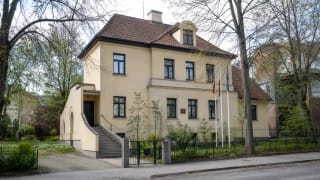
This is guberniya-period historicist architecture with neo-Baroque forms and symbolic elements typical of synagogues. From E. Ožeškienės Street, the pilasters, tall arched second-floor windows, rectangular first-floor windows, wooden double doors, voluted pediment, and Star of David are the easiest features to read.
Facade, dome, and fence
The register's valuable-features description records a compound volume, rectangular main block with attic, apse, staircase annex, and dome base over the southwest facade. The dome was rebuilt in 2001, so today the building again has a vertical accent visible above the street facade.
The plot fence also matters. The register states that the southeast part of the fence with gates was built in 1893 and that its author was engineer Piotr Dorofeyevsky. Even if visitors do not go inside, the fence, gates, pediment, dome, and window rhythm give a fairly precise view of the synagogue architecture from the pavement.
Value of the prayer hall
The interior is one of the object's key values, but visiting it is not automatic because the synagogue functions as a religious space. The register describes a rectangular prayer hall surrounded on three sides by open galleries, an octagonal bimah, ark, wooden gallery railings, stained glass, stencil ornament, benches, and memorial plaques.
AUTC emphasizes that the hall space is three-aisled and supported by columns, with the aron kodesh, the sacred ark for Torah scrolls, dominating the interior. These details explain why the synagogue is protected not only for the facade. Its cultural value lies in the structure of liturgical space and in wood, metal, glass, and painted work.
Interwar music and Kaunas intelligentsia
The register states that in the 1920s, one of the world's most famous cantors, Misha Alexandrovich, led the boys' choir of Kaunas Choral Synagogue. Through his work, the synagogue became not only a prayer house but also a cultural place: religious hymns and secular concerts were heard here, attended by the Kaunas intelligentsia.
The register also mentions notable people connected with this space: artist Neemia Arbit Blatas, philosopher Emmanuel Levinas, scientists Hermann and Oskar Minkowski, and physician Elchanan Elkes, chairman of the Kaunas Ghetto Jewish Council of Elders. These names show the synagogue's connection with a broad Litvak intellectual and public environment.
After the Second World War
The Holocaust destroyed most of the Kaunas Jewish community and its network of prayer houses. AUTC recalls that before the Second World War Kaunas had more than 20 synagogues and Jewish prayer houses, while only some buildings and one active synagogue have survived to the present.
A particularly strong postwar detail appears in the register description: after the Second World War, Kaunas Choral Synagogue sheltered Jews who had survived. For some it was a temporary place to sleep; for many it was a point for searching for relatives, because a board in the synagogue carried messages left by survivors.
Memory in the courtyard
The register's object-parts list includes Robertas Antinis's memorial sculpture Children's Torah. This is an important memory layer beside an active synagogue: the building is not only a nineteenth-century architectural monument but also a place of Holocaust loss and continuity of the Lithuanian Jewish community.
For that reason, do not rush here. From outside the synagogue looks calm, almost absorbed into the city centre, but its history includes prayer, choral culture, interwar Kaunas Jewish everyday life, wartime catastrophe, postwar reunions, and current community life.
How to visit
The most reliable way to see the synagogue without arrangement is from E. Ožeškienės Street. The best angle is opposite the facade, where the arched windows, pediment, dome, wooden doors, and fence are visible. Trees cover part of the building, but they also help show the real city-centre scale.
Plan the interior only as a pre-arranged visit or when an event makes it possible. This is an active prayer house, so do not expect regular museum opening hours. When photographing from outside, avoid disturbing the community and be especially sensitive during services or commemorations.