- Place
- Kaunas City Municipality
- Region
- Kaunas
- Type
- active Catholic garrison church, former Kaunas Fortress Orthodox cathedral, and Neo-Byzantine historicist monument
- Address
- Nepriklausomybės a. 14, Kaunas
- Coordinates
- 54.89705, 23.92134
Kaunas Soboras, Soboras, St. Michael's Church, St. Michael the Archangel Church, Kaunas Garrison Church
A white landmark at the end of Laisvės aleja
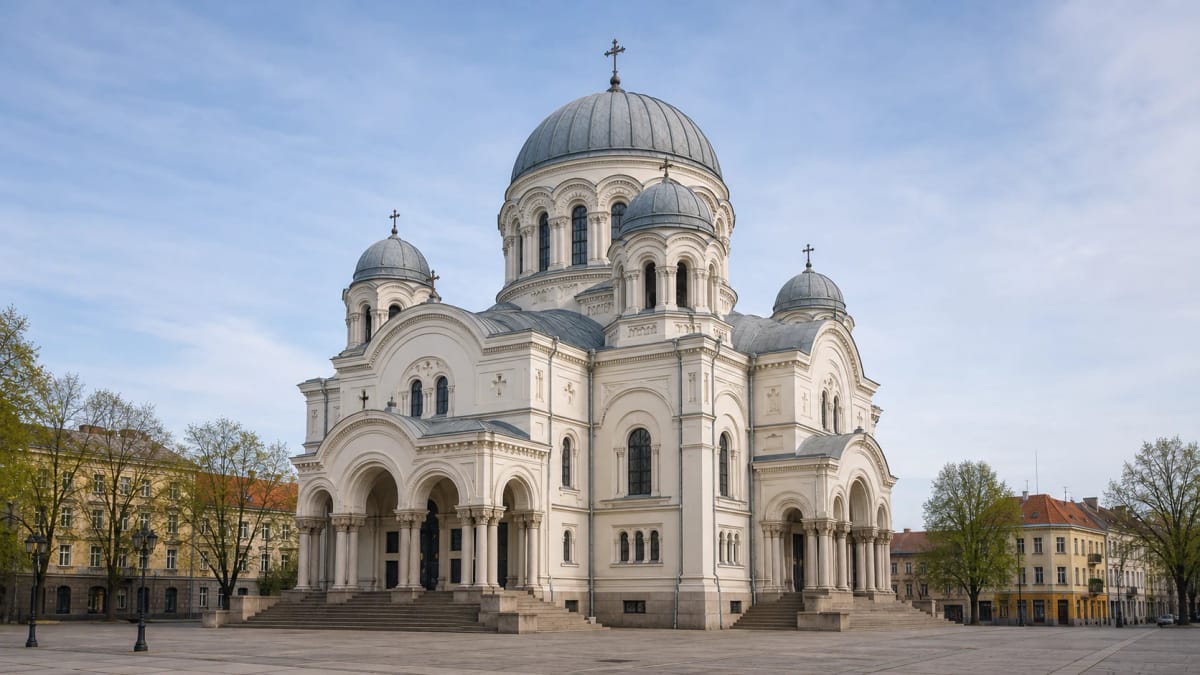
St. Michael the Archangel (Garrison) Church in Kaunas stands at Nepriklausomybes a. 14 and closes one of the city's most important central perspectives. Kaunas residents often call it Soboras, even though today it is a Catholic church and a pastoral place for statutory structures of the Kaunas region.
In the Cultural Heritage Register the object is listed as St. Michael the Archangel, Garrison Church, unique code 20904. It is a state-protected individual object of national significance. VLE's overview of Kaunas architecture mentions it as a 1895 Neo-Byzantine St. Michael the Archangel Church associated with engineer K. Limarenka.
Nikolai Avenue square and the fortress
The register's historical description states that in the mid-nineteenth century a square for a sacred building was planned on the axis of then Nikolai Avenue, today's Laisvės aleja. When Kaunas became a fortress of the Russian Empire, it was decided to build the main prayer house of the fortress garrison here.
In November 1890, the project for the St. Peter and Paul Garrison Cathedral was approved. The register states that it was prepared by Kaunas Fortress military engineer Konstantinas Limarenka and corrected by architect-academician D. Grim. Construction was carried out by contractor F. Shcherbakov.
The 1895 cathedral
Construction was completed and the cathedral consecrated on September 17, 1895. It was the Orthodox garrison church of Kaunas Fortress, intended for a large military city. The register notes that up to 3,000 people could pray there at one time, and that the fittings were expensive and technically modern.
Granite blocks bought in Scandinavia were used for the plinth and steps, the portico columns stood on cast-iron bases, a reinforced-concrete slab was used in the structure of the large dome, and a heating system with heaters brought from Warsaw was installed in the basement. This helps explain why the building is not only a decorative Orthodox form: it was an important object of fortress representation and engineering.
Five domes and a Greek-cross plan
Architecturally, the church is recognized by its central domed, almost cube-like main volume and five-dome composition: the large dome and four corner dome-belfries. The register links the facades with a Greek-cross plan, porticoes, steps, and a five-sided apse.
From the square you can see six-column arched porticoes, granite steps, light plaster, grey metal domes, and bronze crosses. Although the building's origin is Orthodox, its exterior today clearly shows a long path of adaptation: crosses, facade colour, portico details, and the relationship with Laisvės aleja changed along with the city's history.
The Catholic garrison church of 1919
After the First World War, the building lost its original imperial fortress function. The register states that by a Council of Ministers resolution on July 25, 1919, Soboras was recognized as state property and consecrated as the Catholic St. Michael the Archangel Lithuanian Army Garrison Church.
This transformation was not only religious. It shows how the Lithuanian state took over signs of former imperial infrastructure and tried to adapt them to new army and capital symbolism. From 1929 to 1938, the church rector was army chaplain and Act of Independence signatory Vladas Mironas.
Adaptation in 1932-1934
In the interwar period there were debates about the building's fate, but demolition was stopped in 1932. In 1932-1934, through V. Mironas's efforts, repair and adaptation for Catholic liturgy were carried out. Exterior Cyrillic inscriptions were removed, some images were painted over, plaster was repaired, and the domed roofs of the corner towers were restored.
Inside, the iconostasis was dismantled, new altars were installed, and in 1934 Vladas Didziokas painted the Good Shepherd composition in the apse vault. In 1939 an organ by E. F. Walcker & Cie was installed, later important for sacred-music evenings and concerts.
The Soviet gallery
During the Soviet period, the church's history turned again. The register states that in 1962 the building was transferred to the M. K. Čiurlionis Memorial Museum, and in 1965 the Sculpture and Stained Glass Gallery opened here. The interior was adapted for museum display, and the inventory was moved to other churches.
Another reconstruction took place in 1978: crosses were removed from the domes, window frames were replaced with metal ones, domes were reinforced, and facades repainted. The present building therefore carries not only Tsarist fortress and interwar garrison-church layers, but also a Soviet museum layer.
Return and present function
On March 28, 1991, the church was returned to the Kaunas Archdiocese Curia, and crosses were returned to the domes. In 1992-1997, under rector Ricardas Mikutavicius, the church was restored, and the interior reconstruction concept was prepared by architect Diana Piksriene.
From 1996 the shrine was again returned to the pastoral needs of those serving and working in the military, and from 2001 the register links it with the pastoral centre for statutory structures of the Kaunas region. Visitors should treat it as an active sacred object, not as a permanently open museum.
Kaunas modernist city context
Soboras is not an interwar modernist building and should not be presented as one. It was built in 1890-1895 as a Tsarist fortress cathedral. But it is an essential landmark of central Kaunas, around which the public life of the modernizing temporary capital grew in the interwar period.
The UNESCO Modernist Kaunas inscription speaks about the city's 1919-1939 transformation, and Soboras helps visitors see which earlier imperial signs that transformation had to work with. That is why it belongs naturally on routes with Laisvės aleja, the Officers' Club, the post office, banks, and museums.
How to visit
The best first viewpoint is Nepriklausomybes Square in front of the main facade. From here you can see the five-dome composition, porticoes, granite steps, and the axis of Laisvės aleja. Walking around the building helps you understand the Greek-cross plan, apse, and side porticoes.
Visit the interior only when the church is open for services, an event, or an arranged visit. Inside, behave as in a place of prayer: do not photograph people without permission, do not disturb liturgy, and remember that part of the interior value has been restored and changed across several periods.