- Place
- Kaunas City Municipality
- Region
- Kaunas
- Type
- reconstructed reinforced-concrete memorial
- Address
- Ramybės Park, Vytauto pr., Kaunas
- Coordinates
- 54.89239, 23.92756
- Visit duration
- 20-40 minutes
- Best time
- in daylight, when the reliefs and full composition are easiest to see; expect more visitors around All Souls' Day
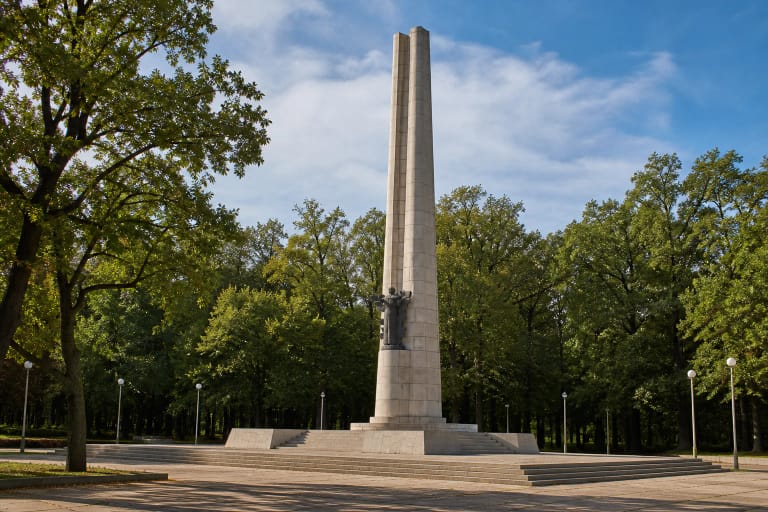
A pale nine-metre memorial at the centre of Ramybės Park
The We Died for the Motherland Monument stands at the centre of Ramybės Park, on the grounds of Kaunas's former Karmelitų Cemetery. The coordinates 54.8923929, 23.9275567 mark the memorial itself, not the whole park or its other commemorative signs. It is a separate destination even though it belongs to a larger historic cemetery landscape.
The light-coloured monument is a tall vertical structure in the form of a cross and stylised sword. Its lower part is a broad stepped plinth; four corner masses with urn-shaped bowls emphasise the upper base, while heraldic and geometric reliefs break up the concrete surfaces. The front carries the monument's name and a biblical thought about laying down one's life for friends.
Ramybės Park is part of the experience rather than a backdrop: mature trees, straight paths, and seasonal flowerbeds frame the memorial while recalling the former cemetery. Walk around it from several sides, do not touch the reliefs or climb the steps, and keep the flowerbeds clear, especially during remembrance ceremonies.
A 1930 memorial to unknown soldiers
The first monument was unveiled on 27 October 1930, the 500th anniversary of the death of Grand Duke Vytautas. The Kaunas County Public Library describes it as a nine-metre reinforced-concrete memorial designed by artist Stasys Stanišauskas. Cultural Heritage Department records place it at the burial site of unknown soldiers.
The memorial has more than one war-remembrance context. The Lithuanian Special Archives and library descriptions connect it with Lithuanian soldiers killed in the 1918-1920 Wars of Independence or with unknown Lithuanian soldiers, while a 2020 Kaunas municipality notice describes it as a memorial to Lithuanian soldiers killed during the First World War. Both contexts are relevant when reading the site.
The site was designed as the centre of a cemetery plot and a sign of military remembrance, not as an arbitrary decorative column. Its cross, oak-wreath, Vytis, and other state-symbol language reflects interwar Lithuania's effort to give a public place to the memory of defenders and unknown soldiers.
The 1956 All Souls' gathering and a destroyed monument
During the Soviet occupation, people gathered at the monument on All Souls' Day and on other prohibited national occasions. More than a thousand people, mostly school and university students, assembled there on 2 November 1956. They sang the Lithuanian anthem, sang patriotic songs, and raised a tricolour made from scarves on top of the monument.
The gathering became an anti-Soviet demonstration, and the crowd grew to 3,000-4,000 people after moving into the streets. After the event, Soviet authorities began removing the monument's reliefs and inscriptions, enclosed it with a high fence, and eventually destroyed it together with the cemetery.
This episode is essential to the place's meaning because its story is not limited to the 1930 construction. Ramybės Park brings together soldiers' graves, civic resistance in 1956, and deliberate reconstruction after independence; nearby memorials should still be understood as separate objects and separate histories.
Reconstruction on the historic site and the 2020 repair
Today's monument is not surviving material from the 1930 structure. After the Soviet-era destruction it was reconstructed in 1994 by sculptor Robertas Antinis Jr, artist Ričardas Bankauskas, and engineer Kęstutis Linkus. Finishing work continued into spring 1995, so the reconstruction unfolded in several stages.
The reconstruction followed the historic site and the first monument's documented form, but visitors now see a reconstructed work rather than an intact interwar original. That distinction helps read the reliefs honestly: they carry forward the earlier memorial's shape and symbols, while the present structure belongs to the period of restored independence.
In 2020 the municipality announced that repairs had been completed. Drainage and breathable paving were added around the monument, the foundations were cleaned, damaged areas received protective concrete, open joints were sealed, and the surface was protected with primer and special waterproofing paint. These were conservation measures, not the construction of a new monument.
How to visit the memorial respectfully
The monument is in a public park with no separate ticket or gate. Approach it along park paths in daylight, although access can change for maintenance, events or commemorative ceremonies. Around All Souls' Day, allow extra time and leave room for participants.
Twenty to forty minutes is enough for a focused stop: study the rhythm of the four corner masses, the cross silhouette, the reliefs, and the flowerbed axis, then walk calmly through the former cemetery grounds. This is not a place for a noisy picnic backdrop; respectful behaviour matters especially near burial sites and on remembrance days.
Visit in daylight, when the cross silhouette, reliefs and full composition are easiest to see. Before All Souls' Day or an event, check whether the park has temporary arrangements and allow time for a quiet walk through the former cemetery grounds.