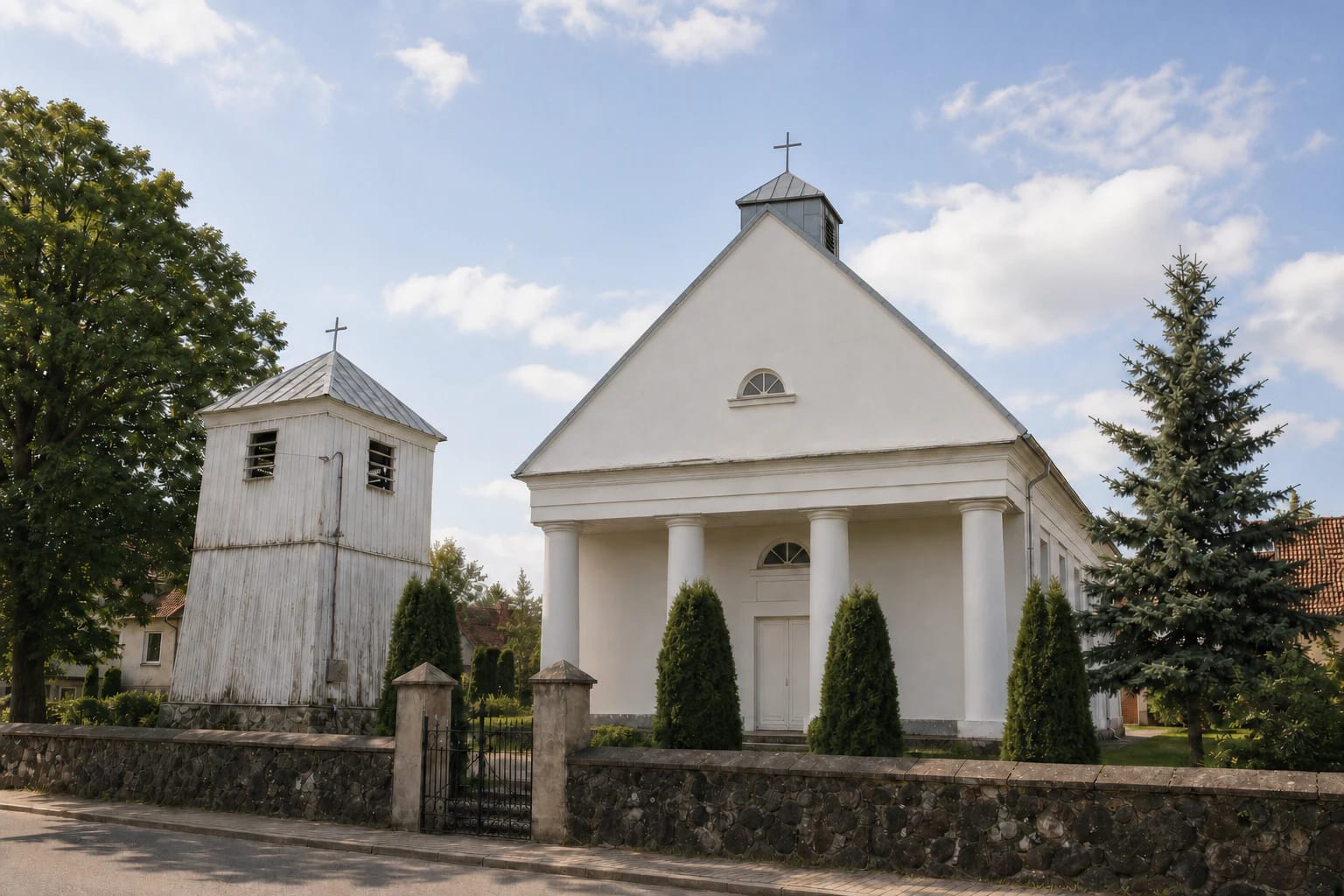
- Place
- Šilutė District Municipality
- Region
- Pamarys
- Type
- active masonry Evangelical Lutheran church completed in 1842, with a Doric portico and detached timber belfry
- Address
- 13 Klaipėdos Street (Google Maps lists KK165 25), Žemaičių Naumiestis, Šilutė District
- Coordinates
- 55.35834, 21.70073
- Visit duration
- 20-40 minutes for the church, belfry, and churchyard exterior; longer for a service or event
- Best time
- in daylight for the architecture; for the interior, attend a publicly advertised service or arrange access with the parish
Žemaičių Naumiestis Lutheran Church, Naumiestis Evangelical Lutheran Church
The four-column portico fronts a hall church rather than a tower church
The church stands on a low rise in the southern part of the old town, at 55.3583377, 21.7007293. Its pale plastered rectangular body, tall gabled roof, and recessed front portico create a clear, restrained silhouette. Four Doric columns carry the entablature, a small metal-clad turret rises behind the triangular pediment, and a completely separate belfry clad in vertical timber boards stands to the left.
The designer's name has not survived. Hewn-stone steps lead inside; the official parish history describes a single nave with a flat boarded ceiling, a gallery on the right, a central aisle, and an altar and pulpit combined into one composition. Tin candlesticks, an image of the Last Supper, a portrait of Martin Luther, and changeable hymn-number boards are also recorded - a spare setting centred on preaching and congregational singing.
The timber belfry is not the same structure as the small roof turret. The parish account explains that money and energy ran short for a grander bell tower after the church was built; the bell arrived in 1848 and an organ was installed around 1890. These dates document when the fittings appeared, but do not by themselves prove that every component remains original.
The fire of 1825 and the church of 1842 belong to two different buildings
By about 1800, the Lutherans of Naumiestis already had a school and place of prayer, but the source does not establish its precise location. The parish history gives accounts of an earlier school and prayer house burning around 1820 and again in 1825; oral tradition places it at Sugintai or near the present church, while the author considers another site beside the road to Švėkšna. The year 1825 therefore cannot be treated as the start of the current masonry church.
The present site was chosen on a rise beside what was then Sloniškė Street. The congregation collected 500 roubles for materials, the state contributed another 300, and parishioners worked alongside serfs sent by Count Adomas Ronikeris. It is said that the count's wife took a particular interest in the project, but the parish history presents this as oral tradition, not a documented fact.
Construction began in 1841 and ended in 1842, so the present church took less than two years to build rather than the often repeated seventeen. The first service was held in May 1842 on Exaudi, the final Sunday before Pentecost. The Universal Lithuanian Encyclopedia likewise dates the present building to 1842.
Land belonging to the Tauragė filial paid for walls, gates, and the cantor's house
Around 1800 the congregation was attached to Tauragė Evangelical Lutheran Parish and long remained its filial church. Between a pastor's visits, cantors carried much of the religious and educational work: leading services, preparing confirmands, keeping records, and teaching children. An account by the Šilutė Hugo Scheu Museum notes that in 1835 cantor Jurgis Avyžius taught children from Lutheran families religion, reading, and writing in their native language.
In 1864 the authorities granted the congregation 40 desyatinas of pasture outside the town. According to the parish history, rental income helped rebuild the cantor's residence, known as the canteria, in 1911-1912, finish stone walls around the churchyard and cemetery, and install wrought-iron gates. In today's street view, the fieldstone wall and gate are not incidental decoration but traces of a filial community that gradually built its own infrastructure.
Frydrichas Mėgnis organised a choir here and printed issues of Svečias
Cantor, publisher, and later deacon Frydrichas Mėgnis worked in Žemaičių Naumiestis in 1899-1914, 1933-1936, and 1945-1950. Around 1903 he formed a Lithuanian choir at the church, in 1907-1908 he attempted to establish a Lithuanian parish school, and in 1908 he organised a Blue Cross temperance society. This was more than liturgical activity - the congregation became a centre of Lithuanian education on the Russian-Prussian border.
In November 1911 Mėgnis began publishing the Lithuanian weekly Svečias. Enzys Jagomastas's press in Tilsit printed the first six issues; subsequent numbers were produced in Naumiestis on a small hand-operated press bought by the publisher, reaching 188 issues by 1914. His 72-page primer Raktelis appeared in Tilsit in 1913, and he helped establish a public reading room in 1914. The publishing work belonged to the life of the congregation, but did not take place in the church nave.
Russian authorities arrested Mėgnis in 1914, accused him of spying, and exiled him, bringing Svečias to an end. He returned after the war and settled in Naumiestis once more in 1945; he was ordained a deacon in 1947 and served until his death in 1950. His career explains why this modest church matters to the history of Lithuanian Protestant writing as well as architecture.
Wars depleted the congregation, but the building retained its religious life
In 1941, approximately 500 Germans and a similar number of Lithuanians left the Naumiestis congregation for Germany, abruptly shrinking what had been a large community. As the front approached in 1944, its valuable library, manuscripts, and collections of music were carried off and dispersed. This was a documented loss of communal memory; the masonry church itself survived.
Mėgnis resumed work after returning, and following his death Jonas Armonaitis served the congregation for four decades. The official parish history stresses that during the Soviet period the place of worship was preserved, services continued, and the filial community became an independent parish. More members departed in 1958-1959, but the church did not lose its religious use.
The exact map listing is more reliable than inconsistent street numbers
Address sources differ: street directories commonly use 13 Klaipėdos Street, while the exact Google Maps listing showed KK165 25 on 15 July 2026. Both refer to the same church, but coordinates 55.3583377, 21.7007293 or place ID ChIJg7qdGMtf5EYRjTCz0XboAkI are the safest navigation reference. Do not infer a car park or step-free access from the address - the official sources do not confirm either facility.
This is an active parish church, not a museum with fixed visitor hours. On 15 July 2026, the official parish page published no permanent tourist opening hours, worship schedule, or admission price. View the exterior in daylight; for the interior, attend a publicly announced service or event or arrange access with the parish, and recheck the official page before making a dedicated journey.
On the same date, the exact Žemaičių Naumiestis Evangelical Lutheran Church Google Maps listing had 15 reviews averaging 4.7 out of 5. This is a dated snapshot rather than an expert assessment, and both the review count and average can change.