- Place
- Šilutė District Municipality
- Region
- Pamarys
- Type
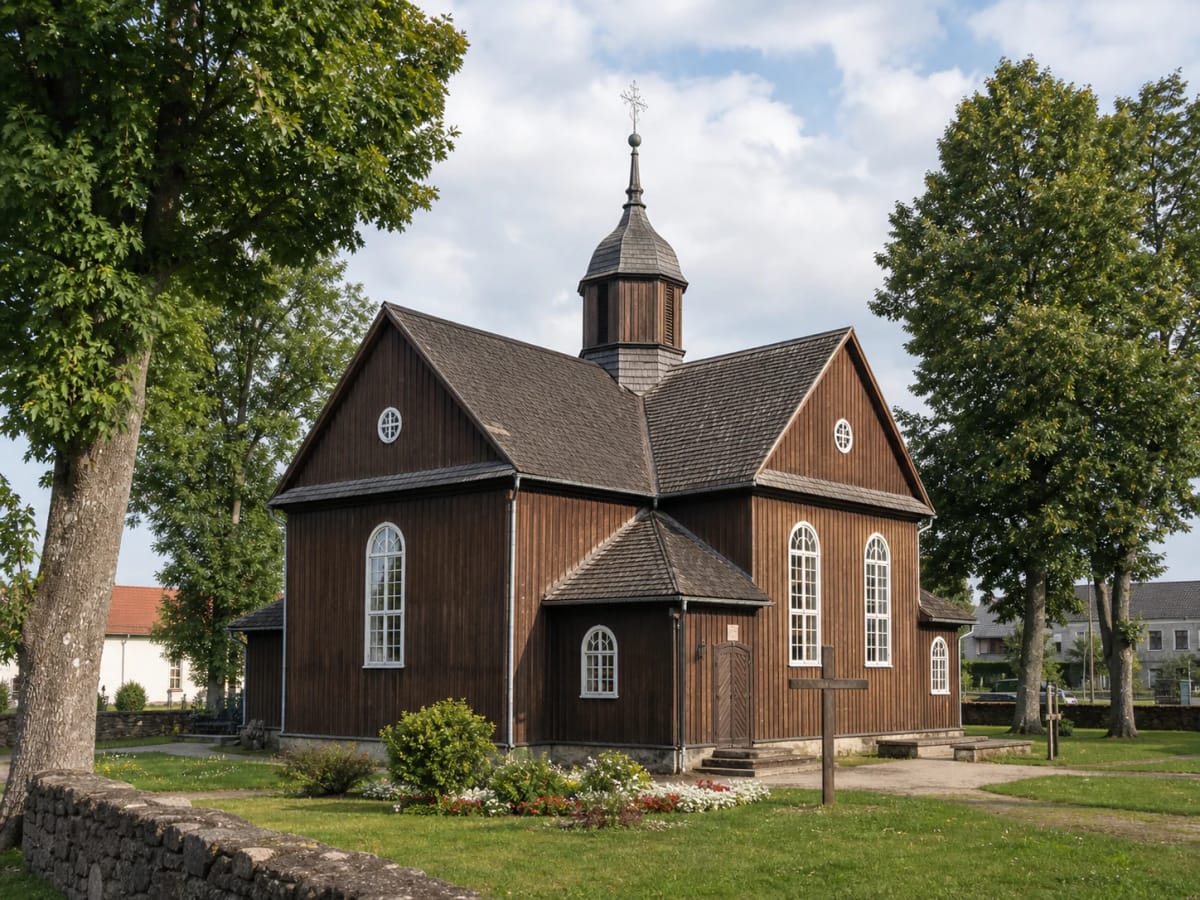
- wooden Catholic church with five altars
- Address
- S. Dariaus ir S. Girėno g. 3, Žemaičių Naumiestis, Šilutė District
- Coordinates
- 55.35993, 21.70625
Žemaičių Naumiestis Roman Catholic Church of St Michael the Archangel, Žemaičių Naumiestis St Michael the Archangel Parish Church
Wooden church in the town centre
Žemaičių Naumiestis Church of St Michael the Archangel is one of the town's main sacred places. It stands on S. Dariaus ir S. Girėno Street, close to the centre, so it is easy to include in a short walk through Žemaičių Naumiestis.
The Telšiai Diocese page describes the church as a wooden, cross-plan sanctuary with a small turret at the roof intersection. Inside, it mentions a structure of five altars and a pulpit, giving a restrained but rich interior.
1782 or 1790? A question of dating
The dating of this church needs care. The official Telšiai Diocese page states that the church was built in 1790. The Šilutė District Municipality page and the VLE article on Žemaičių Naumiestis, however, give 1782, and VLE's architecture section places the building in the second half of the eighteenth century.
The safest wording is therefore to describe it as a late-eighteenth-century wooden church and to note the difference between sources. This is not a trivial detail: date differences are common in wooden heritage, where construction, consecration, rebuilding, or a source record may be confused.
Inside the church and its art
According to VLE, the church holds a nineteenth-century painting of St Martinian and an early-twentieth-century sculpture of the Crucified; the chapel has an early-nineteenth-century altarpiece with reliefs of Mary and the Nazarene, and early-twentieth-century sculptures of Christ at the Pillar and the Crucified.
The towers (second half of the eighteenth century) carry two ornamented nineteenth-century crosses, and an 1890 chapel-post stands in the churchyard. If the church is open, do not rush: in a wooden sanctuary, proportions, light, altar arrangement, and the order kept by the local community all carry the experience.
A border town of three communities
Žemaičių Naumiestis is also interesting as a town shaped by three communities. It lay right on the border of the Russian Empire and Germany (Prussia), with a border customs house, a goods warehouse, and dozens of shops and taverns. VLE records that a Catholic church was built in 1782, an Evangelical Lutheran church in 1842, and a synagogue in 1816.
This coexistence of Catholics, Lutherans, and Jews also explains the name: 'Žemaičių' (Samogitian) Naumiestis stresses the Samogitian, Russian-Empire side facing Prussian Lithuania across the border. The town's Lutheran and literary memory is recalled today by a 2007 chapel-post to Martynas Mažvydas and the first Lithuanian book (sculptor V. Bliūdžius), and by the Samogitian Ethnoculture Centre.
Services and visiting
At the time of research, the Telšiai Diocese page listed Sunday Mass at 12:00, weekday Mass at 18:00 in summer and 17:00 in winter, and Saturday Mass at 18:00. The titular feast of St Michael the Archangel is celebrated on September 29 (Mykolinės). Check the official page before travelling, because service times can change.
The church is not a museum, so visit respectfully: do not disturb services, do not photograph people without consent, and if the doors are closed, view the architecture and the churchyard chapel-post from outside.
In a Pamarys and Samogitia route
Žemaičių Naumiestis connects conveniently with Šilutė, Rusnė, and Nemunas Delta routes. The church can be a short but meaningful stop, showing that Šilutė District heritage is not only manors, Lutheran churches, and delta landscapes.
If wooden churches interest you, compare this place with other wooden sanctuaries in Samogitia, such as those in Veiviržėnai or Švėkšna. Then the date is only one part of the story: regional scale, town setting, and local community care become just as visible.