- Place
- Plokščiai Eldership, Šakiai District Municipality
- Region
- Suvalkija
- Type
- a low-flow contact spring in a wooded Didžiupis valley ravine, with a grotto begun in the nineteenth century and rebuilt in fieldstone in 1927-1928
- Address
- Didžiupis valley, Plokščiai, LT-71483 Šakiai District Municipality
- Coordinates
- 55.07412, 23.17652
- Visit duration
- 30-60 minutes for the descent and spring site; 1.5-2 hours for the full Plokščiai Nature Trail of approximately 3.3 km
- Best time
- a dry day in daylight from spring to autumn; stone steps and the shaded ravine can be slippery after rain, and religious services call for quiet, respectful visiting
Šventaduobė, Šventduobė, Plokščiai Spring, Holy Hollow, Holy Hollow well
The 4.6 Google listing marks Šventaduobė itself in the Didžiupis valley
The exact Google Maps listing Plokščių lurdas, place ID ChIJUyqYb3OV5kYR8Wpshoi9ECs, marks the site at 55.0741198, 23.1765233. On 15 July 2026, it averaged 4.6 out of 5 from 104 reviews. This is a clearly identified listing for the grotto, although both its score and review total will change over time.
The Lithuanian Geological Survey locates the spring in Plokščiai Eldership, in a gully of the Didžiupis stream valley roughly 250 m south-east of the corner of Bažnyčios Street. Its LKS coordinates 447379, 6104563 identify the spring, whereas the Saugoma.lt point at 55.079, 23.172 represents the wider Plokščiai Nature Trail. This page therefore maps the exact Google point for the grotto rather than the centre of the whole route.
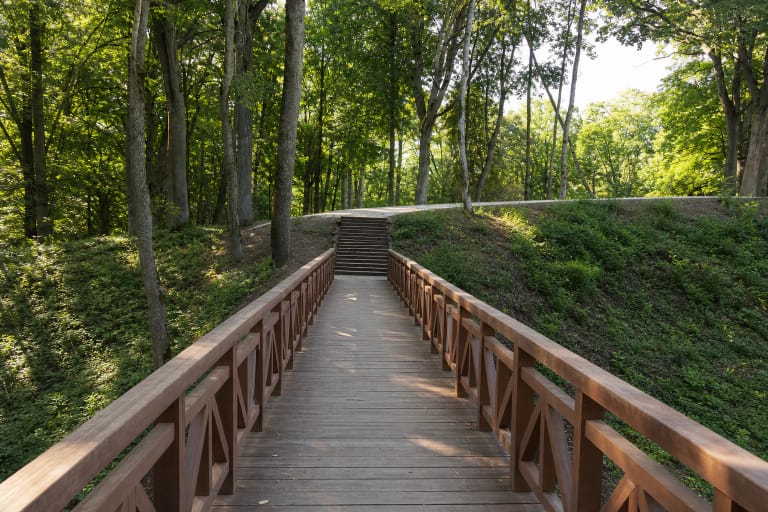
A path decorated with wooden sculptures by Zigmas Sederevičius leads down from the street. The Geological Survey describes deciduous woodland and steps made from broken stone on the descent to the spring. It is a short but distinct change in height, so walk slowly and wear shoes with grip after rain or when wet leaves cover the path.
Geologists classify it as a low-flow descending contact spring
The Geological Survey classifies Plokščiai Spring as a descending contact spring. Groundwater emerges on the slope where layers with different permeability meet and then runs down into the ravine. The official account calls its flow low and its regime unknown. It therefore does not promise the same discharge in every season.
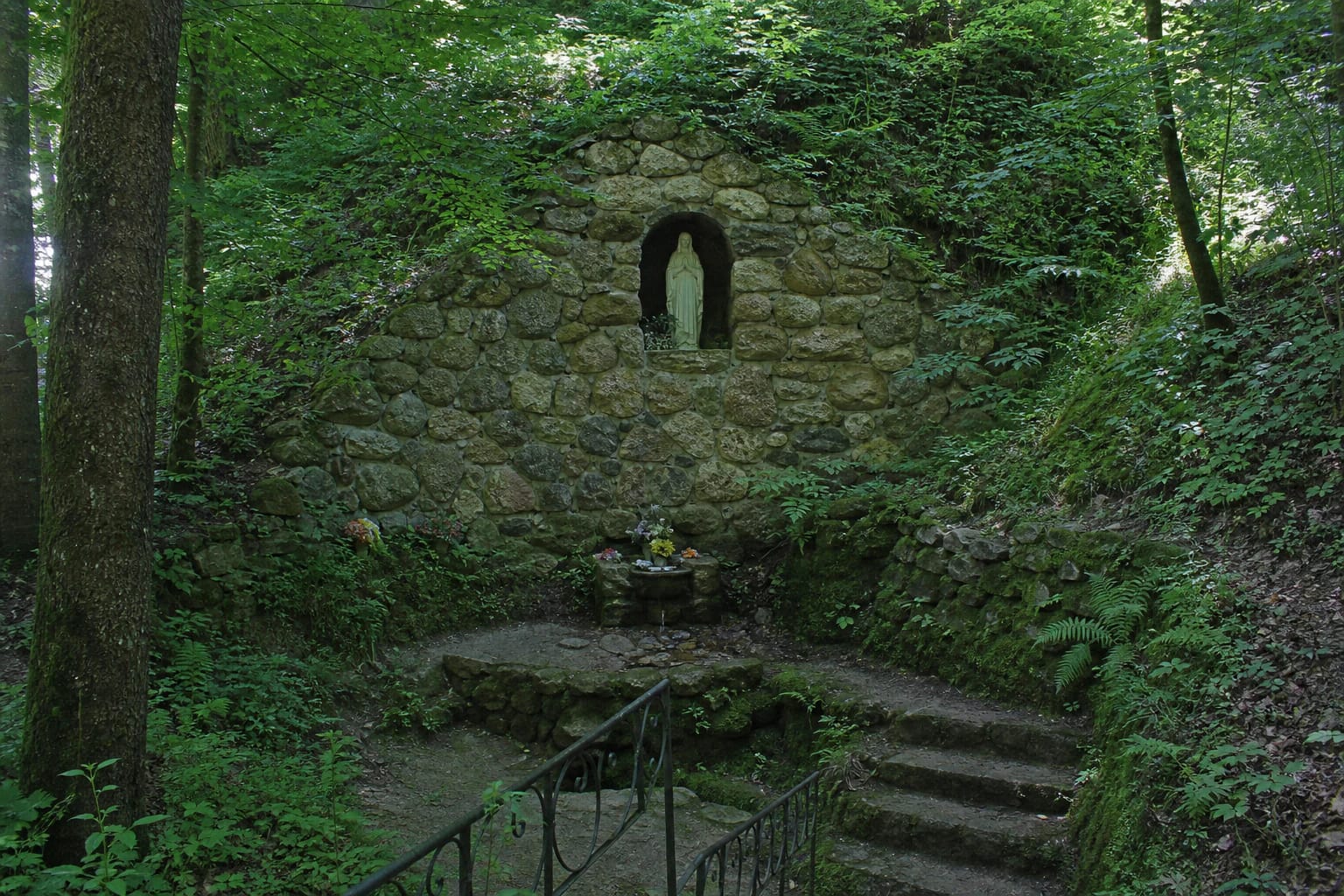
The spring capture is described in modest terms: a small well built from fieldstones. It collects the emerging water but is not a mains-fed drinking fountain or a controlled public tap. The stone grotto wall and religious niche are the cultural layer, while the actual groundwater outflow is the natural feature.
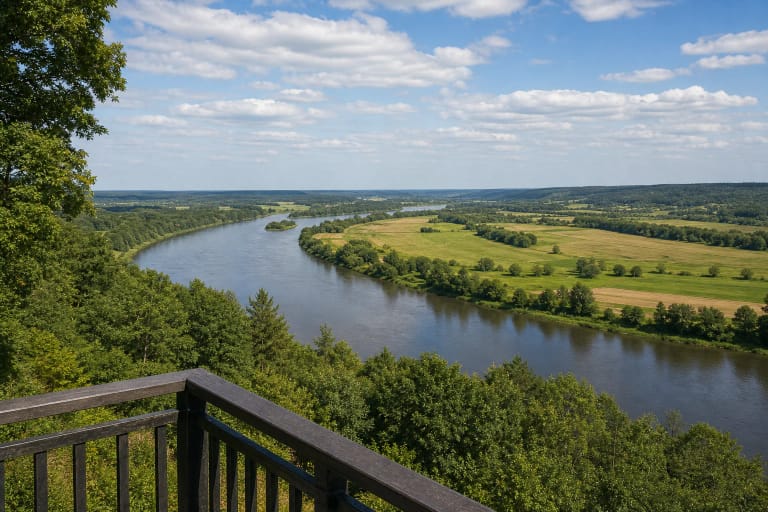
The Panemuniai Regional Park account includes the Didžiupis and Vaiguva valleys with Šventduobė Spring in the protected lower-Nemunas landscape. Conservation therefore concerns more than the small well. The spring-fed gully, eroded slope, deciduous setting, and their relationship to the wider left-bank terrain all matter.
The 2014 water analysis is a useful snapshot, not a permanent guarantee of safe drinking water
During the 2014 field assessment, the water was clear, tasteless, and odourless. Its temperature was 12.2 °C, pH 7.19, and dissolved oxygen 8.28 mg/l. The laboratory table gives pH 7.61 at 20 °C. These pH figures should not be merged: one belongs to the field description and the other to stated laboratory conditions.
The water was calcium-magnesium bicarbonate in type. Dissolved minerals totalled 471 mg/l, overall hardness was 5.37 meq/l, and iron measured 0.05 mg/l. Neither nitrite nor ammonium was detected, but the Geological Survey singled out an elevated nitrate value of 11.98 mg/l. Most hardness was carbonate hardness and could readily be reduced by boiling.
Saugoma.lt says visitors can taste the spring water, but one chemical sample from 2014 does not answer every safety question in 2026. The source provides no recent microbiological analysis, continuous monitoring record, or assurance after heavy rain. Young children, pregnant visitors, medically vulnerable people, and anyone uncertain should carry trusted drinking water. No healing property has been demonstrated by the laboratory data.
Fieldstone replaced a decayed nineteenth-century wooden chapel in 1927-1928
The Geological Survey's historical notes say the first altar and chapel at Šventaduobė were wooden and built in the nineteenth century. They soon decayed. Around 1927-1928, a Plokščiai farmer identified as P. Rimkus oversaw the site's renewal with a fieldstone altar and wall. The grotto seen today therefore belongs to an interwar rebuilding, not the Middle Ages.
An arched niche for a statue of Mary is formed in the stone wall, with a modest enclosed space in front and the spring well lower in the ravine. The masonry is embedded in the slope rather than enclosed as a chapel building. Visitors should not expect a museum interior or a full-scale architectural replica of Lourdes in France.
The official geological account records that Mass is held here during the Porziuncola indulgence. Dates and arrangements can change, so anyone intending to attend should consult current parish or municipal notices. During a service, keep the path clear, do not photograph people without consent, and never treat the altar as a picnic surface.
Three recorded legends are not proof that the spring water heals
One legend in the Geological Survey account tells of an image of Mary that supposedly floated down the Nemunas, was carried to the church, then repeatedly vanished and reappeared beside the spring. People are said to have responded by building a chapel and altar at the spot. Another version also centres on an image returning to the water but differs in its details.
A second legend connects the name Holy Hollow with a deeply hurt girl who came to cry in the ravine and saw Mary, who comforted her. In that story, the water is miraculous and can even make someone ten years younger. This is an unmistakable folklore motif, not medical advice or a measured effect of the spring.
Documented and oral history enrich one another here only when they remain distinct. The nineteenth-century wooden chapel, the fieldstone work of 1927-1928, and the 2014 water analysis are dated in the sources. The travelling image, apparition, and healing powers are presented as legends and local beliefs.
Šventaduobė is a stop on a 3.3 km trail, but a 24-hour map label does not mean lighting
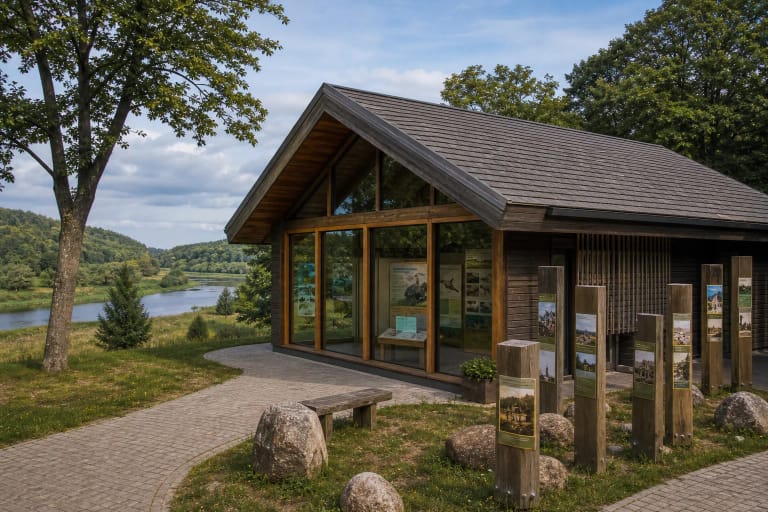
Saugoma.lt gives the Plokščiai Nature Trail a length of about 3.3 km. It connects the Vaiguva stream-street, whose water runs along the middle of a road for more than half a kilometre, Plokščiai-Vaiguviškiai Hillfort, Šventaduobė Spring, Plokščiai church, and a memorial complex. Allow 1.5-2 hours for the circuit or 30-60 minutes for the grotto and descent alone.
On 15 July 2026, Google displayed 24-hour access. The official object pages publish no separate admission charge, ticket office, or gate schedule. That does not mean the route is lit, attended all night, or cleared in winter. Ravine steps, roots, and moisture are safest in daylight, while religious events can alter the usual pattern of a visit.
The authoritative sources checked do not confirm a step-free descent or a formal car park beside the Google marker. Stone steps and the natural gradient may prevent access with a wheelchair or pushchair. Park only where permitted in the village, keep Bažnyčios Street clear, do not climb the grotto masonry, and take away every candle container or other item you bring into the ravine.