- Place
- Stakai, Poškonys Eldership, Šalčininkai District Municipality
- Region
- Dieveniškės Historical Regional Park
- Type
- state-protected pedunculate oak and botanical natural heritage site
- Address
- Stakai Forest, about 1 km south-east of Stakai village
- Coordinates
- 54.29014, 25.55326
- Visit duration
- 20-40 minutes; about 1-2 hours when combined with the Stakai conglomerate blocks
- Best time
- May to October in dry weather; the crown structure is clearer as the leaves thin in autumn
Stakų ąžuolas, Millennium Oak of Stakai
A massive trunk beneath a low-starting crown
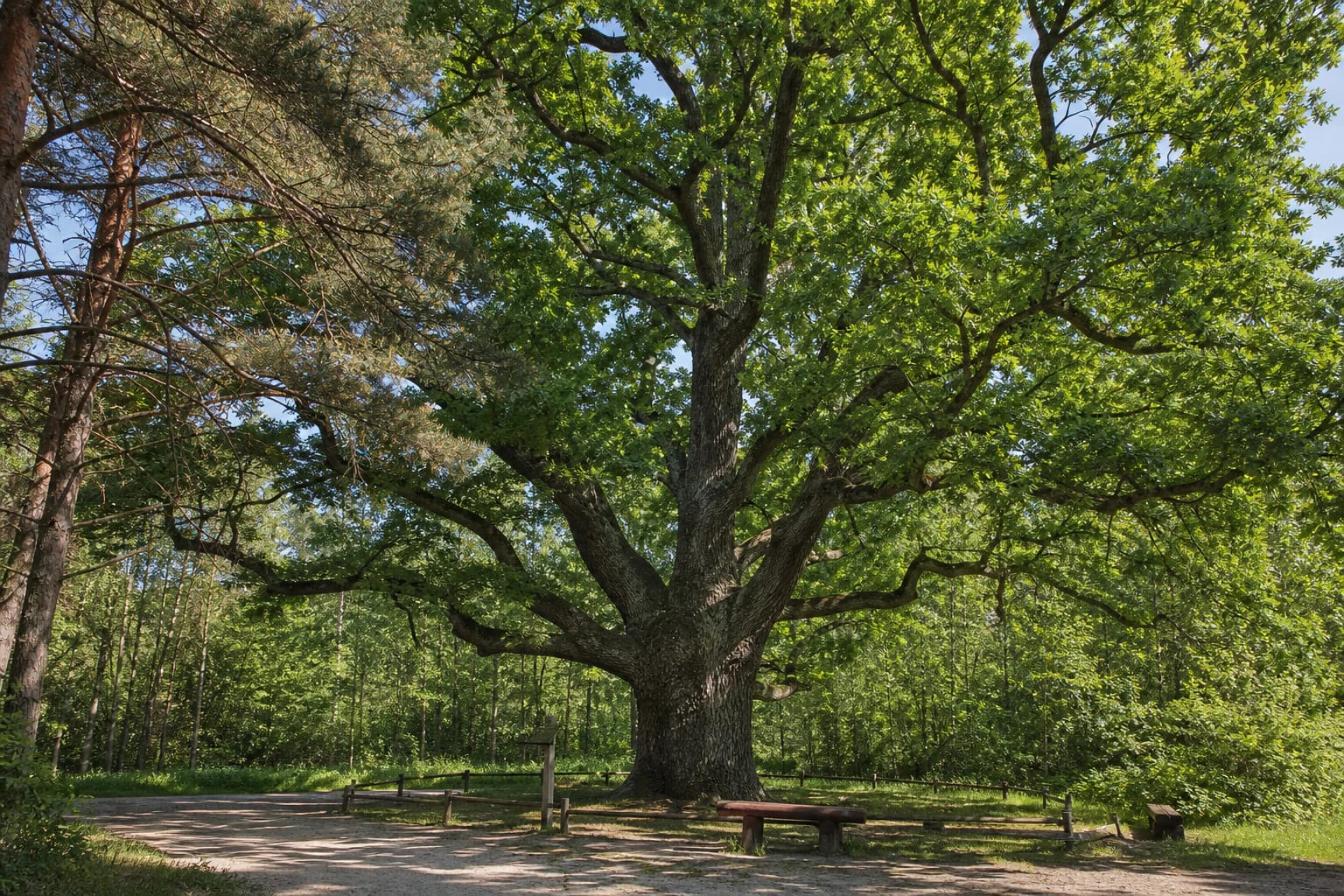
Stakai Oak is a pedunculate oak, Quercus robur. VLE gives a trunk circumference of 4.90 metres measured 1.3 metres above ground, a diameter of roughly 1.6 metres, and a height of about 24 metres. These figures make most sense from the edge of the clearing, where the full trunk-and-crown silhouette replaces the close-up scale of bark.
Its dense, roughly 21-metre-high crown starts low and spreads into a broad conical form. Thick, sometimes mossy limbs reach almost horizontally, making the tree look as wide and powerful as it is tall. Summer foliage hides part of that structure, while early spring and late autumn reveal the old branch network more clearly.
What the estimated thousand-year age means
VLE, Saugoma.lt, and the park directorate describe the oak as approximately 1,000 years old. This is not a known planting date. The public official descriptions do not cite a complete tree-ring or dendrochronological study, so the number should be treated as an expert and inventory-based age estimate.
Dimensions can also vary slightly between sources produced in different years: the trunk continues to expand, and height or circumference depends on the measuring method and exact point chosen. The responsible response is to protect a living, ageing organism, not to test its age by entering hollows or breaking dead branches.
Protection within the Stakai Landscape Reserve
The oak grows at the edge of Stakai Forest in the Stakai Landscape Reserve, part of Dieveniškės Historical Regional Park, about one kilometre south-east of the village. It has been protected as a state-level botanical natural heritage site since 2002.
Protection extends beyond the visible trunk. Soil over the root system, moisture, open crown space, and the surrounding forest edge all support the tree's health. Stay outside the protective boundary, never cut or mark the bark, hang nothing from the limbs, and do not drive towards the trunk even when the ground looks firm.
Finding the site and accessibility
Direction signs lead from regional road 104, the Šalčininkai-Dieveniškės-Krakūnai route, towards the oak. The Google Maps pin marks the tree itself rather than the nearest turn. The final approach uses a forest road, so drive carefully after prolonged rain and never block access.
Saugoma.lt says the oak can be viewed from the parking area without leaving a vehicle. Reaching the closer viewing point involves about 50 metres of sandy and gravelly forest-road surface, where a visitor with limited mobility may need assistance. The official listing gives neither a separate admission fee nor gate-closing hours.
Conglomerate blocks and the current visitor rating
About 150 metres north of the oak lie the Stakai conglomerate blocks, two bodies of cemented sand and gravel. This short link brings two very different forms of natural heritage into one stop: a living ancient tree and a geological formation.
The route can continue to Poškonys, Bėčionys Hillfort, or the park visitor centre. On 27 July 2026 the exact Google Maps listing showed a rating of 4.8 out of 5; the publicly indexed listing record showed 143 reviews. Ratings and review totals change.