- Place
- Kalesninkai, Šalčininkai District Municipality
- Region
- Vilnius Region
- Type
- red-brick Catholic church blending Romanesque and Gothic Revival forms
- Address
- 17 John Paul II Street, Kalesninkai, Šalčininkai District Municipality
- Coordinates
- 54.19165, 24.84374
- Visit duration
- 35-60 minutes
- Best time
- Sunday between 09:20 and 13:00, when the official listing says the church is open, or a bright afternoon for the towers
Kalesninkai Church, Church of the Immaculate Conception in Kalesninkai
Red-brick towers above the Eišiškės-Varėna road
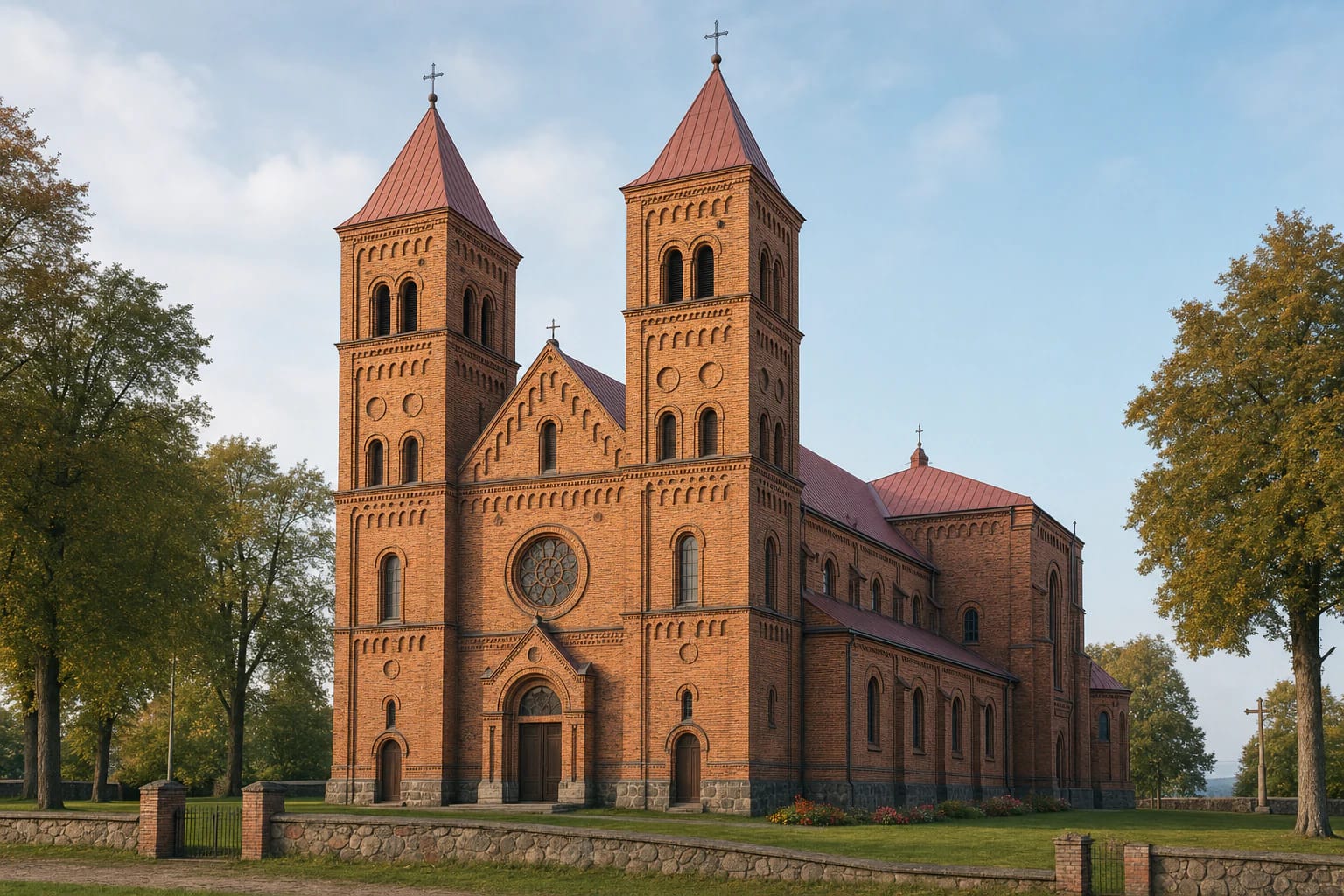
Kalesninkai church rises above the small village like a landmark. Two tall square towers end in steep pyramidal roofs of red metal and slender crosses. Round-headed windows, narrow blind openings, stepped cornices, and rows of miniature arches articulate the exposed red and russet brick. A grey base of dressed stone gives visual weight to the already massive lower walls.
A steep gable occupies the space between the towers, with a large circular window and three entrances below. Walking around the building reveals a cruciform plan, lower side aisles, the transept, long rows of arched windows, and a semicircular apse. This is not pure Gothic Revival: the basilican structure and arcaded decoration are Romanesque Revival, while the vertical towers and steep roofs add a Gothic character.
The chapel, the Carmelites, and suppression of the parish in 1831
The Catholic history of Kalesninkai reaches back to 1643, when the landowner Samuelis Kuncevičius built a chapel. In 1676 Konstantinas Kuncevičius granted the Kalesninkai estate to the Carmelites; a monastery and school operated here. A church was built in 1703 and the parish was established in 1707.
After the 1831 uprising, the imperial Russian authorities closed the church and monastery, abolished the parish, and attached its territory to Eišiškės. In 1838 the timber church was dismantled and moved to Radun in present-day Belarus; its organ, bells, and registers were dispersed to other places. Kalesninkai remained without a parish church for almost seven decades.
The 1905 foundation stone and a long construction campaign
Permission for a new Catholic church was secured early in the twentieth century, and the former monastery grounds were selected as the building site. A VDU archival study records that twenty-two Kalesninkai residents donated land for the church and parish buildings, amounting to nineteen hectares, while Petras Sedleckis became the principal benefactor. Bishop Eduard von der Ropp blessed the foundation stone on 11 July 1905.
Architect Mykolas Dubovikas designed the building, Antonijus Adamas Filipovičius-Dubovikas directed construction, and Father Mykolas Rudis gathered the restored parish. Work extended through war and several changes of political authority. On 11 November 1922 Father Janas Kuzminskis celebrated the first Mass in the newly built but still unfinished church.
A basilican interior, the project's scale, and memory in the churchyard
Inside, the church is a three-aisled basilica. Piers separate the higher central nave from the side aisles, vaults cover the spaces, and a semicircular apse closes the presbytery. The historic project dimensions in the VDU study reveal the ambition: an interior 39 metres long and 21 metres wide, rising 13.5 metres from the floor to the vault. These are project figures, not a modern laser survey.
The first priest of the restored parish, Mykolas Rudis, principal donor Petras Sedleckis, and organist Mykolas Čoblis are buried in the churchyard. Two crosses stand nearby. In the village square, a 2.5-metre statue of Pope John Paul II by the Polish sculptor Andrzej Szafraniec was unveiled in 2010.
Opening times, Mass, and respectful visiting
On 27 July 2026 the Archdiocese of Vilnius listed the church as open on weekdays forty minutes before the 18:00 Mass from April through October, and forty minutes before the 12:00 Mass from November through March. Sunday opening was listed from 09:20 to 13:00, with Mass at 10:00 in Lithuanian and 12:00 in Polish.
The official page did not list a separate visitor ticket. Recheck the schedule before travelling, do not roam the aisles during worship, and ask before taking photographs. On 27 July 2026 the Google Maps listing showed 4.8 out of 5 from 93 reviews; both figures change over time.