- Place
- Aukštadvaris, Trakai District Municipality
- Region
- Trakai District
- Type
- active historicist and Neo-Gothic wooden Catholic church
- Address
- Pušyno g. 2A, Aukštadvaris, 21254 Trakai District Municipality
- Coordinates
- 54.57821, 24.53444
- Visit duration
- 30-60 minutes for the facade, churchyard, and a quiet interior visit if it is open
- Best time
- during daylight and outside Mass, when the white wooden exterior is easiest to see
Aukštadvaris Church, Aukštadvaris Roman Catholic Church of the Transfiguration of Christ
Aukštadvaris Church: address and exterior
Aukštadvaris Church of the Transfiguration of Christ stands in Aukštadvaris, Trakai District, at Pušyno g. 2A, 21254. The coordinates 54.5782084, 24.5344375 mark the church building itself.
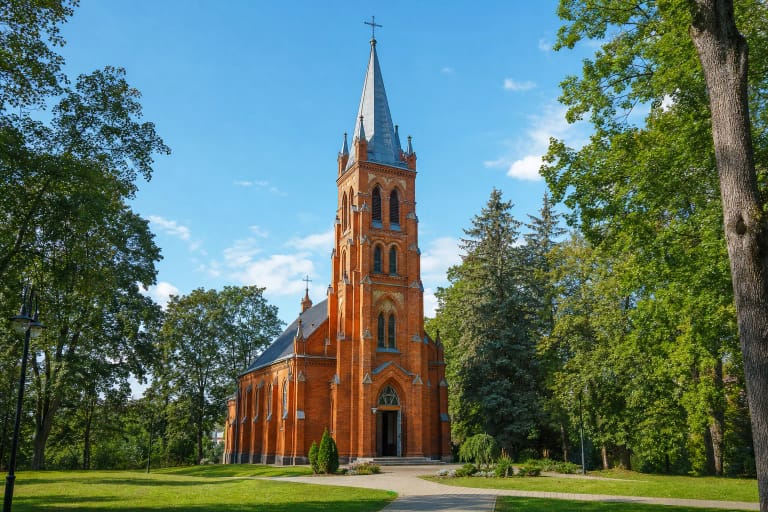
The church is recognisable from a distance by its white-painted wooden volume and two tall pointed towers. In front are a simple lawn, low fence, central facade, and three entrance openings. Use the current Pušyno g. 2A address, because older tourism descriptions may contain outdated information.
White wooden historicist and Neo-Gothic architecture
The current church is a wooden 1913 building combining a historicist composition with Neo-Gothic elements. Symmetrical towers end in pale pyramidal roofs and crosses, while pointed-arch windows, decorative trim, and circular sun motifs animate the facade.
The parish description calls it a two-tower church with a three-sided apse, three naves, and four altars. It was designed by A. Filipovičius-Dubovikas, while construction was supervised by engineer Bronislovas Malevskis and priest Konstantinas Gruzdys. From outside, look at the rhythm of the wooden boards, tower proportions, and central-window decoration.
Layers of Aukštadvaris parish history
The Catholic history of Aukštadvaris predates the present church. VLE records a first church here in 1518, followed by a Dominican church and monastery founded in 1629. The monastery was closed in 1832, and the church was converted into an Orthodox church in 1866. These events belong to the wider town history rather than only to today's wooden building.
The new church was built in 1913, and the Catholic parish was restored in 1919 after earlier restrictions. The parish account says three bells were taken away during the First World War and the roof was damaged during the Second World War, after which the building was restored. Keep these periods distinct from the active community that worships here today.
An altar, relic, and organ heritage
Inside, the 1913 space meets religious art from earlier periods. Descriptions mention a 1913 Transfiguration altarpiece by Stanislaw Gobiata, an eighteenth-century relic, and a 1934 organ by Jurgis Astrauskas. Seeing them depends on whether the interior is open and whether liturgy is taking place.
A visitor is a guest in an active parish. Ask before photographing inside, silence your phone, and do not enter the altar area. Do not touch works of art, and stop walking or taking photographs during Mass. For a special look at the art heritage or organ, arrange it with the parish.
How to visit Aukštadvaris Church
The church has no museum admission ticket, but published Mass times can change. The church-map information lists Sunday Mass at 11:00 and weekday Mass at 10:00; check parish news or contact the parish before travelling. A visitor should arrive before services or arrange another time.
Allow 30-60 minutes, depending on whether you see only the facade and churchyard or can look quietly inside. The lawn can be wet after rain, and parish events can change access. The church combines naturally with Aukštadvaris Regional Park, the hillfort, and other places in and around the town.