- Place
- Akmenė District Municipality
- Region
- Samogitia
- Type
- large public pinewood park incorporating the Dabikinė valley, a former sand quarry, pond shore, sculptures, and a stone-built outdoor amphitheatre
- Address
- Kadagiai village, Akmenė Eldership, Akmenė District
- Coordinates
- 56.24353, 22.72465
- Visit duration
- 1.5-2 hours for the stone amphitheatre, sculptures, pinewood, and waterside landscapes; longer for an event or a broader circuit
- Best time
- a dry day from late spring to autumn; check access before major festivals or while the 2025-2026 infrastructure work remains in progress
Akmenė Nature Park, Akmenė Culture Park, Akmenė Town Pinewood, Akmenė Stone Amphitheatre
A large pinewood park, not merely a stone stage
Akmenė Nature and Culture Park spreads through Kadagiai village immediately outside Akmenė, along the Dabikinė. Akmenė Eldership gives its area as 66.95 hectares, so the official map point at 56.243530, 22.724650 is only a representative location within a large landscape. It is not a surveyed main gate, a guaranteed car park, or the start of every path. Follow current signs for the approach and entrance, especially while infrastructure work is under way.
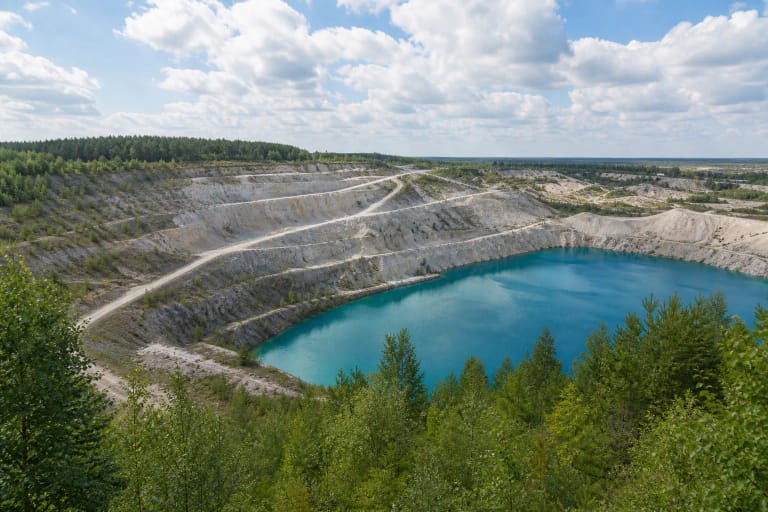
Official descriptions identify four distinct components: the pinewood, the Dabikinė valley, a former sand quarry, and the shore of a pond. The walk consequently changes character. Tall pines and open event clearings dominate one area, while elsewhere the ground descends towards water or retains the shape of earlier quarrying. A quick look at the amphitheatre does not convey the park's full scale.
As of 20 July 2026, official sources did not publish the length of one definitive marked circuit or promise a uniform surface across every route. Allow 1.5-2 hours for a first visit, choose paths suited to their condition, and do not feel obliged to cover all 66.95 hectares. Woodland surfaces after rain, valley slopes, and diversions around building work can all lengthen a walk.
Pines planted in 1958-1960 became the foundation of a park created in 2002
The woodland is not simply a remnant of an untouched ancient forest. Akmenė District Municipality records that residents planted thousands of young pines here in collective work campaigns between 1958 and 1960. Over the following decades, those saplings matured into the wooded framework for a recreation area. The park therefore begins with shared civic labour rather than the vision of a single estate owner or landscape architect.
The Nature and Culture Park was formally created in 2002. Both halves of the name matter: nature denotes the pinewood, river valley, and waterside landscapes, while culture encompasses sculptures, the open-air amphitheatre, and community events. Reliable public sources do not provide a complete catalogue naming every artist, work, and date, so this guide does not assign unsupported authorship to individual sculptures.
The former sand quarry records another transformation. Human-altered terrain was absorbed into a recreational landscape instead of being hidden beneath a perfectly level urban garden. The airfield and autocross track beside the park continue that tradition of active use, but they are separate facilities with their own event and safety controls.
The stone amphitheatre and woodland sculpture give the park its identity
The park's most recognisable cultural feature is its outdoor amphitheatre. Official photographs show semicircular rows of timber benches facing a stage wall and steps assembled from large, varied boulders. Rustic towers shaped around tree-like timber supports carry small shingled roofs, while a taller stone pyramid forms another focal point. These materials connect the performance space to the pinewood instead of imitating an enclosed concert hall.
Stone and timber sculptures are dispersed through the woodland rather than displayed as a uniform museum collection. Some forms emerge from large boulders; others are carved from wood or placed beside paths and seating. Look at how material, scale, and setting interact. Do not climb the sculptures, stone walls, or stage towers simply because they lack a physical barrier.
The amphitheatre remains in use, so its appearance and availability vary with maintenance and events. Temporary stages, sound equipment, stalls, or fenced areas may appear before a festival, and cleaning may continue afterwards. Visit outside major performance hours to study the stone structure quietly, or consult the official Culture Centre calendar if you want to experience it as a community venue.
The Dabikinė valley, pond, and quarry terrain reward a slower walk
The Dabikinė gives the park a natural axis, but official sources do not describe this site as one continuous, fully engineered riverside nature trail. Do not assume that every section will have decking, distance posts, guardrails, or the same width. Stay on clear paths near the water, avoid trampling soft banks, and do not cut through wet low ground for a shorter route.
The pond shore and former sand quarry diversify the scenery while introducing slopes, uneven ground, and exposed clearings. Earth and sandy surfaces may become slippery after rain. In summer, prepare for ticks and take woodland fire precautions. Light fires only where a clearly designated facility is open, leave no glass or cigarette ends, and obey seasonal restrictions.
The word nature in the name does not place the entire park under strict nature-reserve rules. This is a public recreation and event landscape. Kamanos State Strict Nature Reserve is a separate Akmenė District destination with far tighter access. Both may fit into one day's itinerary only after checking the Kamanos visitor arrangements, but their rules should never be confused.
Akmenės smuikelis proves that culture here is more than decoration
The amphitheatre and surrounding clearings host district celebrations. Akmenė District Municipality Culture Centre records that the traditional Akmenės smuikelis festival took place in the park on 6 June 2026, with a community run, market, children's programme, educational activity, performances by local groups and guests from Latvia, and evening concerts. That is a documented example of current use, not a promise of an equivalent programme every weekend.
On an event day, the park may be busier, louder, and less suitable for a quiet woodland walk. Traffic circulation, parking, path capacity, and access to the amphitheatre may change. Yet a festival also reveals the stone stage performing its intended civic role. Decide which experience you want and use the organiser's current programme rather than an old listing.
The municipality also mentions an adjacent airfield, aviation festivals, and autocross races in the former sand quarry. An aircraft above the trees or engine noise does not necessarily mean unauthorised activity inside the recreation area. Conversely, visibility from the park is not permission to enter the airfield, track, paddock, or other technical zones.
A 2025-2026 project promises more amenities, but work is not yet complete
The official 2021-2027 EU investment portal lists project No. 26-312-P-0001 as under implementation. Its contract took effect on 15 December 2025, with activities scheduled to end on 30 November 2026. The municipality gives a total value of €347,754, including €295,590.90 from EU funds. Because this guide was checked on 20 July 2026, every proposed element cannot be described as operational.
Plans include renewed lighting for the park hill and approach, paths, a campsite with parking, water and wastewater connections, a viewpoint, children's attractions, shelters, information boards, toilets, visitor counters, benches, bicycle stands, fire sites, and other small-scale facilities. Treat this as a programme to be verified after completion, not a guaranteed inventory of services available today.
The official attraction page publishes neither fixed park hours nor a general admission ticket, so the pinewood is normally approached as an open public space. A particular concert or service may charge admission. Obey barriers and never enter a work zone. If you require a confirmed step-free route, working toilet, legal campsite, or specific parking place, contact Akmenė Eldership or the event organiser before travelling.