- Place
- Palanga City Municipality
- Region
- Palanga
- Type
- Neo-Gothic Catholic church and architectural landmark of central Palanga
- Address
- Vytauto g. 51, Palanga
- Coordinates
- 55.91763, 21.06584
Palanga Church, Palanga Parish Church
Neo-Gothic landmark of central Palanga
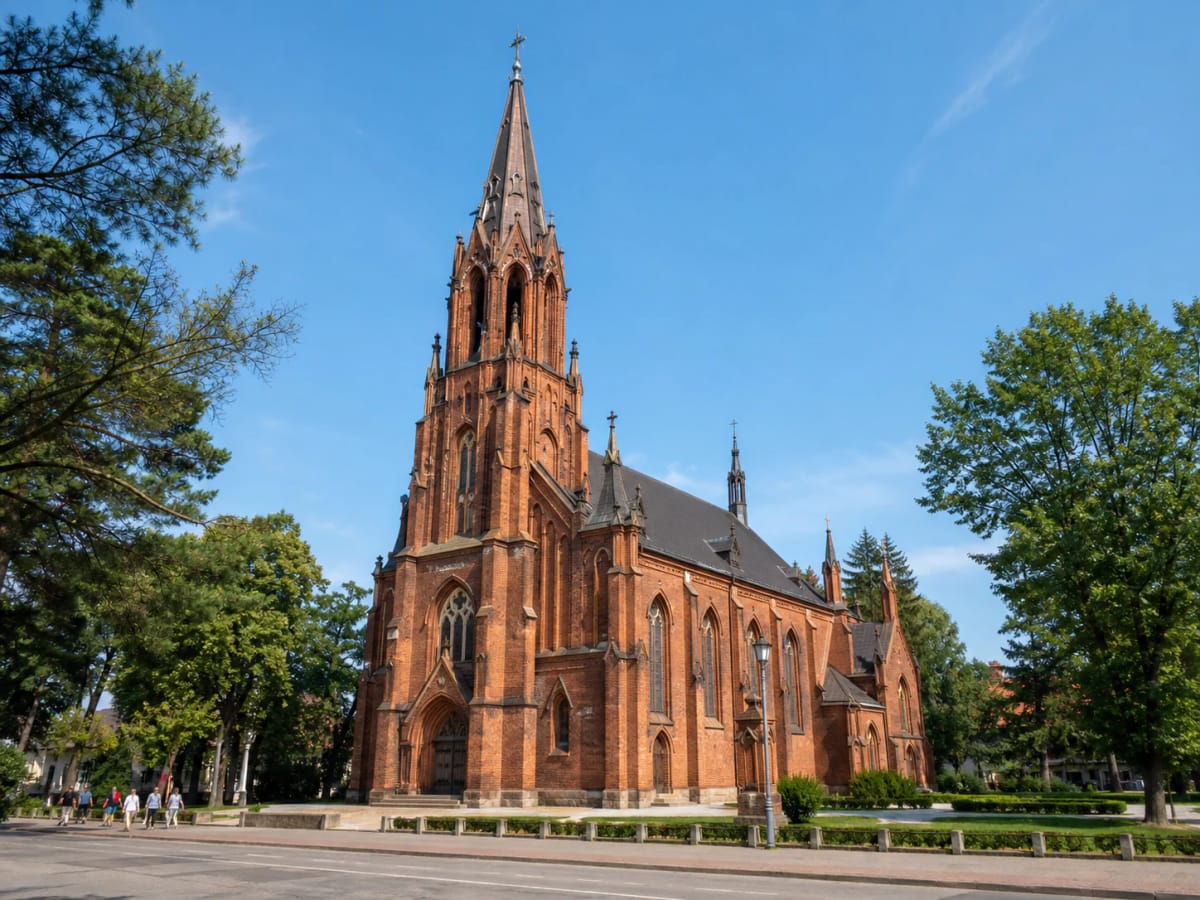
Palanga Church of the Assumption of the Blessed Virgin Mary stands on Vytauto Street and is one of the clearest orientation points in the town centre. Its red-brick Neo-Gothic volume, pointed windows, a tower supported on all four sides by stepped buttresses, and a spire about 24 m tall stand out among resort trees, villas, and pedestrian routes.
In the Register of Cultural Property the church is protected as a valuable object (code 1294). It matters beyond worship: it marks the period when Palanga was becoming a modern resort in the late nineteenth and early twentieth centuries, and when a growing parish needed a larger, more representative sanctuary.
From a wooden church to the present sanctuary
The official parish history says the first Palanga church was built through the care of Anna Jagiellon in 1554 or 1590, and that a new wooden church rose in 1767. The construction of the present masonry church at the end of the nineteenth century was initiated by the priest, later canon, Juozapas Šniukšta.
The design was prepared by the Liepāja-born Swedish architect Karl Eduard Strandmann, who also designed other Neo-Gothic churches in Lithuania. Construction began in 1896, the cornerstone was blessed on 22 August 1899, the walls and tower were built in 1901-1905, and the church was consecrated on 12 October 1906; the fence and gates were completed in 1911.
Brick, stone, and Tiškevičiai support
The parish history records that about one-third of the construction costs were covered by Count Feliksas Tiškevičius, who also supplied timber, while the rest came from parishioners rallied by canon J. Šniukšta. Stones raised from the sea were used for the foundations and transported across the sand on a wooden road.
Bricks were fired in a special brickyard built at Vilimiškė, and some were brought from the Klaipėda Region. The official history mentions more than 20 different brick profiles, so the building is worth looking at up close - its Neo-Gothic effect comes not only from the silhouette but also from material craft.
The Neo-Gothic space and interior
The church is a basilica with a Latin-cross plan, three naves, and a five-sided apse. Inside, several eras overlap: Baroque altars from the old wooden church at the ends of the transept, early twentieth-century marble furnishings, stained glass, and later restored elements.
In 1907, white-marble side altars, the presbytery balustrade, and the pulpit were installed, made in the J. Monna workshops in Toulouse. In 1914 the S. G. Żeleński workshop in Kraków created the stained-glass windows "The Annunciation," "Kneeling Mary," and "The Visitation"; the floor was laid with terracotta by the Marivill firm, and in 1976-1978 the craftsman E. Alekna built a 16-register organ.
Visiting with respect
This is an active parish church, so access depends on services, events, and parish arrangements. The official parish website publishes current information and schedules, so check it before making a special trip.
If you come outside Mass, daytime is best and the space should be treated as a church: do not disturb prayer, avoid photographing people up close, and silence devices. Architecture usually needs 20-45 minutes; for a broader route, combine the church with the Botanical Park, Birutė's Hill, the Amber Museum, and the pier.