- Place
- Akmenė, Akmenė District Municipality
- Region
- Samogitia
- Type
- municipal natural and regional-history museum with butterfly, fossil, ethnography, folk-art, philately, and archaeology displays
- Address
- 17 K. Kasakausko Street, Akmenė
- Coordinates
- 56.24506, 22.75177
Akmenės krašto muziejus, Akmenė District Museum, Akmenė Museum
The main museum is in the town of Akmenė, not in Naujoji Akmenė
The main exhibition of Akmenė Regional Museum is at 17 K. Kasakausko Street in Akmenė, centred on 56.2450645, 22.7517746. Select this exact listing in navigation: the district's administrative centre is Naujoji Akmenė, but the museum stands in the older town of Akmenė, approximately 12 km away. The symmetrical grey two-storey building is recognisable by its pale pilasters, the central group of arched windows, and the museum name above the facade.
LIMIS classifies it as a history and natural-history museum, with holdings organised into Natural History, History, Ethnography, Folk Art, and Fine Art departments. Alongside the butterfly and fossil rooms, permanent displays cover regional household life, folk art, postage stamps, and finds from the Papilė burial ground. Temporary exhibitions and activities add other subjects, but their programme changes.
The Simonas Daukantas Memorial Museum in Papilė and the Lazdynų Pelėda Memorial Museum in Paragiai are branches of the same institution, but they have different addresses, hours, and tickets. Dabikinė Manor and the E. and S. Adomaitis Picture Gallery also belong to the museum, so the shared website menu must not be mistaken for a single complex inside this building.
Boris Izenbekas assembled about 5,000 diurnal butterflies, with nearly 2,000 now on display
Boris Izenbekas began collecting butterflies in 1955. He caught them around Ukmergė and Akmenė and on journeys through Kazakhstan, Kyrgyzstan, Tajikistan, Armenia, Buryatia, and the Altai, while exchanging specimens by post with collectors and specialists in numerous countries. Approximately five decades of work produced a worldwide collection of about 5,000 diurnal butterflies.
The museum acquired the collection in 2007 and opened its permanent display on 12 June 2009. Zoologist Povilas Ivinskis described it as Lithuania's largest collection of diurnal butterflies, and nearly 2,000 specimens are now shown in the cases. Its value extends beyond colour: locality labels, differences between closely related forms, and examples of species now under strict protection also document a period in the history of collecting.
The live-butterfly house is a separate seasonal experience, not a year-round part of the permanent collection. The museum gives an approximate April-November season, while its 2026 education descriptions say April-October and explicitly note that live butterflies are seen only when stock is present. If the conservatory is the reason for travelling to Akmenė, telephone during the same week to confirm it is operating.
The Šaltiškiai specimens are phytosaur jaw elements and three teeth, not a dinosaur
In 2010, an international research team found two phytosaur premaxillary fragments and three teeth in the Šaltiškiai clay quarry. After study in Poland, the material reached the Lithuanian Geological Survey in September 2011 and was transferred to Akmenė Regional Museum on 18 November. A scientific paper published in 2013 identified these as the first Mesozoic terrestrial vertebrate fossils reported from Lithuania and the wider eastern Baltic region.
Phytosaurs were neither dinosaurs nor ancestors of living crocodiles. They were a separate group of semi-aquatic Late Triassic archosauriforms whose long snouts, armoured bodies, and predatory way of life merely made them resemble crocodiles; large individuals could reach about 5 m. The Šaltiškiai material was assigned a probable Late Triassic age and represents one of the group's most northerly known occurrences. The museum's older claim that it is certainly the world's oldest phytosaur material was one possibility considered by researchers, not their demonstrated conclusion.
One of the museum's earliest major donations provides a broader setting for the phytosaur case. Stasys Sungaila collected approximately 2,000 rocks, minerals, and fossils within Akmenė District, including Jurassic corals, molluscs, and crinoid remains. The same gallery therefore brings together two distinct geological stories: a Triassic land vertebrate and traces of life from younger Jurassic seas.
A local campaign created the museum, and 500 signatures turned the idea into a municipal institution
Local cultural figures argued for an Akmenė museum before it formally existed. Artists Stanislovas and Antanas Adomaitis, collector Povilas Pliuskys, local historian Leopoldas Rozga, and others gathered objects and support, while Sandra Saliamanienė collected 500 signatures backing its creation. Preparatory work began in 2005 in disused rooms on the second floor of the Akmenė clinic.
The first public presentation of the proposed museum and the work already completed took place on 22 December 2005. Rooms, regulations, furniture, and displays were prepared for another year, while local folk artists donated work. After the municipal council resolved to establish the institution late in 2006, Akmenė Regional Museum began operating on 2 January 2007; historian and educator Lionė Stupurienė became its first director.
That community origin explains why the museum is not confined to a single period. Butterflies, local archaeology, philately, folk art, and geology entered through different regional collections and initiatives rather than one commissioned master display. A rewarding visit therefore picks two or three subjects of greatest interest and reads their labels at an unhurried pace.
Adult admission is EUR 5 in 2026, while independent visits are free on the last Saturday of each month
The municipal tariff in force since 24 March 2026 sets adult admission at EUR 5 and admission for school pupils, students, seniors, and disabled visitors at EUR 3. Entry to the butterfly display alone is EUR 3 for every social group. An Akmenietis Card reduces the adult rate to EUR 4 and the student rate to EUR 2, while pupils, seniors, and disabled visitors with the card enter free.
Unguided admission to the museum and its branches is free on the last Saturday of every month. Separate concessions also apply to Lithuanian museum employees and to pupils and accompanying adults from municipal education partners. Tariffs can change, so check official information or telephone before travelling, particularly when arranging an activity or group visit.
The 2026 programme uses the collections in genuinely specific activities: older pupils examine butterfly biology and wing material, younger groups compare butterflies with Mesozoic fauna, felt with wool, or write using a quill. Sessions target defined age groups, have separate prices, and normally require advance arrangement; an individual arriving with a standard ticket should not assume an activity begins automatically.
Official hours are 09:00-18:00 Tuesday-Saturday, but confirm any late Saturday visit
The museum and LIMIS publish visitor service from 09:00 to 18:00 Tuesday-Saturday. It closes on Sunday, Monday, and public holidays, finishes one hour early on the eve of a public holiday, and stops admitting visitors to galleries during the final fifteen minutes. On 13 July 2026, Google instead showed 09:00-17:00 on Saturday, so telephone +370 425 55 075 before planning an arrival after 17:00.
Allow 1-1.5 hours for a first independent visit, or up to 2 hours with children, the live-butterfly house, or a pre-booked activity, subject to the programme's stated duration. The official website does not publish a detailed verified access statement for every gallery, so anyone requiring a lift, wheelchair access, seating, or another specific adjustment should agree arrangements before arriving.
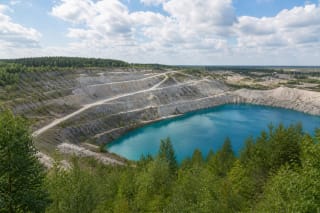
The Šaltiškiai clay quarry is not an outdoor extension of the museum or a public fossil-hunting area. It is an active industrial site, so the find should be studied safely in its display case and the mining landscape viewed only from authorised Akmenė quarry viewpoints. On 13 July 2026, the exact Google listing for Akmenė Regional Museum had 334 reviews averaging 4.6 out of 5.