- When / context
- As death approached, through the funeral and later mourning
- Tradition area
- Life cycle
- Themes
- The approach of death, keeping vigil, preparing and laying out the deceased, šermenys, budynės, pagrabas, laments, hymns, funeral procession, burial, pakasynos, mourning, and later commemorations
Lithuanian funeral customs formed a sequence extending from the approach of death through preparation of the deceased, vigil, farewell, burial, pakasynos, mourning, and later commemorations. The order remained recognizable, but its names, music, community roles, and timetable varied by place, confession, household, and historical period.
A Funeral Was an Extended Life-Cycle Passage
From an ethnological perspective, funeral rites enable a community to recognize an irreversible change of status. The deceased is gradually separated from the everyday household, accompanied to the cemetery, and incorporated into the community's memory of its dead, while close relatives enter a period of mourning. The meaning therefore lies not only in individual details but in their order: preparation, vigil, removal, journey, burial, a shared meal, and repeated acts of commemoration.
The sources describing that sequence are not all equivalent. Wulfstan's ninth-century account and medieval documents about Prussia describe communities on the eastern Baltic coast or the Prussians; they are not direct descriptions of the later Lithuanian village funeral. Sixteenth- to eighteenth-century writers were often outside observers or clergy recording practices they wanted to restrict. Nineteenth- and twentieth-century ethnography comes closer to family experience, while Rimutė Garnevičiūtė's fieldwork in 2009–2013 documents change in Catholic funerals across post-independence Lithuania. These periods can be compared, but they cannot be collapsed into one unchanging “ancestral rite.”
Preparing for Death and Marinimas
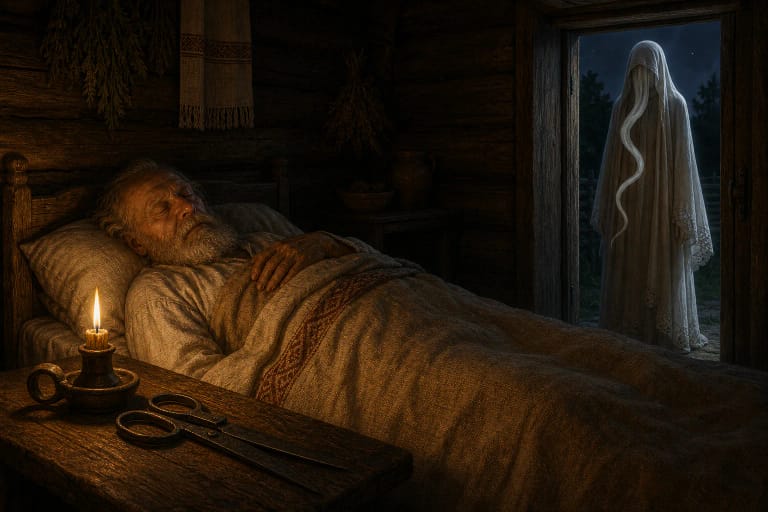
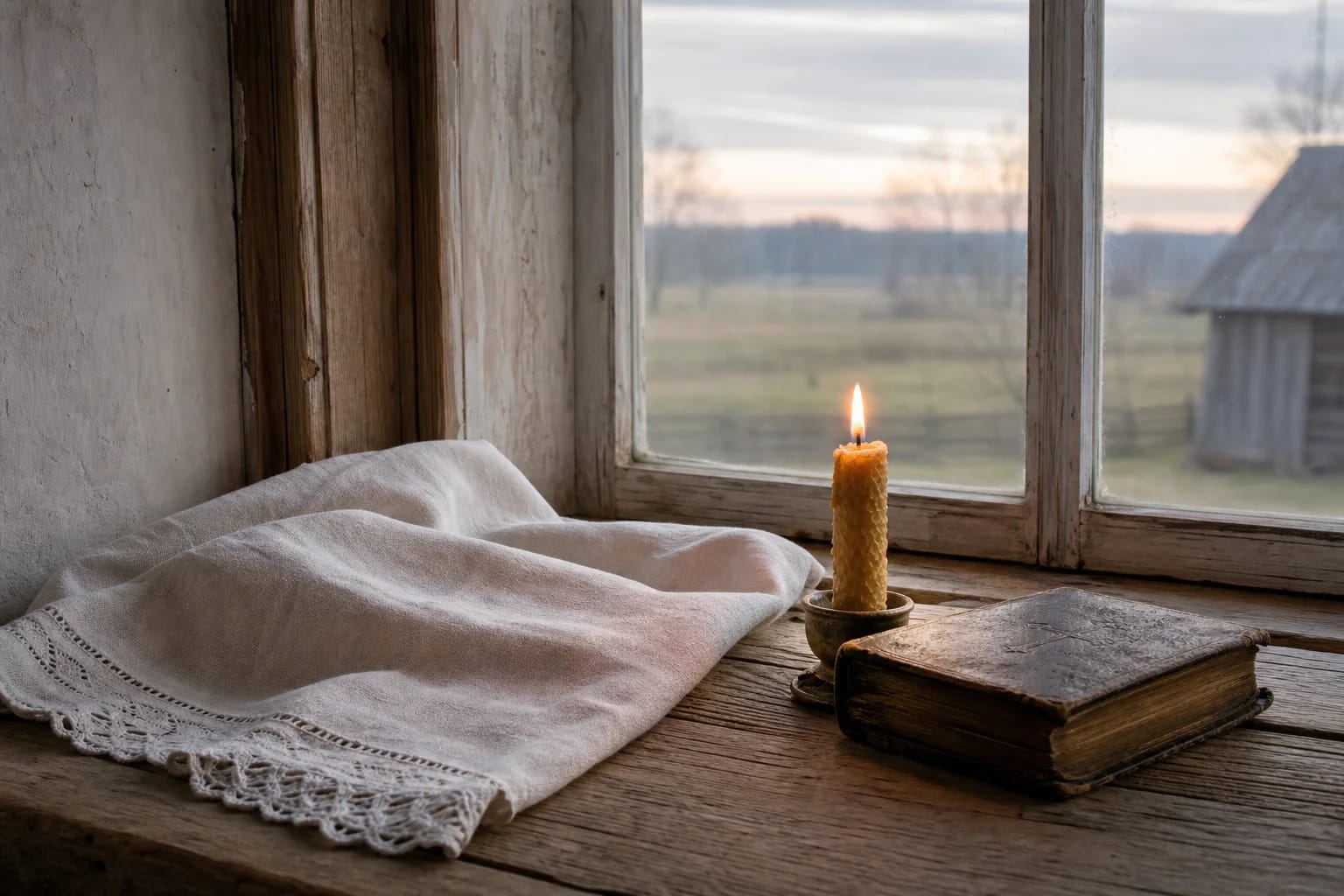
In older village accounts, the threshold of death began while the person was still alive. Someone approaching death might wish to settle debts, state a last will, reconcile with relatives, or say farewell. Family members and neighbors—especially women with relevant experience—came to marinti: to remain nearby, care for the person, pray, and help the household. In a Catholic setting, a priest could be called, the sacraments received, and a blessed graudulinė candle lit. This was both spiritual support and a social assurance that the person would not be abandoned.
The sources also contain actions believed to ease the soul's departure and judgments about whether a death was fortunate, difficult, or untimely. These are historical beliefs, not instructions. Illness, the length of dying, and the circumstances of death are not measures of a person's moral worth. Choosing hospital, hospice, nursing, or professional support today is not a failure of communal duty. A cultural history should show how people once made sense of uncertainty, not prescribe a modern “good death.”
Announcing a Death and the Duties of Neighbors
Relatives and the local community had to be told of a death. Different accounts mention a church bell, a drum, a board hung from a tree and struck, a handbell, or a member of the family or a neighbor sent through the village. The method changed, but the social meaning was clear: from that moment, a household's loss also became a concern of the community. People came to express sympathy and offer work, food, transport, prayer, or other support.
The Universal Lithuanian Encyclopedia's synthesis of sixteenth- to twentieth-century village customs says it was considered improper to refuse a request to sew a shirt or pillow, make a coffin, or dig a grave. Tasks were not assigned identically everywhere, however. In one locality neighbors did the work; elsewhere it fell to relatives or people with a particular skill, and institutions increasingly assumed it during the twentieth century. The evidence is better served by tracing real mutual aid and its transformation than by romanticizing an invariably united village.
Washing, Dressing, and Laying Out the Deceased
Washing and dressing the deceased prepared the person respectfully for farewell and burial. The work could be done by relatives, a neighbor, an older local woman, or someone else known to have the necessary experience. Donata Mitaitė's study of Panemunėlis records that family members washed and dressed their own dead and, if unable, usually asked an older woman. Garnevičiūtė's fieldwork shows that, around the turn of the twenty-first century, city households almost inevitably relied on professional services, while home assistance remained in some small-town and village families.
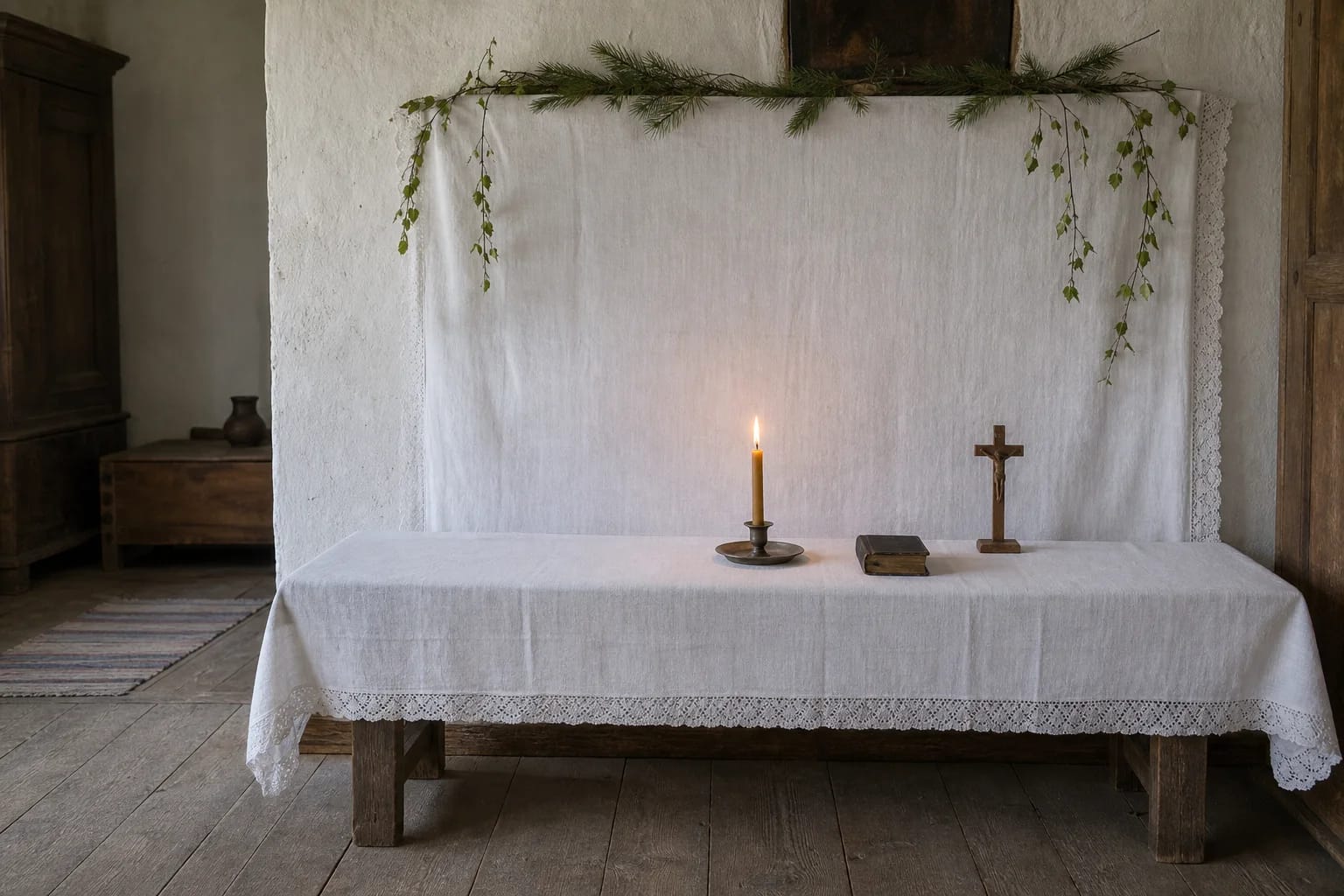
Before a coffin was ready, the deceased might be laid on a raised board resting on benches and covered with white linen or a finer textile. The Panemunėlis account mentions a pillow filled with wood shavings and blessed herbs, but this local detail cannot be made into a rule for all Lithuania. The place, helpers, and objects used for preparation also differed. This page is not a practical guide to caring for a body: present-day preparation is governed by health requirements, law, and professional practice.
Burial Clothing and Signs of an Unfinished Life Cycle
Writers of the sixteenth through eighteenth centuries mention white garments and leather footwear; later ethnography describes clothing saved in advance, the best items available, or garments made expressly for burial. In twentieth-century Catholic funerals, a rosary, cross, or holy picture might be placed with the deceased. Rural and urban clothing differed, while the offerings of funeral businesses gradually encouraged standardization. There is consequently no one “authentic” costume by which a Lithuanian funeral can be identified.
Young unmarried people formed a distinctive but by no means universal category. Dalia Černiauskaitė showed that some laments and customs metaphorically associated their death with a wedding that could never take place: white clothing, rue, a wreath, or figures recalling bridesmaids and groomsmen might appear. This imagery represented an interrupted life cycle; it does not mean that every unmarried young person was buried “as at a wedding.” It must be described with restraint rather than turning early death into picturesque folklore.
From Laying Out the Deceased at Home to the Funeral Hall
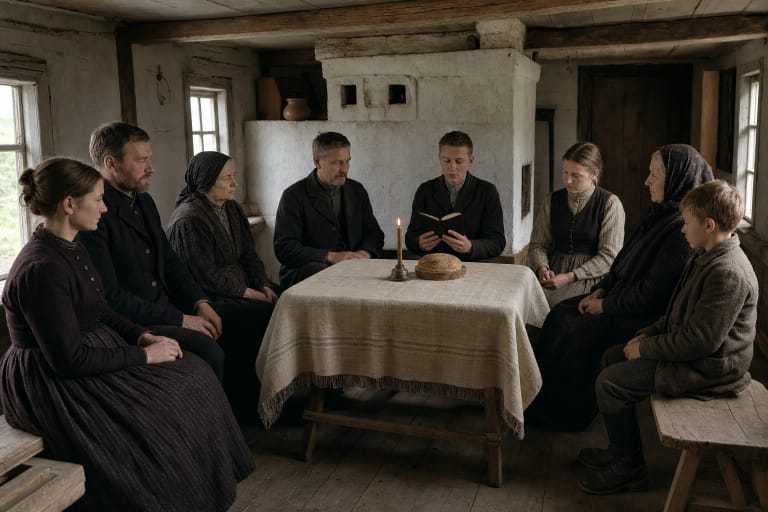
For a funeral at home, the household usually selected its most suitable room, covered walls with textiles, and arranged places for candles, devotional objects, and the chanters. Preparing the room was shared work. Borrowed benches, bedspreads, dishes, or hymnals recorded the neighbors' participation. Because the deceased remained in the surroundings in which they had lived, the final farewell and removal from the house formed an especially clear boundary.
By the late twentieth century, the laying-out had moved to rented funeral halls in many parts of Lithuania. Garnevičiūtė identifies a double movement: funeral providers often preserved religious signs and singing important to local clients, while urban hall aesthetics, service packages, and professional performers also standardized practice. This was not simply the death of tradition. Families gained needed support, but the local community more often became a visitor than an organizer of the rite.
What Do Šermenys, Budynės, and Pagrabas Mean?
In contemporary standard usage, šermenys most often means the vigil beside the laid-out deceased before burial. The Universal Lithuanian Encyclopedia gives a traditional duration of one to three days and notes prayer, condolences, and evening singing. In historical sources, however, the same word can mean funeral feasting beside the deceased. When reading an old account, the first question is therefore whether the author means a vigil or a meal.
Local terminology was more diverse still. Garnevičiūtė's fieldwork recorded pakravai in the Švenčionys area, šermenys in Užnemunė, and pagrabas in parts of Aukštaitija, Dzūkija, and Žemaitija. Informants in Žemaitija explained that budynės could denote not the whole interval before burial but the evening gathering for prayer and singing during a pagrabas. These examples do not draw rigid dialect borders; they warn against treating the words as perfect synonyms.
Keeping vigil had practical and symbolic meanings. Relatives received visitors; people expressed condolences, remembered the deceased, prayed, and sustained the household. Some local descriptions say the deceased was not left alone even at night, but interpretations range from religious respect to beliefs about the soul. No single explanation should be declared a fear compulsory for all Lithuanians or an automatic survival of pre-Christian religion.
Laments, Hymns, and Regional Voices
A funeral rauda, or lament, was not a song memorized word for word. It arose in a particular loss, combining conventional forms of address with improvisation: Why did you leave? Why do you not rise? What road are you taking? Whom will you meet beyond? Who will care for those who remain? The motifs could follow the entire funeral sequence—death, washing, laying on the board, arrival of the coffin, removal, procession, and grave. Close female relatives lamented most often, although sources also mention skilled mourners invited for payment.
Laments should not be described as a heritage exclusive to Dzūkija, although the greatest range was recorded there and the practice lasted longest. Evidence also comes from eastern Aukštaitija, Suvalkija, the Veliuona and Seredžius areas, and Lithuanian villages in present-day Belarus. Lamenting disappeared in Lithuania Minor during the nineteenth century and mostly ended in Žemaitija by the early twentieth. Even within Dzūkija, melody and poetic structure differed between localities. An archival recording may document an actual bereavement or a later demonstration for a collector, so its circumstances matter.
In Christian communities, prayer and hymns supplemented and in many places eventually displaced lament. The Žemaičių Kalvarijos Kalnai devotion was important in Žemaitija, yet Rūta Žarskienė's research in the Raseiniai borderland found the Rosary of the Holy Name of Jesus to be the principal work there. In the Klaipėda Region and southwestern Lithuania, psalm singing connected Catholic and Evangelical Lutheran folk piety without erasing confessional identity. Confession and borderland history therefore explain the repertory more accurately than the claim that “all Samogitians sang the same thing.”
Farewell, the Threshold, and the Funeral Road
On the day of burial, the vigil space became the beginning of a journey. The deceased might be transferred from the board to the coffin, relatives said farewell, and chanters marked the moment of removal. Threshold, yard, village boundary, turn in the road, and cemetery gate recur in sources as places of passage. In laments, the road becomes the dominant metaphor: the dead person departs as a guest for a distant land or a dark little house, while the living may accompany them only as far as a boundary.
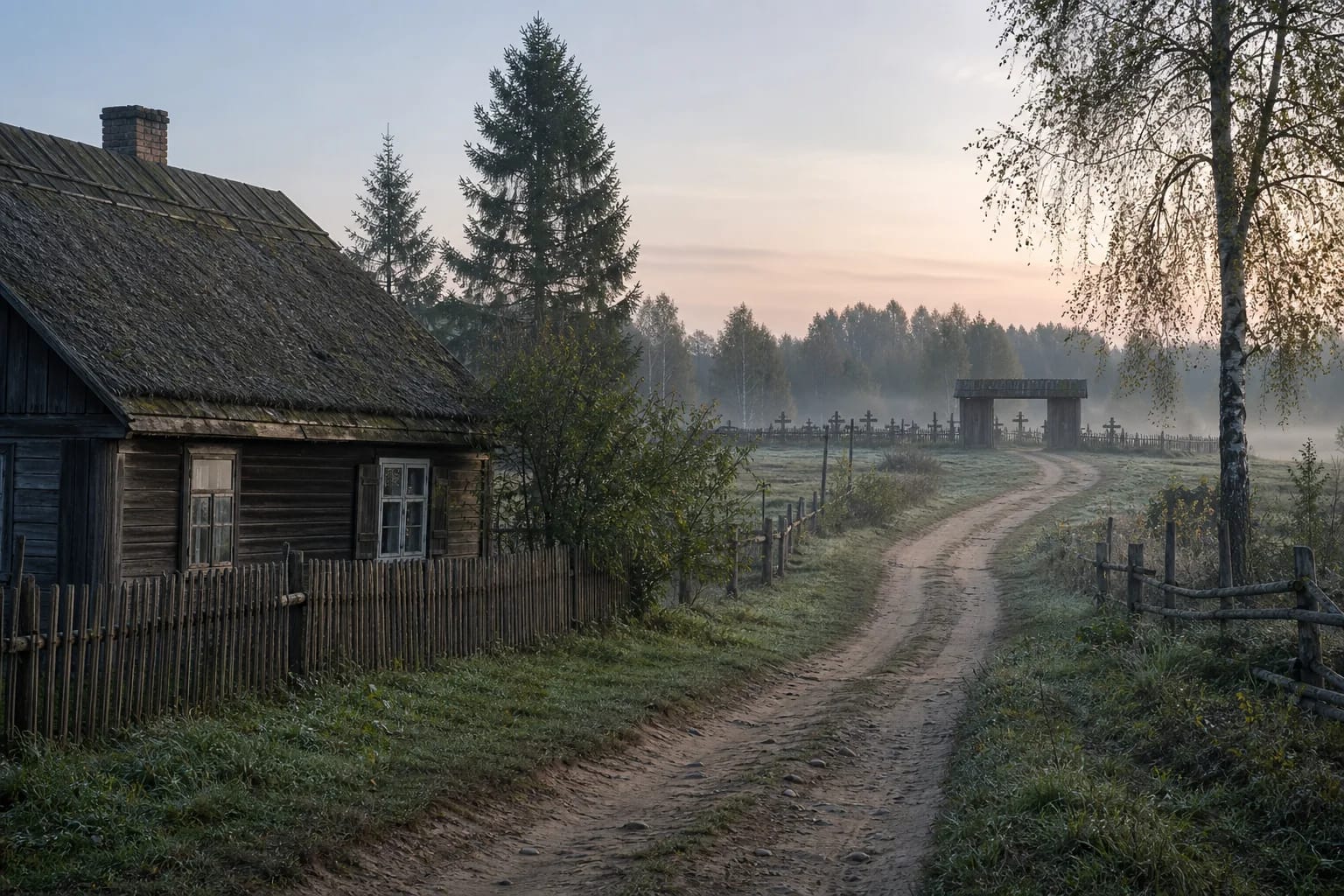
Accounts from the late nineteenth and early twentieth centuries describe a coffin transported in winter on a sleigh decorated with small spruces and in summer on a wagon dressed with birch branches, although decoration and transport were not uniform. What mattered most was accompaniment. Family, kin, neighbors, chanters, pallbearers, and clergy publicly affirmed the community's farewell. A motor vehicle has replaced the wagon, but order in the procession, a pause, or walking in silence can still give the journey ritual weight.
The Catholic funeral rite identifies three principal settings: the place where the deceased is laid out, the church, and the grave. Scripture is read, the Eucharist may be celebrated, the final commendation and farewell take place, and the coffin is sprinkled with holy water and incensed. This is the official liturgical layer, complemented but not replaced by local hymns, family speeches, and procession customs. Other confessions and secular funerals have their own ritual logic; the Catholic pattern is not the only one found in Lithuania.
Burial in the Cemetery and Grave Markers
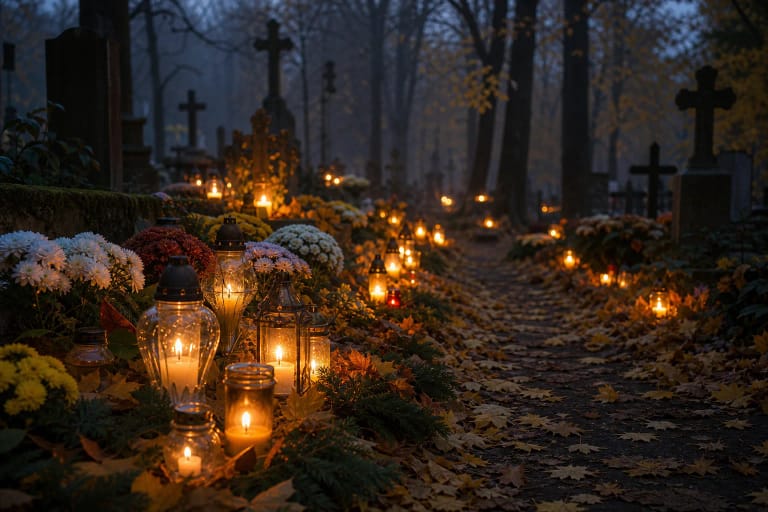
At the grave, the public procession reaches its conclusion. Farewell words are spoken, prayers offered, the coffin or urn lowered, and the grave marked. Older sources describe who could dig, carry the coffin, or cast earth into the grave, but duties varied and should not be revived today as compulsory restrictions based on kinship. A cross, later a headstone, plants, and an inscription place the deceased within the concrete memory landscape of a family and cemetery.
Burial in the ground was long the usual Christian choice, but cremation is also chosen in contemporary Lithuania. Catholic rites permit it when cremation has not been selected in opposition to Christian belief. Customs around cremated remains were still developing during Garnevičiūtė's research, so one late twentieth-century practice cannot be treated as the final present-day norm. Dignity rests not in the form of a coffin or urn but in respect for the deceased, their wishes, and the family's choice.
Pakasynos: Prayer, Thanks, and a Shared Table
After burial, participants returned to commemorate the deceased. These rites were called pakasynos, pakapynos, pakastuvės, and by other local names. Older accounts associate the meal with leaving a share for the dead or feeding the soul; by the nineteenth and twentieth centuries, thanking those who had accompanied the funeral—chanters, pallbearers, gravediggers, and neighbors—became more prominent. Prayer, remembrance, and eating together helped the community return from the procession to the daily world of the living.
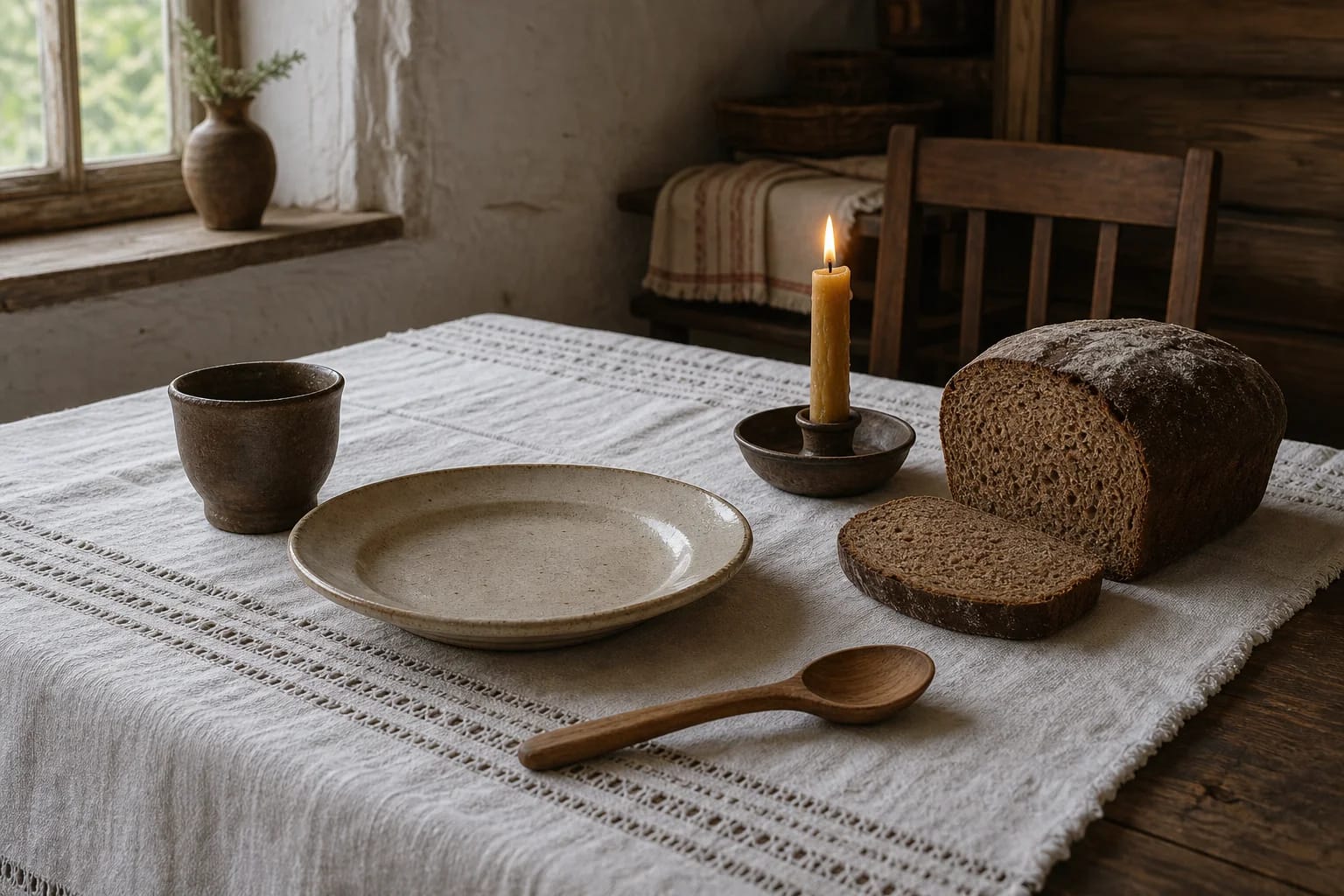
The scale of pakasynos depended on household resources and local custom. The encyclopedia notes that wealthy farmers' feasts could last longer, but such expenditure was not the measure of the tradition. During the later twentieth century, pakasynos largely became one funeral luncheon, increasingly held in a restaurant or other catering venue from the end of the century. Its cultural substance is not a fixed menu or amount of alcohol; it is gratitude, support for the bereaved, prayer, or respectful remembrance.
Mourning, the Ninth and Fortieth Days, and Anniversaries
After the burial, close relatives entered a period of mourning. Dark clothes, a black headscarf or band, restrained conduct, and avoidance of entertainment could mark it. Traditional descriptions sometimes give the closest family a year of mourning and more distant kin a shorter interval, but these time limits were already less often observed around the turn of the twenty-first century. Garnevičiūtė stresses that the Catholic Church does not prescribe one obligatory outward form or duration.
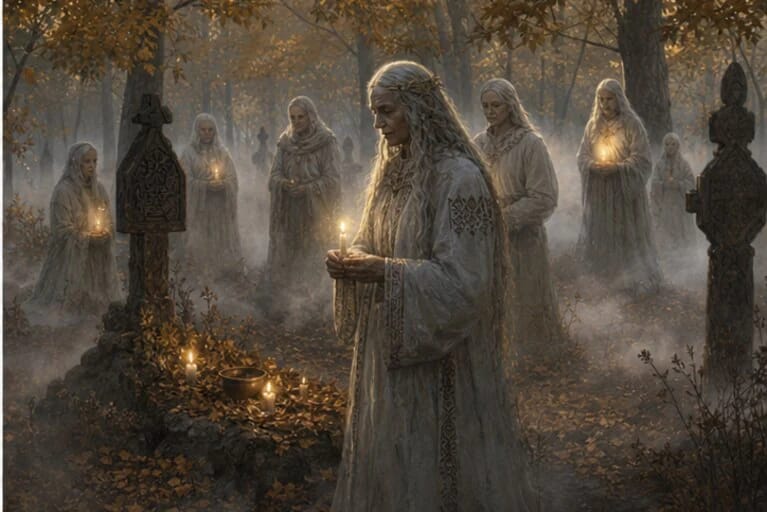
The deceased might be commemorated again after seven or nine, twenty-eight, thirty, or forty days, and on the anniversary. The numbers differed by locality, confessional environment, and family practice. Garnevičiūtė's study distinguishes a ninth-day observance in western Lithuania, while a month or the fortieth day mattered more elsewhere. The belief that a soul remained near the home for forty days must be identified as a recorded folk understanding, not a verifiable fact. Repeated prayer, gathering, and the rebuilding of a relationship through memory were the enduring purposes.
What Endured, What Changed, and How to Tell the Story Respectfully
Garnevičiūtė's conclusion avoids two extremes: the funeral sequence remained recognizable at the turn of the twenty-first century, but its elements kept changing. Halls replaced homes; professional services took over neighbors' tasks; hired performers or recordings sometimes replaced communal singing; cars replaced wagons; and a shorter farewell replaced a long vigil. Elsewhere, families deliberately maintained local hymns, the chanters' table, a ninth-day observance, or another custom important to them.
A funeral today may be Catholic, belong to another Christian confession or another religion, or be secular. This page gives greatest attention to the Catholic village and small-town layer because it is the subject of most of the research used here, not because it encompasses every community in Lithuania. Orthodox, Old Believer, Jewish, Lithuanian Tatar Muslim, Karaite, and other traditions require their own authoritative sources. Shared features formed through proximity—such as Catholic and Lutheran psalmody—do not erase confessional distinctions.
Respectful cultural interpretation avoids images of the body, recognizable grieving people used without consent, and horror aesthetics. A lament recording may preserve an actual family's loss or wartime trauma; it should not be used as atmospheric sound or recreated with an artificial version of a dead person's voice. Archival photographs and recordings should be accompanied by place, date, performer or informant, recording circumstances, and rights information. The central meaning is not an exotic prohibition but the community's effort to say farewell with dignity, support the bereaved, and gradually turn loss into memory.