- Type
- Goddess
- Domain
- Death, the end of life, illness, fate
- Source status
- folkloric
Giltinėlė, Death
Who is Giltinė in Lithuanian mythology?
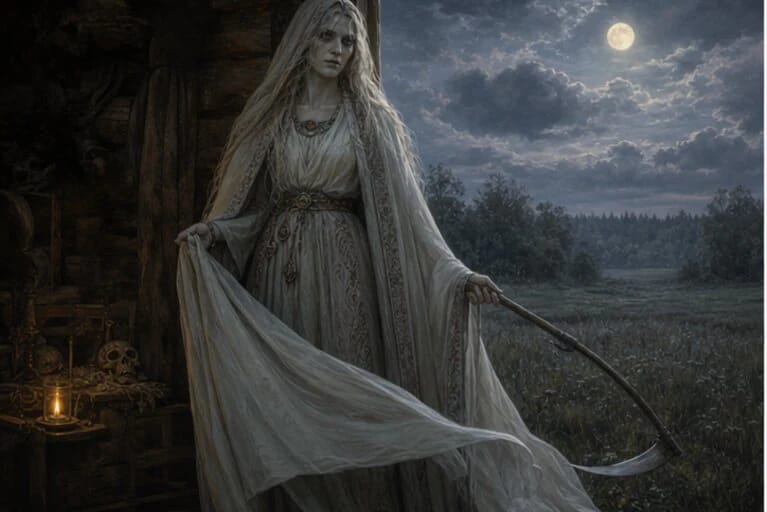
Giltinė is the goddess of death or the personification of death: the being who comes to take a person's life. In Lithuanian folklore she is one of the clearest images of death itself, embodying the boundary at the end of life.
Unlike vėlės, the souls of the dead, or Velnias, Giltinė is not a dead person's soul or an underworld spirit. She is death itself, carrying out her unavoidable work. For that reason her image in Lithuanian culture is closely tied to fate, illness, and the limit of a person's lifespan.
Giltinė's name and origin
Giltinė's name is linked with the Lithuanian verb gelti, to sting or hurt, with the color geltonas, yellow, and with the word giltis. These associations reveal the image of death: Giltinė kills by a sting, poison, or touch, while yellow in tradition is associated with sickness and death.
In folklore Giltinė is often imagined as a tall, thin, pale woman in white clothing, sometimes blind. People believed she killed by licking or touching a person with her poisonous tongue, so death was imagined as a direct, physical contact.
Giltinė and Laima: the beginning and end of life
Researchers often set Giltinė beside Laima, the goddess of fate and birth, as her opposite. Laima determines a person's lot at birth, while Giltinė comes to bring it to an end. Together the two goddesses cover the whole arc of life from birth to death.
This pair shows that death in the Lithuanian worldview was not simply an accident. The span of life was understood as an allotted portion: one goddess determines it, and the other carries it out. To die at the right time meant to reach the end of one's allotted fate.
Giltinė in legends and tales
Lithuanian narratives often include the international tale type of Giltinė as a godmother. She shows a doctor whether she is standing by a sick person's head or feet, revealing whether the person will recover or die. Such stories make death into a concrete being who can bargain with humans.
In other plots a person tries to trick or trap Giltinė in order to delay death, but in the end she cannot be avoided. These stories express the same idea: one may speak with Giltinė, but her work cannot be abolished.
Giltinė and later death iconography
In Western Christian iconography, from the late Middle Ages onward, death was depicted as a human skeleton with a scythe and hourglass, especially in fifteenth-century danse macabre scenes, whose spread is often connected with plague epidemics.
This image of the skeleton with a scythe later merged with the Lithuanian Giltinė, so today she is often imagined that way. Still, the older Lithuanian image, a pale woman with a poisonous tongue, is more distinctive and closer to local tradition.
Giltinė today
Giltinė's image helps explain how Lithuanians gave meaning to death: not as chaos, but as the end of an allotted fate, with its own being, rules, and stories. Through her it is easier to read Vėlinės, funeral customs, and death symbolism in folklore.
Giltinė should be read carefully: some of her traits belong to old folklore, while others come from later Western iconography. But the central image, death as a separate, unavoidable being connected with Laima, remains a strong element of Lithuanian mythology.