- Field
- Lithuanian folk art and sacred small-scale architecture
- Type
- ritual craft
- Heritage status
- UNESCO heritage
- Context
- crosses, koplytstulpiai, stogastulpiai, small chapels, saints' sculptures, forged sunbursts, and signs of communal memory
Cross-crafting and cross symbolism, Lithuanian cross-crafting, Lithuanian crosses, Lithuanian folk small-scale architecture
Cross-Crafting forms and objects
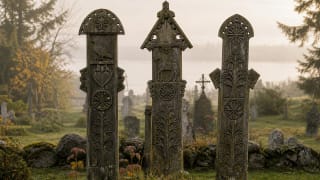
Cross: The main form of cross-crafting: a vertical wooden or mixed-material monument with a crossbar, often decorated with carving, plant motifs, a forged finial, or an image of a saint.
Koplytstulpis: A pillar monument with a small chapel or niche for sculptures of saints. It is especially important in the Žemaitian tradition, but is also found in other regions.
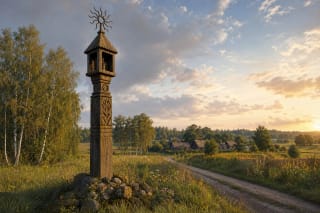
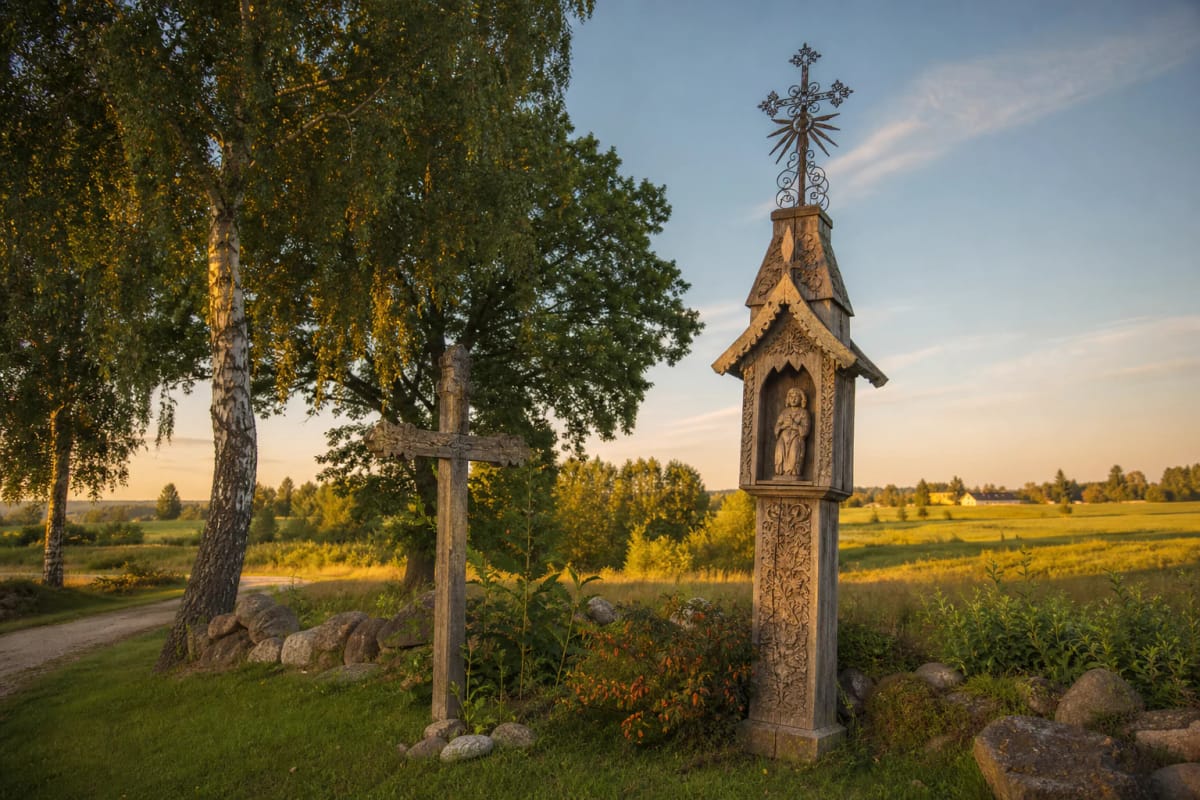
Stogastulpis: A post with one or several small roofs under which figurines or religious signs are placed. Multi-tiered, richly ornamented stogastulpiai are common in Aukštaitija.
Small chapel: A small wooden shrine for images of saints, hung in a tree, attached to a building, set on the ground, or incorporated into a pillar monument.
What is cross-crafting?
Cross-crafting is the whole of Lithuanian folk art, traditional craft, sacred small-scale architecture, and living community practice. It includes not only making a wooden cross, koplytstulpis, stogastulpis, or small chapel, but also the intention, choice of place, master's work, erection, blessing, visiting, decorating, maintenance, and respectful replacement of a decayed monument.
For that reason cross-crafting cannot be understood as simple wood carving. Carving is only one layer. The tradition also brings together carpentry, sculpture, blacksmithing, painting, ornament, Catholic devotion, local memory, and older images of nature and cosmic order.
Lithuanian cross-crafting and cross symbolism were proclaimed a UNESCO Masterpiece of the Oral and Intangible Heritage of Humanity in 2001 and were inscribed on the Representative List of the Intangible Cultural Heritage of Humanity in 2008. What is safeguarded is the living tradition itself: knowledge, craftsmanship, symbols, customs, and transmission.
Why is cross-crafting so important to Lithuania?
For a long time crosses in Lithuania were signs in the landscape. They stood beside homesteads, roads, fields, village edges, cemeteries, churchyards, springs, stones, water, and crossroads. A traveler therefore saw not just a decorative object, but a local prayer, thanks, request, memory, or boundary of community.
Cross-crafting survived even when the public erection of crosses was restricted or forbidden. After the 1863 uprising, tsarist authorities banned the building and repair of crosses in unconsecrated places, and during the Soviet period many monuments were destroyed or left to decay. Still, people erected new crosses secretly, rebuilt old ones, and used them to mark faith, deportation, partisan memory, hope for freedom, and national identity.
This layer of resistance and endurance explains why cross-crafting in Lithuania sounds stronger than a term from art history alone. A cross here often becomes a sign of moral stance: it shows what a community feared, asked for, thanked, and wanted to preserve.
Main forms: cross, koplytstulpis, stogastulpis, and small chapel
Cross-crafting monuments have several main forms. In everyday speech the simple word cross often covers the whole tradition, but it is more precise to distinguish the cross, koplytstulpis, stogastulpis, and small chapel. Each type has its own construction, visual center, and regional nuances.
A cross usually has a shaft and a crossbar. It may be modest or very ornate, with carved plant motifs, rays, sunbursts, forged finials, a small chapel, or figures of saints. The UNESCO description notes that Lithuanian crosses are usually 1-5 m high. A koplytstulpis is more like a post with a shrine that holds sculptures or paintings. A stogastulpis is recognized by one roof or several small roofs sheltering figurines and ornaments.
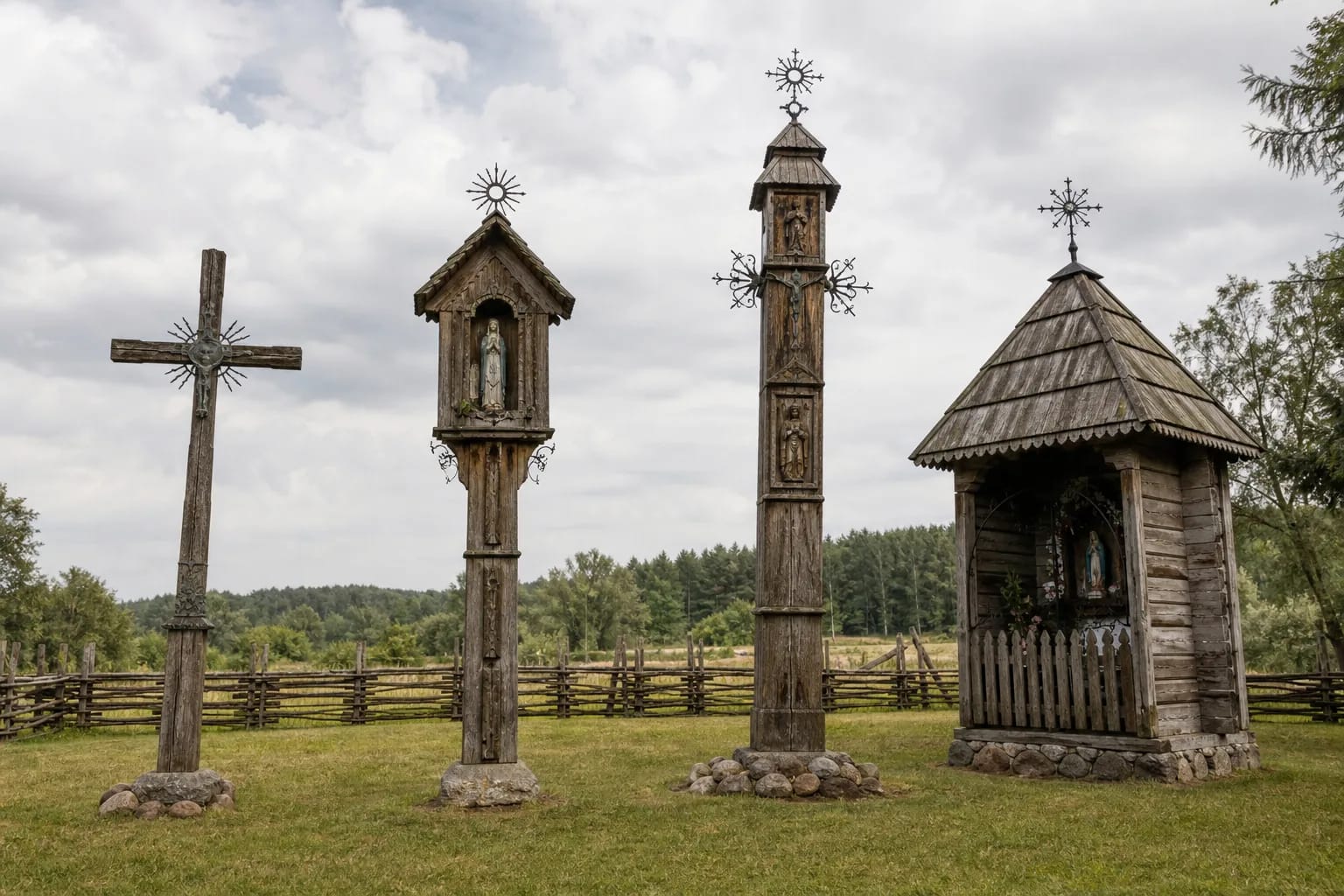
The dimensions of individual forms vary. The shaft of a wooden koplytstulpis is usually about 2-3 m, while masonry ones reach 4-9 m; the body of a stogastulpis is about 3-8 m, and its prototype is considered to be 1-3 m high grave posts related to the krikštai of Mažoji Lietuva. Wooden koplytstulpiai are most widespread in Žemaitija, while masonry ones were built throughout Lithuania.
A small chapel is a small space for images of saints. It may hang in a tree, stand on the ground, be fixed to a house, or become part of a koplytstulpis. These forms allow cross-crafting to be highly varied: in one place tall openwork monuments dominate, in another low chapel ensembles, and elsewhere small devotional signs hanging in trees.
Symbolism: how to read a Lithuanian cross
Several symbolic layers often meet in a Lithuanian cross. The Christian center may be the Crucified Christ, the Blessed Virgin Mary, Rūpintojėlis, the Pietà, or saints. Alongside them appear sunbursts, plant ornaments, birds, geometric patterns, hints of the tree of life, and forged rays.
The sunburst is one of the most recognizable signs in cross-crafting. It can be a metal finial, a wreath of rays, or an ornamented part of the crossbar. It should not be explained only as a pagan sign or only as decoration. In cross-crafting the sun, light, Christ's victory, heavenly order, and renewal of life often merge into one image.
Rūpintojėlis is an especially powerful subject in Lithuanian cross-crafting and devotional carving. The pensive Christ sits with his head resting on his hand, and so appears close to human pain, hardship, and patience. It is no accident that Rūpintojėlis is often understood as a symbol of national fate, endurance, and quiet inner strength.
Decoration and offerings are also a symbolic language. In Dzūkija crosses may be girded with sashes, wreaths, flowers, or small aprons. In Žemaitija sculptures of Mary are sometimes dressed in garments and adorned with beads and ribbons. This is not random decoration: it shows a request, thanks, respect, or personal bond with a sacred place.
Where crosses are erected and what place means
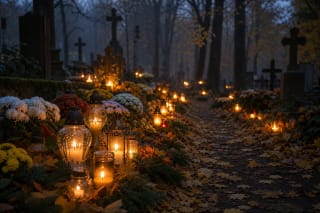
In cross-crafting the place is almost as important as the monument itself. A cross beside a homestead speaks of home and family protection. A roadside cross accompanies the traveler, marks a boundary, or recalls an event. A cross at a crossroads strengthens the symbolism of passage and choice. A cemetery or churchyard cross joins prayer with remembrance of the dead.
Crosses are also erected near water, springs, stones, forest places, or older sacred sites. In such places the syncretic character of cross-crafting is especially visible: a Christian monument settles in a landscape that already carried special meaning for the community.
A place can also be a historical wound. Crosses have been erected to remember plague, war, deportation, partisan deaths, torture, disasters, or struggles for freedom. The question of one cross is therefore often not only who made it, but why it stands here.
Cross-crafting by Lithuanian regions
The ethnographic regions help show how varied cross-crafting is. Aukštaitija is characterized by tall, multi-tiered stogastulpiai rich in ornament. They often look light and vertical, with several small roofs and decorative rhythm.
In Žemaitija, koplytstulpiai and ground-level small chapels are especially important. The region's cross-crafting often has a strong sculptural center: a figure of Mary, Christ, or a saint lives in the chapel or niche and is visited, decorated, and protected by people.
Dzūkian crosses have a distinctive cross-shaped form and a lively tradition of adornment. Wreaths, flowers, sashes, aprons, and other textile or plant signs are especially prominent. In Suvalkija the tradition of chapels in trees is mentioned, while the krikštai of Mažoji Lietuva are a close but separate world of wooden memorial signs.
These regional traits should be understood as tendencies, not strict rules. A local craftsperson, patron, parish, materials, historical period, and concrete event could change a form just as strongly as region.
The cross-crafter's work: wood, sculpture, blacksmithing, and memory
A traditional cross-crafter was often a self-taught master who learned from other craftspeople, the family environment, or long work with wood. Many men in a village could make a simple cross, but artistically mature koplytstulpiai, stogastulpiai, and sculptural ensembles required experience, a sense of construction, and an understanding of iconography.
Carvers of religious figurines, known as dievdirbiai, are first mentioned in written sources in 1752 in the synod resolutions of Bishop Antanas Tiškevičius of the Diocese of Žemaičiai. The most famous cross-crafter and dievdirbys of the second half of the nineteenth century, Vincas Svirskis, carved monumental koplytstulpiai from oak, while stone koplytstulpiai, for example those of Ukrinai in 1861, were carved by the folk master S. J. Gailevičius. Other known nineteenth- and twentieth-century cross-crafters include J. Bieliauskas, V. Braslauskas, J. Dzidaveckas, N. Mockus, Jonas and Kazys Orvidai, and A. Potockis; the contemporary tradition is continued by A. Jusevičius, A. Teresius, and other folk artists.
Wood gives cross-crafting warmth and fragility. It allows ornament, figure, roof, and niche to be carved, but also reminds us that the monument is not eternal. Maintenance, restoration, making copies, documentation, and respectful replacement of a decayed monument are therefore part of the tradition.
Blacksmithing is also important in cross-crafting. Metal finials, sunbursts, rays, small crosses, and decorative details add signs of light, sky, and firmness to the wood. When these layers are joined, the cross becomes a unity of small-scale architecture, sculpture, and ornament.
History: prohibitions, revival, and living tradition
The cross-crafting tradition formed after Christianity came to Lithuania, but its artistic language preserved older images of nature, sun, plants, wood, and the sacredness of place. In the nineteenth century crosses were so common that they became one of the identifying signs of the Lithuanian landscape.
After the 1863 uprising, tsarist restrictions limited cross erection outside cemeteries and churchyards. During the Soviet period cross erection was again restricted, many monuments were destroyed, and the Hill of Crosses was repeatedly damaged. Yet prohibitions did not destroy the tradition: crosses were erected secretly, rebuilt, and reinterpreted as signs of faith and resistance. Even in those years cross-crafting forms lived in secular ensembles, including the Ablinga memorial in 1972 and the sculpture avenue near the Čiurlionis Road in 1975-1976.
After the restoration of independence, cross-crafting again became publicly visible. Some old monuments were restored, and crosses were erected in memory of deportees, partisans, villages, parishes, families, and historical events in Lithuania. In 2008, the same year the tradition was inscribed on the UNESCO Representative List, the Bank of Lithuania dedicated a silver 50-litas coin to cross-crafting, designed by Rytas Jonas Belevičius. Today the tradition is sustained by cross-crafters, folk artists, museums, the Lithuanian National Culture Centre, communities, camps, educational work, and heritage initiatives.
Where to see cross-crafting in Lithuania
The best-known cross-crafting site is the Hill of Crosses in the Šiauliai region. It is not only a museum-like object: it is a living accumulation of crosses, a place of pilgrimage, prayer, national memory, and personal vows. Its scale helps reveal the vitality of cross-crafting, but it does not cover the whole diversity of the tradition.
Cross-crafting is also worth observing in smaller places: Žemaitian churchyards and cemeteries, old village roadsides, Dzūkian homesteads and crossroads, Aukštaitian stogastulpis settings, regional parks, ethnographic villages, and museum displays.
Museums and archives help show what is no longer preserved outdoors. The National Museum of Lithuania holds a large collection of folk sacred small-scale architecture, saints' sculptures, forged finials, and related objects. Photographs by Adomas Varnas and other researchers matter because wooden monuments decay more quickly than stone or metal.
How to present this tradition responsibly
When speaking about cross-crafting, it is important not to reduce it to a decorative folk style. Many crosses remain places of prayer, remembrance, or family history. They should be treated respectfully: do not climb on bases, move decorations, or photograph in ways that violate the sensitivity of cemeteries or private space.
It is also worth avoiding the simplification that cross-crafting is either purely pagan or only ecclesiastical. Official sources explain it as a syncretic phenomenon of Lithuanian culture, where Christian sacred art intertwines with older language of nature, place, wood, sun, and communal memory.
The best way to understand cross-crafting is to read it on three levels: as a master's work, as a sign of place, and as a human intention. Then the wooden cross becomes not only an object, but a story about the people who erected it and keep returning to it.