- Place
- Visaginas, Visaginas Municipality
- Region
- Aukštaitija
- Type
- commemorative boulder with a bilingual plaque marking the start of city construction in 1975
- Address
- Sedulinos al. 4A, Visaginas
- Coordinates
- 55.59846, 26.42443
- Visit duration
- 10-20 minutes; 1-2 hours with Sedulinos Avenue and central Visaginas
- Best time
- in daylight, when the bilingual plaque can be read and the boulder's natural outline compared from several angles
Visaginas city stone, Visaginas foundation stone, Visaginas founding stone
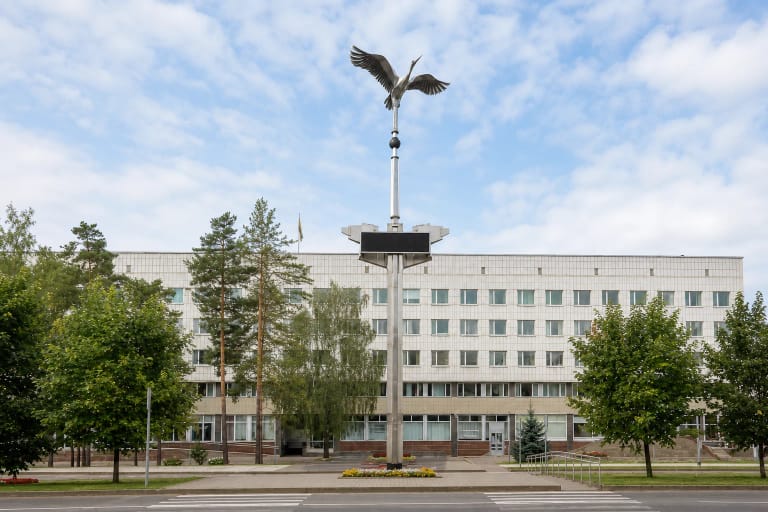
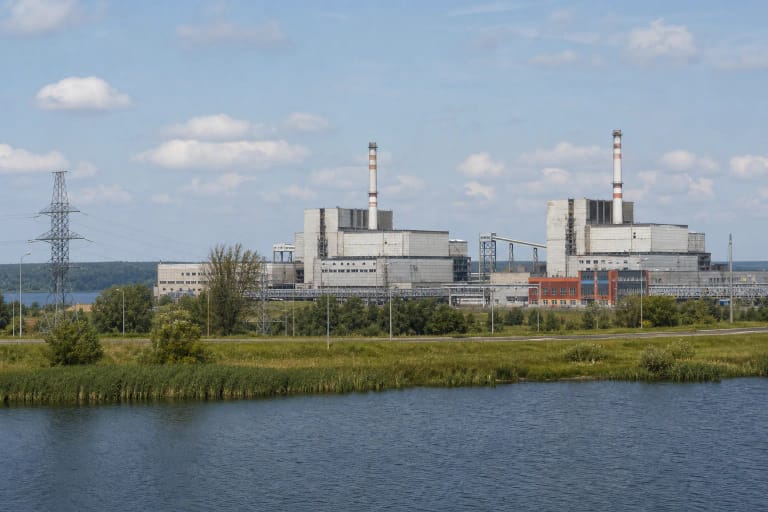
The stone is on Sedulinos Avenue, not at the nuclear power plant
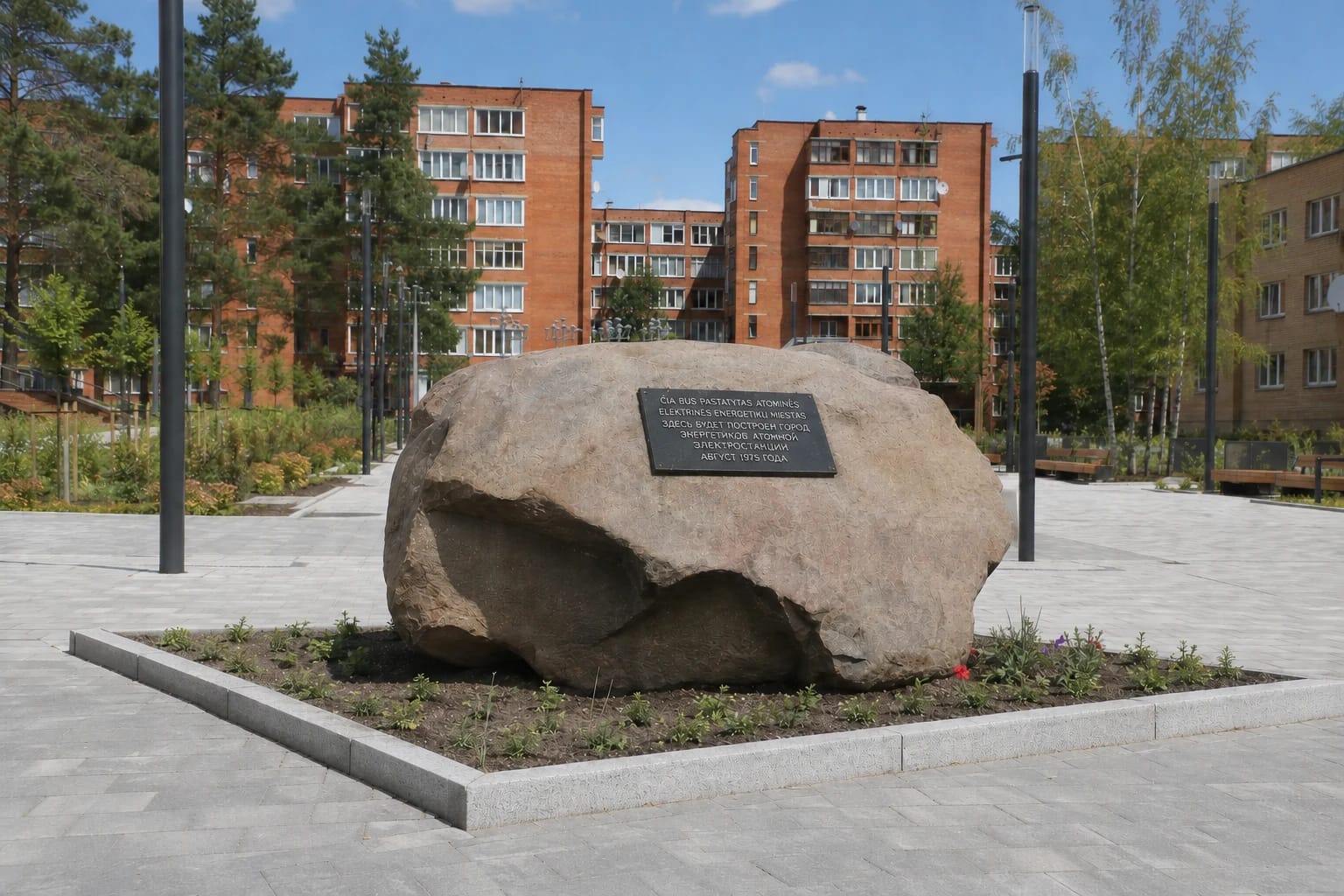
The commemorative stone stands at 4A Sedulinos Avenue in a central pedestrian space among apartment blocks. It is a large, irregular brown-grey boulder with a dark rectangular plaque on its front. It is in Visaginas itself, not on the grounds of the Ignalina Nuclear Power Plant and not beside the Crane city symbol on Parko Street.
An official visitor activity asks participants to measure the boulder and gives an indicative maximum width of approximately 3.46 metres. Because the surface and edges are irregular, individual measurements can differ slightly. No equally reliable height, depth, or weight was found, so those values should not be estimated from a photograph.
The map coordinate is a representative point for the stone in the renewed square, not a parking location. Approach on foot along Sedulinos Avenue and identify the boulder by its deeply recessed lower edge and the bilingual plaque fixed to the front face.
Builders brought it to the first apartment foundations on August 10, 1975
Visaginas Municipality records that builders of the Ignalina Nuclear Power Plant brought the huge boulder to the foundations of the first apartment blocks in the summer of 1975. Its installation date, August 10, was later declared the city's birthday. This is the ceremonial beginning of city construction, not the date when a place already called Visaginas received legal city status.
A later published recollection by one of the first builders adds a vivid but personal account. The stone stood among pines, only three house excavations existed on the future city site, and the writer remembered sewing a blue fabric cover that could be pulled away easily at the unveiling. This is valuable eyewitness memory, not an official protocol or evidence of who selected or geologically identified the boulder.
The municipality credits the plant builders collectively with bringing the boulder but does not name a driver, crane operator, designer, or artist for the ceremony. There is therefore no basis for assigning the stone to a single creator.
The plaque promised a workers' city but did not yet name Sniečkus or Visaginas
The Lithuanian text on the present plaque says that a city for workers at the nuclear power plant would be built here. The same promise follows in Russian, with August 1975 recorded on the final line. The two languages are part of the monument's historical appearance, not a later tourist interpretation panel.
The plaque gives no future city name. VLE records that the settlement was called Sniečkus from 1977 to 1992, received the name Visaginas in 1992, and gained city rights in 1995. The 1975 stone therefore marks the beginning of construction and the community's founding story, not the formal creation of a municipality already bearing its present name.
The current black plaque is visible in municipal photographs from 2023, but the checked sources do not confirm whether it is the unchanged 1975 plaque or identify its maker, metal, or any restoration. The message is documented; the physical history of the particular plate should not be invented from appearance.
The outline of Lithuania is a popular comparison, not a carved shape
The municipality carefully says that the boulder's outline reminds many people of Lithuania. An official self-guided city activity also asks visitors to examine the silhouette for themselves. This widely shared visual interpretation has become part of the stone's symbolism.
No checked source says that the boulder was dressed into the outline of Lithuania or selected according to a documented map-shaped design. Photographs show an uneven natural surface and a large recess, but appearance alone cannot establish the geological rock type. It should not automatically be labelled granite or any other specific stone.
The expression foundation stone is symbolic here as well. The boulder was placed beside the foundations of the first apartment blocks and became the city's foundation marker, but it is not a structural part of a building footing. Its significance comes from the date, inscription, and collective memory rather than a load-bearing role.
The 2020-2023 reconstruction changed the setting, not the story
The reconstruction of Sedulinos Avenue between Parko and Visagino streets began on December 14, 2020, and ended on December 31, 2023. About 390 metres of pedestrian paving, retaining walls, steps, the fountain, lighting, benches, and planting were renewed.
Municipal photographs from 2023 show the commemorative boulder clearly retained in the newly paved space, in a low planting bed among the apartment blocks. The project gave it a new public-space setting, but the official description does not say whether the boulder was shifted by a few metres, rotated, or left on precisely the same footprint. Different photographic angles cannot settle that question.
The project aimed to improve pedestrian convenience and safety, but no separately verified step-free route description specifically to the plaque was found. The square has hard paving, although gradients, nearby steps, and the most practical wheelchair approach should be assessed on site.
The outdoor monument is free and works best as part of a city-history walk
The stone stands in an open pedestrian space and has no separate admission charge or opening schedule. Allow 10-20 minutes to read both languages, walk around the boulder, and decide from which angle its outline most resembles Lithuania. Do not climb on the stone or handle the plaque fixings.
For more than the inscription alone, continue to the Visaginas City Museum, whose exhibitions use local-history albums assembled by residents in 1975-1985. They place the official founding story beside everyday images made by builders and early residents. Check the museum's official site for current opening hours and admission.
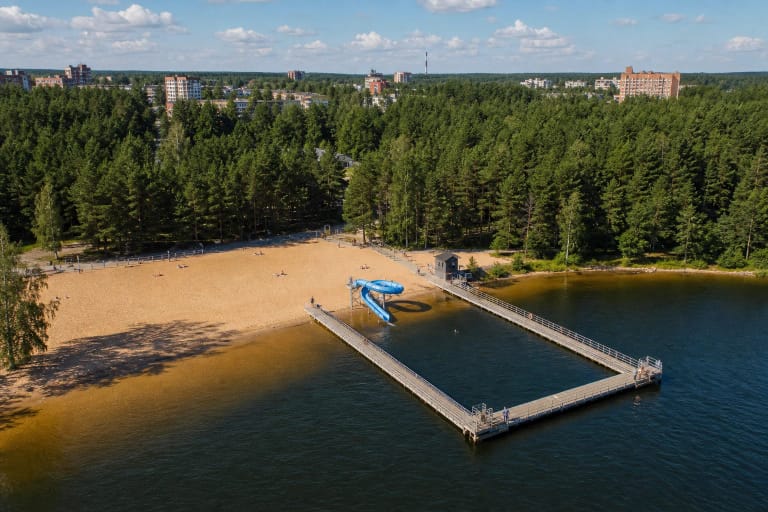
On a short central circuit, combine the stone with Sedulinos Avenue and the Crane city symbol. Add the Lake Visaginas shore for a longer walk. Plan the Ignalina Nuclear Power Plant separately and in advance, because the stone is in the city while the plant is a different restricted-access site by Lake Drūkšiai.