- Place
- Visaginas, Visaginas Municipality
- Region
- Aukštaitija
- Type
- city-symbol sculpture on a tall stele with a public display
- Address
- Parko Street, opposite the Visaginas municipal administration building
- Coordinates
- 55.59756, 26.42353
- Visit duration
- 10-20 minutes; 1-2 hours with a walk through central Visaginas
- Best time
- in daylight, viewed from the open public side of Parko Street while observing any temporary safety restrictions
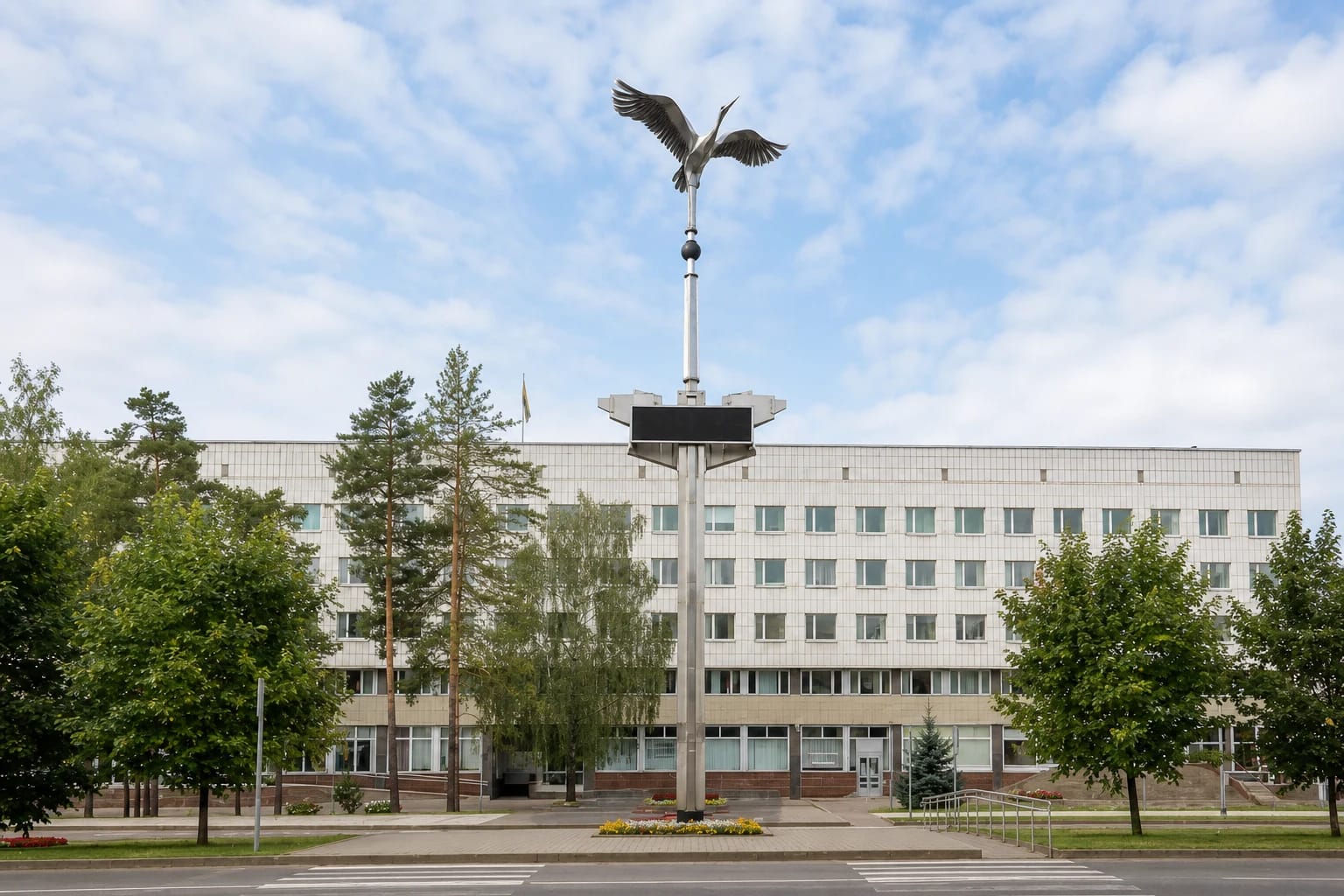
Visaginas Crane, Crane, the symbol of Visaginas, Visaginas city display with the Crane sculpture
The Crane stands on Parko Street opposite the municipal building
The landmark is easiest to identify by its tall vertical stele in front of the broad facade of the Visaginas municipal administration building. A silver-coloured bird rises at the top with its wings open, while a rectangular city display is mounted below. The municipality's formal wording, the Visaginas city display with the Crane sculpture, matters because the sculpture is only the upper element of a larger engineered structure.
The municipal visitor page calls the crane the city's first symbol. It is not a separate monument in a park and it is not at the Ignalina Nuclear Power Plant: look for it on Parko Street in central Visaginas, directly by the administration building. The coordinate on this page is a representative point for the object, not a car park or a certified approach to the stele.
The clearest overall view is from the opposite side of Parko Street, where the complete stele, crossing, and municipal building fit into one frame. The bird's details are harder to see from below because of the height, so optical zoom is useful for photographs.
The silver crane represents caution and vigilance
Visaginas Municipality explains that the silver crane on a blue field in the city's coat of arms represents caution and vigilance in heraldry. Those qualities were chosen for a city created to serve the Ignalina Nuclear Power Plant. The crane is therefore more than a nature motif or a reference to birds around the region's lakes.
Construction of Visaginas began in 1975. The settlement was called Sniečkus from 1977 to 1992 and received city rights in 1995. The first city council began developing official symbols in 1995, and the coat of arms was approved by presidential decree on July 26, 1996. The sculpture and the arms share the crane motif, but the checked sources do not establish whether the present stele sculpture predates the arms, was created alongside them, or followed later.
The sculpture shows a crane taking flight, with its wings open and neck extended upward. It does not reproduce every detail of the graphic coat of arms, so it is more accurate to call it a sculpture of the city symbol than a three-dimensional copy of the official arms.
Reliable sources do not name the artist, installation date, or dimensions
The municipal visitor page documents the location and meaning, while planning records register the site as a display with a sculpture. However, the checked authoritative sources do not name the artist, give a creation or installation year, list exact dimensions, or identify the metal alloy. Specific attributions found elsewhere online should not be repeated without a primary record.
Public photographs support only a visual description: the bird is silver-coloured and stylised, with long tapering feather forms and broadly raised wings. That observation is not a materials analysis, so calling it stainless steel, aluminium, or another specific alloy would be guesswork.
This is also not Sugrįžimas, the 2019 sculpture on Sedulinos Avenue that uses a group of cranes. The Parko Street object is a single rising crane above a stele. Although some photograph captions misidentify it as a stork, official municipal documents and Visaginas heraldry consistently identify a crane.
A 2025 assessment declared the stele unsafe
The Visaginas municipal strategic action plan for 2026-2028 states that the Parko Street display and Crane sculpture were assessed in 2025. The structure was declared unsafe, with failures identified in mechanical resistance, stability, and safe use. This finding concerns the stele as a structure; it does not state that the bird itself has fallen or been removed.
The plan sets out two stages: urgent safety measures first, followed by comprehensive solutions to long-term damage. Funding was planned for design work in 2026 and repairs in 2027. These are planned milestones, not proof that work has already finished, so use the latest municipal notices and conditions on site.
Do not pass barriers, stand immediately beside the stele, or touch its structure when the area is restricted. Older photographs of visitors at the flower bed around the base do not demonstrate that the same approach is safe now. The crane remains clearly visible from the public pavement across the street.
Do not guess the purpose of the display from a photograph
Official sources call the rectangular unit below the sculpture a city display, but the checked documents do not specify which data it showed or currently shows. A single photograph is therefore not enough to identify it reliably as a radiation monitor, clock, thermometer, or single-purpose screen.
The screen may be switched off, altered, or included in work on the stele. The stronger reason to stop is the full composition: the rising bird completes a high vertical axis, while the long horizontal facade of the municipal building gives it scale. Together they form one of central Visaginas's most recognisable late twentieth-century civic views.
Make it a short stop on a wider Visaginas walk
Allow 10-20 minutes to view the landmark from a safe distance. There is no separate ticket or opening schedule because the sculpture is visible outdoors, but repair work and safety restrictions may alter the closest available viewpoint. Check Visaginas Municipality information before making a special journey.
No verified official description of a step-free route to the base was found. The wider view is available from a public pavement, but assess crossings, kerbs, temporary barriers, and works on arrival. This is especially relevant for wheelchair users and visitors with pushchairs.
After the Crane, continue through the planned centre of Visaginas or visit the Visaginas City Museum. A pre-booked Ignalina Nuclear Power Plant programme and Lake Drūkšiai make a longer day and explain the energy history behind the city's symbolism of vigilance.