- Place
- Sudervė, Vilnius District Municipality
- Region
- Aukštaitija
- Type
- free privately operated open-air park of contemporary stone sculpture beside Lake Vilnoja
- Address
- 27 M. Zdziechovskio Street, Sudervė, Vilnius District
- Coordinates
- 54.78864, 25.08022
- Visit duration
- 45-90 minutes for the main circuit; up to 2 hours when reading artwork information and taking photographs
- Best time
- a bright spring or autumn half-day for stone textures; choose morning or evening in summer and avoid intense heat
Vilnoja, Vidmantas Martikonis Stone Sculpture Park, Stone Sculpture Park on the Water
Where Vilnoja is and what the map pin identifies
The park is at 27 M. Zdziechovskio Street in Sudervė beside Lake Vilnoja, about 20 kilometres from central Vilnius. The coordinate 54.7886423, 25.0802177 and Google place ID ChIJeYlWX-CO3UYRYzWrh_PPaSs identify the sculpture-park grounds, not a housing area of the same name, the lake centroid, or the nearby water-sports venue.
Vilnoja is a privately operated outdoor art space. Its official website says visitors are welcome every day during daylight and admission is free. The daylight qualification matters: it does not promise lit paths at night or gates kept open around the clock.
Drivers should navigate to the official address and follow signs on arrival. The map pin marks the complex but does not itself certify one particular accessible parking bay or sole entrance. Keep private driveways clear and leave vehicles only in an area clearly designated for visitors.
How a 2001 symposium became an international park
The park began with a granite-sculpture symposium organised by Vidmantas Martikonis in 2001. Eight Lithuanian artists were invited to the four-hectare site: Šarūnas Arbačiauskas, Juozas Genevičius, Džiugas Jurkūnas, Darius Bražiūnas, Algirdas Kuzma, Daumantas Kučas, Kęstutis Musteikis, and Arvydas Ališanka.
The event became international in 2002 with sculptors from Latvia, Sweden, Russia, Poland, and Belarus. The official history records symposia from 2001 to 2008 and participants from twenty countries over that period.
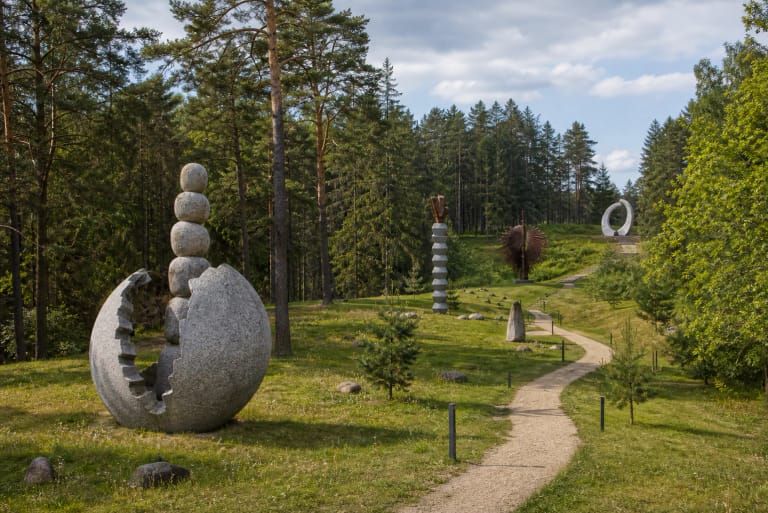
This origin explains the collection's variety. Vilnoja is neither a memorial garden devoted to one artist nor a single-theme exhibition. Works produced through different symposia place abstract geometry beside suggestions of the figure, deliberately rough boulder surfaces beside precisely polished granite.
More than 70 sculptures on land and in water
The official site reports more than 70 monumental stone sculptures. That number conveys the scale but should not be treated as a fixed route checklist: placement, visibility among plants, and interpretation can be updated.
The park's most distinctive idea is to carry part of the exhibition into Lake Vilnoja. Granite forms mounted above the water change with reflections, ripples, mist, ice, and shoreline reeds. View them from land rather than wading towards the works or climbing onto their supports.
Sculptures on land invite a different encounter. Visitors can move around a form, compare polished and split surfaces, and see how its silhouette meets tree trunks or open meadow. A slow rhythm works best: first read the outline from a distance, then approach as far as paths and protective boundaries permit.
How to read the park rather than merely collect photographs
Begin with the park map offered for download on the official visitor page. It makes clear that the exhibition extends beyond the entrance area and reduces the chance of missing works placed in the lake or more distant planting.
Look for the artist, title, and date where interpretation is provided. Not every abstract form has one obvious narrative, so distinguish the artist's title from a comparison invented by a viewer.
Side light in the morning or evening is best for revealing granite relief. Cloudy weather produces more restrained stone colours but less glare on the lake. Do not climb on works for a photograph, and never fly a drone without checking the landowner's permission and aviation rules.
Visiting with children or limited mobility
Children may enjoy the monumental scale, searching for forms, and the water display, but this is not a playground. Stone, plinths, the lake edge, and slippery surfaces require supervision, and artworks must not be climbed.
The outdoor circuit includes grass, soil, uneven ground, and shoreline stretches. The official visitor information does not describe one fully step-free hard-surfaced loop or an accessible toilet, so wheelchair users should call the park's published number to confirm current access.
There is no admission ticket, but this does not automatically cover a guide, private event, or neighbouring services. Arrange conditions in advance for a special tour, group visit, or arrival during difficult weather.