- Place
- Vilnius District Municipality
- Region
- Vilnius Region
- Type
- historic manor estate, watermill museum, and technical-heritage exhibition
- Address
- Malūno g. 25, Liubavas village, Riešė eldership, Vilnius district
- Coordinates
- 54.85080, 25.34143
Liubavas Manor Watermill Museum, Liubavas Manor Estate
Why Liubavas Is Not an Ordinary Manor
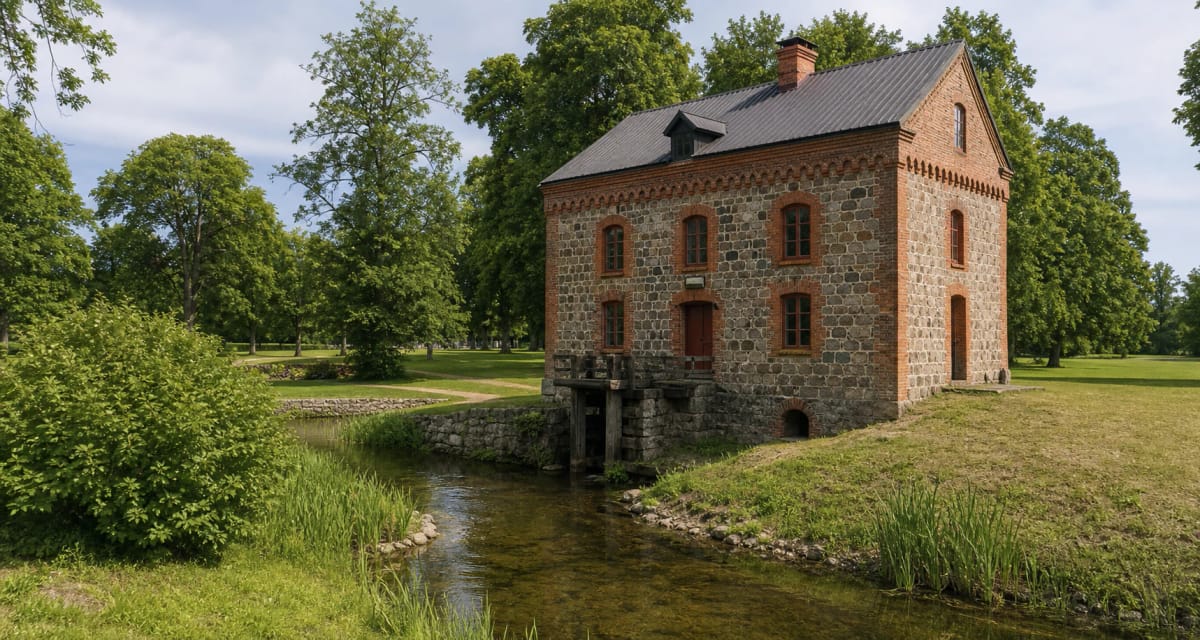
For many visitors, Liubavas begins not with a palace facade but with the stone watermill by the Žalesa River. That matters: the estate's value lies in water, ponds, machinery, roads, and an economic system as much as in noble genealogy.
The Cultural Heritage Register lists Liubavas Manor Estate as a nationally significant monument, unique code 899. The complex includes the officina, orangery, watermill, granary, cowshed, threshing barn, icehouse, stable, and other estate elements; its valuable features include architecture, engineering, archaeology, landscape, and memorial layers.
Early History: Goštautai, Sigismund Augustus, and Ponds
Official Liubavas history mentions the estate in written sources from the sixteenth century. The first known owners were the Goštautai family, including Albertas Goštautas and his son Stanislovas Goštautas, linked with Barbora Radvilaitė. After the family died out, the estate passed to the state in 1542.
Accounts from the court treasury of Sigismund Augustus in 1546-1547 describe Liubavas pond repairs. This shows the estate was not only a residence but an advanced economic centre supplying the royal Vilnius court with fish, timber, and other goods.
Owners and Cultural Figures
Liubavas changed owners often: after the Goštautai and ruler's family came Mikalojus Radvila Rudasis, the Golejevskis, Tiškevičiai, Krišpin Kiršenštein, Tyzenhauz, again Tiškevičiai, and Slizieniai families. This explains the estate's wide political, economic, and cultural context.
In the nineteenth century it passed to the Slizieniai family, linked with sculptor Rapolas Slizienis. In the early twentieth century the estate had a model stud farm and a modern watermill. Soviet nationalization in 1940 was damaging: buildings deteriorated, the pond system suffered, and accidental structures appeared.
The 1902 Watermill
The present Liubavas watermill building is dated by the register to 1902 and was restored in 2009-2011. It is a compact two-storey rectangular building with attic and gable roof, built from split fieldstone and brick.
The facades have historicist features: brownish brick frieze and cornice, toothed surrounds, segmental lintels, and a dressed stone with the date MCMII above the north facade door. The fieldstone and red-brick contrast makes the building easy to recognize.
Inside: Technology, Not Decoration
The official museum emphasizes that the mill's technological equipment has been fully restored and that many processes are demonstrated: grain, wood, and metal processing, fulling, electricity generation, and other work.
The register lists surviving and restored elements such as the millstone tub, hopper, groat machinery, lifting mechanisms, plansifter, millstone transmission, and belt drives with wooden and metal pulleys. That makes Liubavas compelling even for visitors who usually avoid manors.
Europa Nostra Recognition
In 2012, Liubavas Manor Watermill Museum received the European Union Prize for Cultural Heritage / Europa Nostra Award in the Conservation and Adaptive Reuse category.
The recognition matters because Liubavas is not a mass-tourism place. Its quality lies in precise conservation: stonework, water channel, restored equipment, museum interpretation, and landscape relationship.
Landscape: Žalesa, Ponds, and Outdoor Space
The estate is set in the Žalesa River valley. The register highlights a seven-pond system, water channel, Žalesa riverbed, mill dam, road network, park remains, and the planning structure created by surviving buildings.
Do not limit the visit to the mill interior. Walk the Žalesa bridges, pond edges, and former utility-building areas to understand the manor as a hydrotechnical and economic system.
Planning a Visit
The official Liubavas visiting page states that the watermill museum receives visitors from 1 May to 15 October; groups may be admitted at other times by prior arrangement. The outdoor area is listed as visitable daily during daylight.
Tickets can be purchased online, and a self-service ticket terminal is indicated near the bridge over the Žalesa, at Malūno g. 23. A practical route combines Liubavas with nearby Europos Parkas.