- Place
- Dūkštai Eldership, Vilnius District Municipality
- Region
- Neris Regional Park
- Type
- a botanical natural-heritage object and old pedunculate oak
- Address
- Dūkštai forestry district compartment 25, Drebulynė Forest, Dūkštai Eldership, Vilnius District
- Coordinates
- 54.80970, 25.00470
- Visit duration
- about 30-60 minutes for the tree and its setting; longer if combined with Dūkštai Oak Grove Trail
- Best time
- a dry, bright season; autumn reveals the trunk and branch structure, while summer surrounds the tree with dense green foliage
Ąžuolų Karalienė, Dūkštai Queen of Oaks, Queen of Oaks in Drebulynė Forest
The Queen of Oaks stands in a Dūkštai forestry compartment, not a city park
Saugoma.lt places the object in compartment 25 of the Dūkštai forestry district. The official natural-heritage register specifies the Dūkštai forestry district's compartment 25, plot 5, in Drebulynė Forest. This is woodland, not an urban square or a conventional park with a clearly defined gate.
The coordinates 54.8097, 25.0047 mark the tree itself through the map link supplied on the official object page. Use the full object name when navigating and check the final approach on the day, because forest roads, barriers, and their condition are not permanent public infrastructure.
The Queen of Oaks lies in the Neris Regional Park landscape, so a visit can be planned with other Dūkštai forest routes. This page is about one specific tree, however, not the whole oak grove: reaching it does not mean you have completed Dūkštai Oak Grove Trail.
A four-metre circumference is only one measure of the tree's presence
Saugoma.lt records a trunk diameter of 1.40 m and a circumference of 4.40 m. These figures show the tree's scale, but the woodland makes it feel even larger through its relationship with neighbouring trees and the low viewpoint of a visitor standing beneath it.
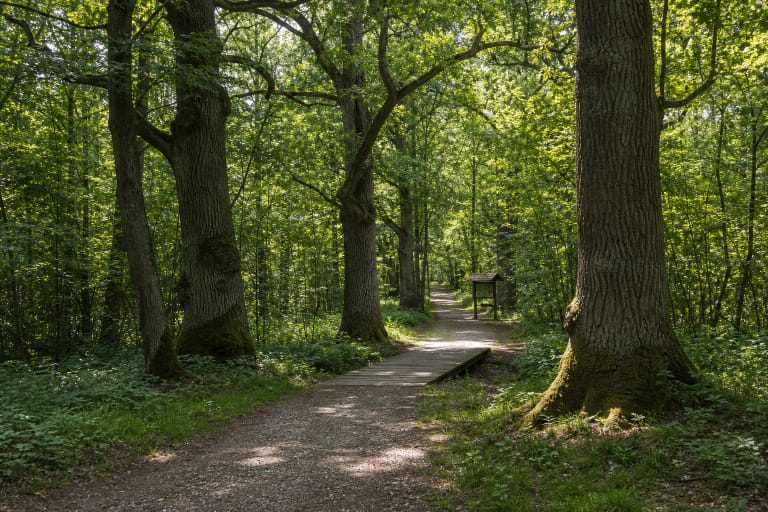
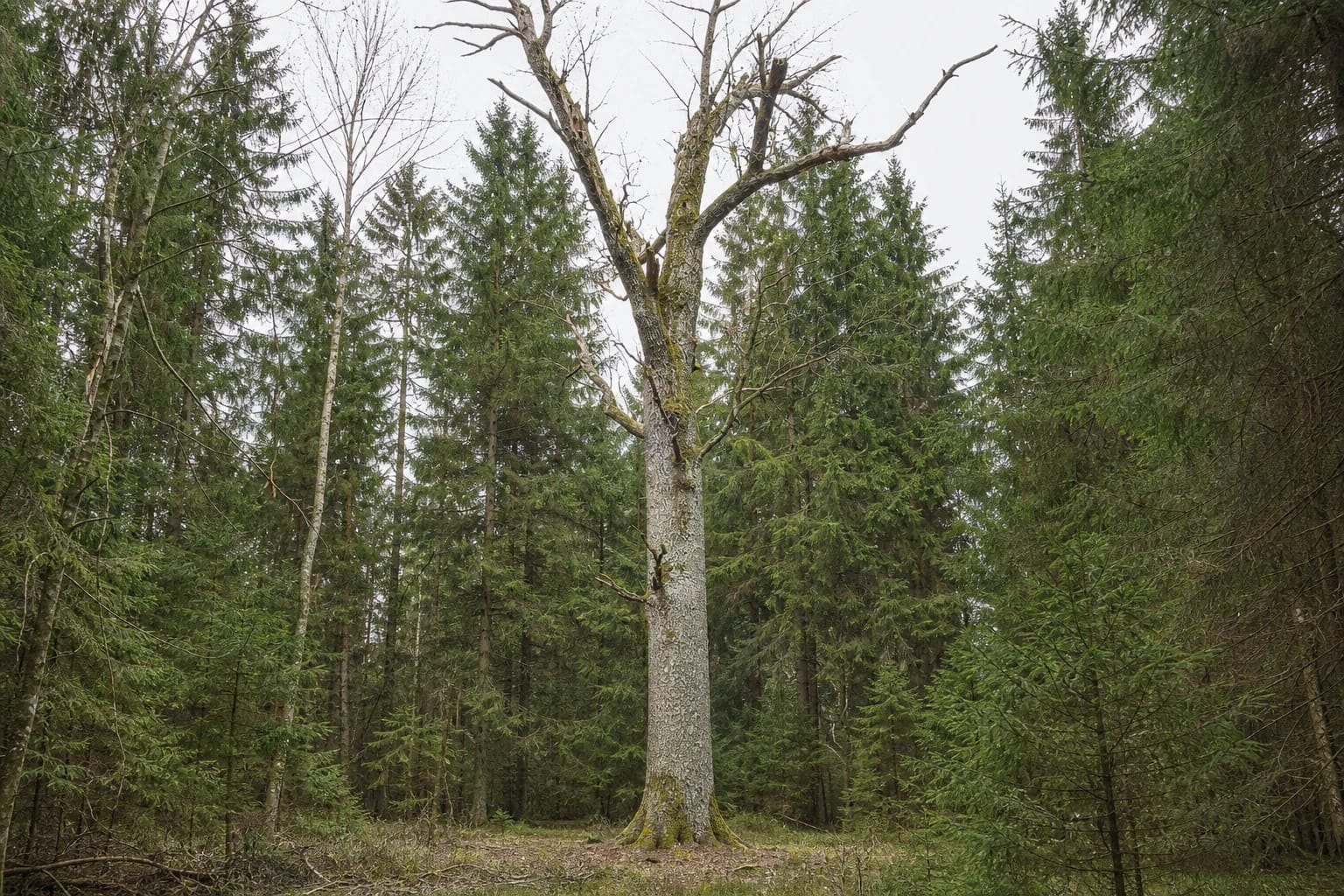
The trunk is not a regular cylinder. Knotted bark, thick branches that begin low, and the wide framework of the crown change the silhouette from every approach. On a wet day, moss and dark bark stand out; filtered light through the leaves traces the bends of the branches.
The reliable current object sources provide diameter and circumference, but not one consistently updated age or height figure. It is therefore more accurate to describe the Queen of Oaks through its protected status, location, and measured trunk than to guess at a number.
It is a botanical natural-heritage object, valuable for more than its size
The State Service for Protected Areas lists the Queen of Oaks among the botanical natural-heritage objects of Vilnius District Municipality. The official state list likewise records it as a botanical natural-heritage object associated with Dūkštai Eldership and Neris Regional Park.
Neris Regional Park's overview includes the Queen of Oaks among the park's veteran protected trees. It also records a local historical detail: an oak called the King of Oaks once grew a few hundred metres away but eventually fell under the weight of the years. That context helps explain the name without turning the present tree into a memorial or adding invented folklore.
In 2025, Neris Regional Park commissioned an arboricultural condition assessment of five protected veteran oaks, including the Queen of Oaks. Old trees remain important to insects, birds, fungi, and other life even when parts are drying or damaged, so a hollow trunk or dead branch does not make the tree ecologically worthless.
The woodland setting asks visitors to stop and observe from a distance
The Queen of Oaks stands among conifers and deciduous trees in Dūkštai Forest. The surrounding ground matters as much as the branches: leaf litter, lichens, moss, hollows, and dead wood are part of the habitat that an old tree supports. The best photograph is not necessarily the one taken with a hand on the trunk.
Do not make new paths, dig into the soil, pick moss, or climb the branches around the protected tree. Do not scratch the bark, attach signs or ribbons, or leave food for animals. These actions can damage the bark, roots, or sensitive habitat.
After rain, the forest floor may be soft, and wind can leave branches across the track or near the tree. Choosing a safe place to stop and a calm approach matters more than reaching the closest possible point to the trunk.
Plan a short visit or a wider forest outing
Allow at least half an hour to see the tree and its immediate setting, or up to an hour if you photograph and read the available information. If you combine the Queen of Oaks with Dūkštai Oak Grove Trail or another Neris Regional Park route, plan it as a separate woodland outing because the routeheads and approaches differ.
The official object page does not provide a daily opening schedule or describe permanent visitor infrastructure. That does not mean a forest road can be used in every condition or that vehicles may stop anywhere. Keep access clear, avoid driving over wet ground, and follow forestry and protected-area signs.
Dry, bright weather is easier for footwear and navigation. In autumn, thinner foliage reveals the trunk and branch structure; in summer, dense green foliage makes the tree merge more closely with the forest. In every season, treat the oak as a living habitat rather than an object to approach without restraint.