- Place
- Vilnius District Municipality
- Region
- Vilnius Region
- Type
- open contemporary art museum in nature
- Address
- Europos Parko g. 300, Joneikiškės, Vilnius district
- Coordinates
- 54.83200, 25.35200
Europos Parkas, Europe Centre Sculpture Park
What Kind of Place Is Europos Parkas?
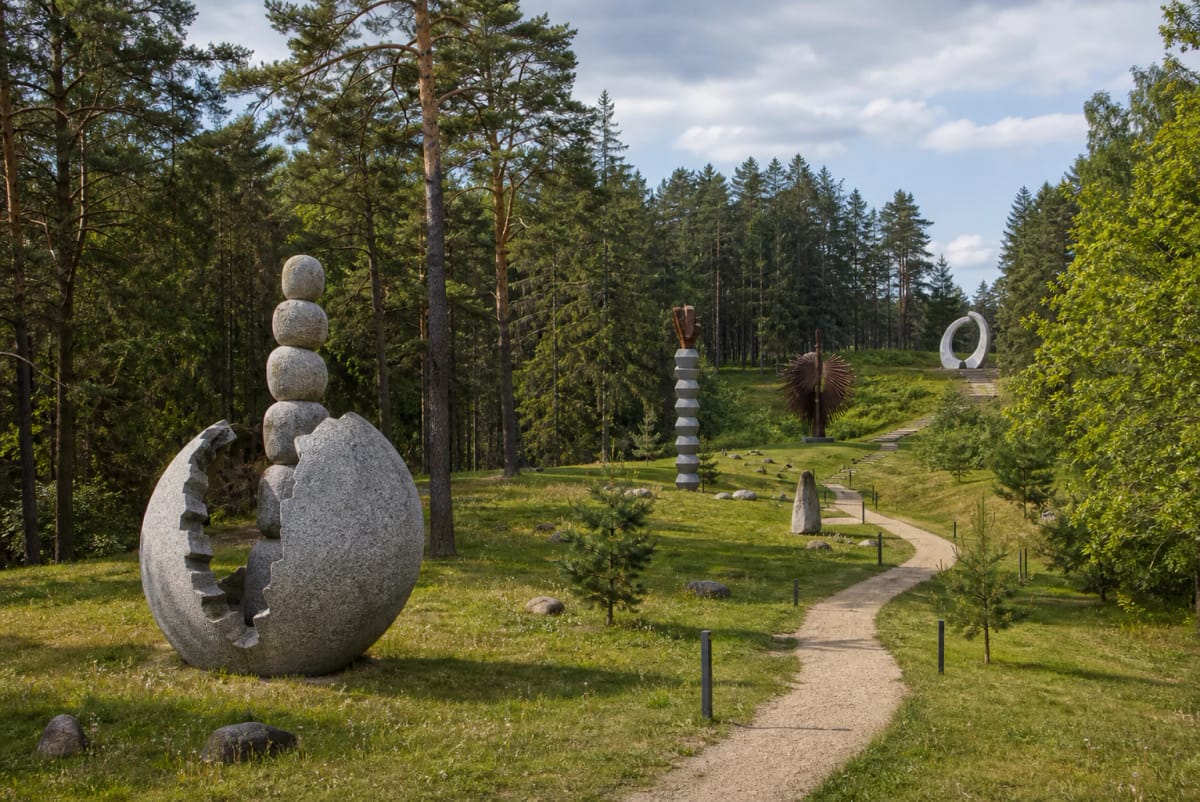
Europos Parkas is not an ordinary city park. It is an open-air contemporary art museum where sculptures, objects, and installations are placed across forest, meadow, and path landscape.
VLE gives an area of about 55 ha and more than 100 sculptures by artists from 34 countries. The experience is not only individual works but walking: art changes with distance, light, and forest background.
Gintaras Karosas and the Park Idea
The park was founded in 1991 by sculptor Gintaras Karosas, born in 1968, and officially opened in 1993. It was one of the early independence-period cultural projects presenting Lithuania as an open part of Europe; Karosas is also the park's landscape architect and director.
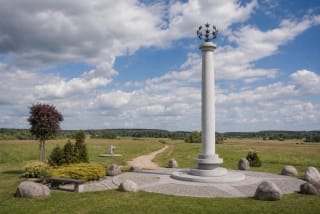
The idea is linked with the geographical centre of Europe near Vilnius. The park turned that coordinate into an art-and-landscape project, visible also in Karosas' own works such as Symbol of Europos Parkas (1991) and Monument of the Centre of Europe (1996). International sculpture symposia have been held here since 1993.
What to See
The museum includes works by Lithuanian and foreign artists in stone, metal, wood, concrete, and land art. Among the best-known are G. Karosas' LNK Infotree (2001), made from more than 3,000 televisions, Magdalena Abakanowicz's Space of Unknown Growth (1998), Sol LeWitt's Double Negative Pyramid (1999), and works by Dennis Oppenheim.
Do not walk only by a 'most beautiful sculptures' logic. The strength of Europos Parkas is the whole route, with works placed at different distances and rhythms.
Europos Parkas and the Europe-Centre Story
Europos Parkas is often confused with the Geographical Centre of Europe. They are related but separate places. The centre is a geodetic object; Europos Parkas is an art museum inspired by the idea.
If possible, visit both. The pair shows how a dry geographic fact can become a cultural story, from coordinates to sculptures among trees.
How to Visit
The park is in Joneikiškės, about 19 km north of central Vilnius. The official website provides car and public transport information, so check the current route before travelling.
Because the exhibition is outdoors, footwear and weather matter. After rain, paths can be damp; in winter, snow and short daylight change the experience. Check ticket and opening-hour information officially.
How Much Time to Allow
The shortest meaningful visit is about 1.5 hours, but for a slower walk and reading the works, plan 2-3 hours. For art-focused visitors it can easily become a half-day site.
With children, choose a shorter loop in advance because the area is large. The space, trails, and large objects are often easier for children than a conventional indoor gallery.
Nearby
Europos Parkas combines well with the Geographical Centre of Europe, Verkiai Regional Park, or northern Vilnius routes. For an art-themed day, Užupis and Vilnius galleries offer an urban contrast.
The park works best when you want a slow art-and-nature walk, not just a quick object to tick off.