- Place
- Ukmergė, Ukmergė District Municipality
- Region
- Ukmergė
- Type
- Neoclassical fieldstone Catholic church with a freestanding Classical bell tower
- Address
- 8 Bažnyčios Street, Ukmergė
- Coordinates
- 55.25327, 24.76692
- Visit duration
- 35-60 minutes
- Best time
- Sunday between 08:00 and 13:00, or before evening Mass, when the Archdiocese lists the church as open
Ukmergė Church of Sts Peter and Paul, Church of St Peter and St Paul in Ukmergė
Fieldstone walls, a portico, and a sculptural roofline
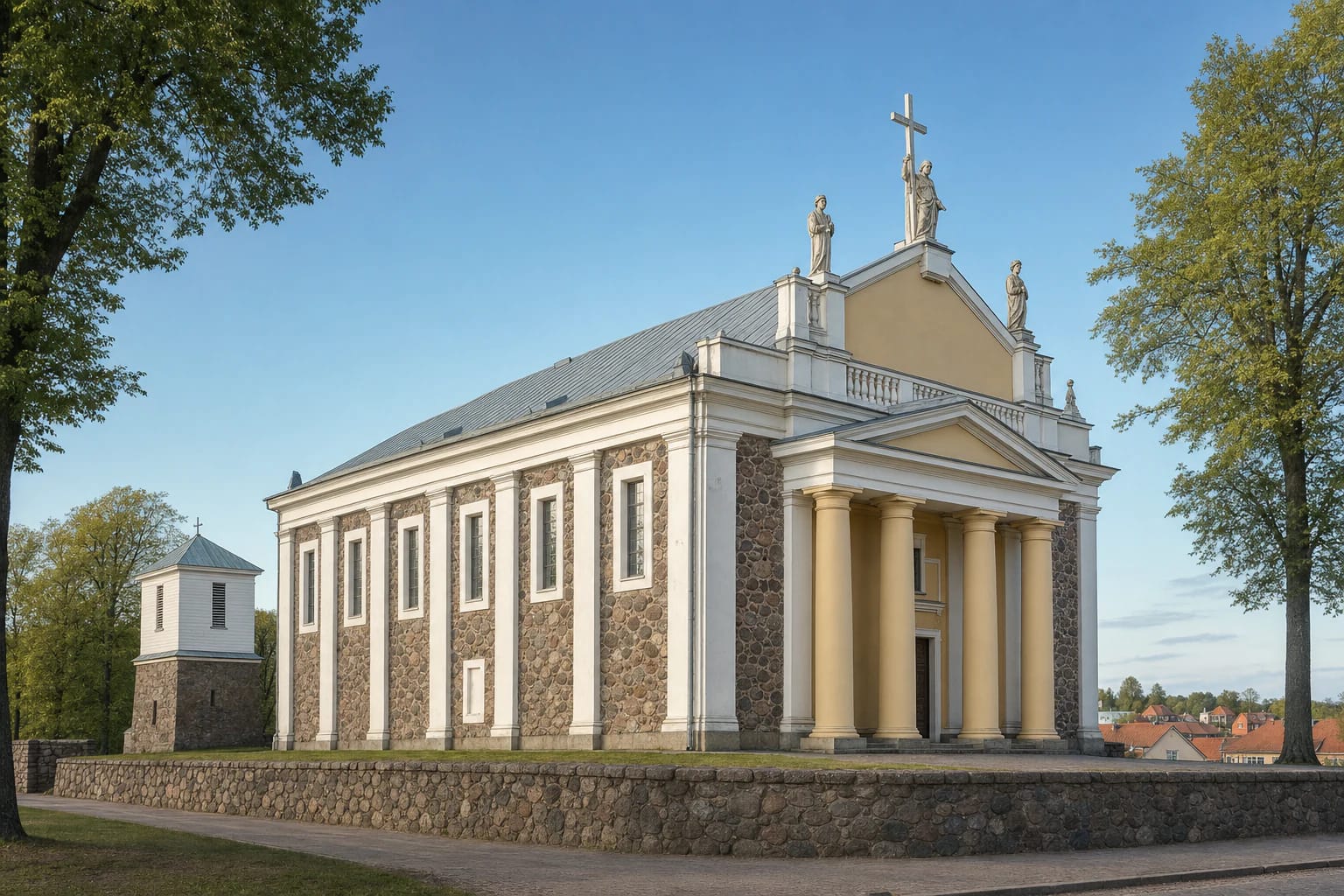
The church occupies higher ground in Ukmergė's old town and is immediately recognisable by fieldstone walls articulated by white rendered pilasters and window surrounds. Four massive pale-yellow columns define the main façade and support a triangular pediment. A balustrade, ornamental urns, and statues rise above it, with Christ carrying the Cross at the highest point.
The church itself has no tower. Its bells hang in a separate Classical bell tower built in 1836, with a masonry fieldstone base and a timber upper stage. A fieldstone churchyard wall and piered gates bind the two buildings into one historic ensemble.
The parish of 1387 and a sequence of timber churches
Ukmergė's Catholic parish is counted among the seven parishes founded as the Diocese of Vilnius was established after the Christianisation of Lithuania in 1387. The precise day on which the first timber church was built is unknown, so it is safest to say it appeared around 1387; Jogaila endowed it with land.
Another timber parish church was built around 1560. Muscovite troops burned it in 1655, and it had been rebuilt by 1674. A later timber sanctuary erected in 1764 was subsequently destroyed in a town fire, leaving the community to worship in a temporary building before construction of the present masonry church.
The masonry church of 1800-1820 and its reversal in 1931-1935
Construction of today's masonry church began in 1800 through the efforts of parish priest Motiejus Šneideravičius and donations from parishioners. Lack of funds slowed the work, and the French occupation of Ukmergė in 1812 halted it. The Archdiocese and municipality date completion to 1820; VLE's concise architectural entry gives 1818, making 1800-1820 the clearest description of the building campaign.
The most radical change came in 1931-1935 to a design by engineer Vaclovas Michnevičius. A presbytery and two sacristies were added at the former entrance end, while today's portico façade rose where the old apse had stood. In effect, the church's liturgical orientation was reversed. Archbishop Juozapas Skvireckas reconsecrated the enlarged church in 1935.
Three aisles, frescoes, and the most important paintings
Inside is a hall church of three aisles covered by barrel vaults. Most of its statues, frescoes, and paintings of saints are nineteenth-century works by unknown artists. The central altarpiece, The Farewell of Saints Peter and Paul, anchors the interior.
A municipal and museum account singles out two eighteenth-century paintings, Mary Breaking the Spears and Our Lady of Częstochowa. Mosaics beneath the windows were created by wall-painting conservator Juozas Algirdas Pilipavičius. The Archdiocese records eleven protected works of art dating from the eighteenth and nineteenth centuries.
Opening hours, Mass, and guided tours
On 27 July 2026 the Archdiocese of Kaunas listed the church as open on Sundays from 08:00 to 13:00 and 17:00 to 18:00, on Saturdays from 09:00 to 11:00 and 17:00 to 19:00, and on weekdays from 17:00 to 19:00. Sunday Mass was listed at 09:00, 10:30, 12:00, and 18:00; Saturday Mass at 10:00 and 18:00; weekday Mass at 18:00. Recheck the schedule before travelling.
The parish page did not list a separate visitor ticket. Ukmergė Local History Museum offers pre-arranged church tours, but dates and fees must be confirmed directly with the museum. On 27 July 2026 the Google Maps listing showed 4.5 out of 5 from 153 reviews; both figures change.