- Place
- Ukmergė District Municipality
- Region
- Aukštaitija
- Type
- interwar independence monument, an obelisk
- Address
- Kęstutis Square, Ukmergė Old Town
- Coordinates
- 55.24980, 24.76400
Lituania Restituta, Monument to Restored Lithuania, Freedom Monument, Independence Obelisk
Lituania Restituta: Ukmergė's freedom symbol
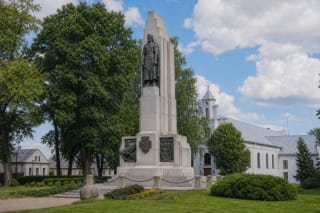
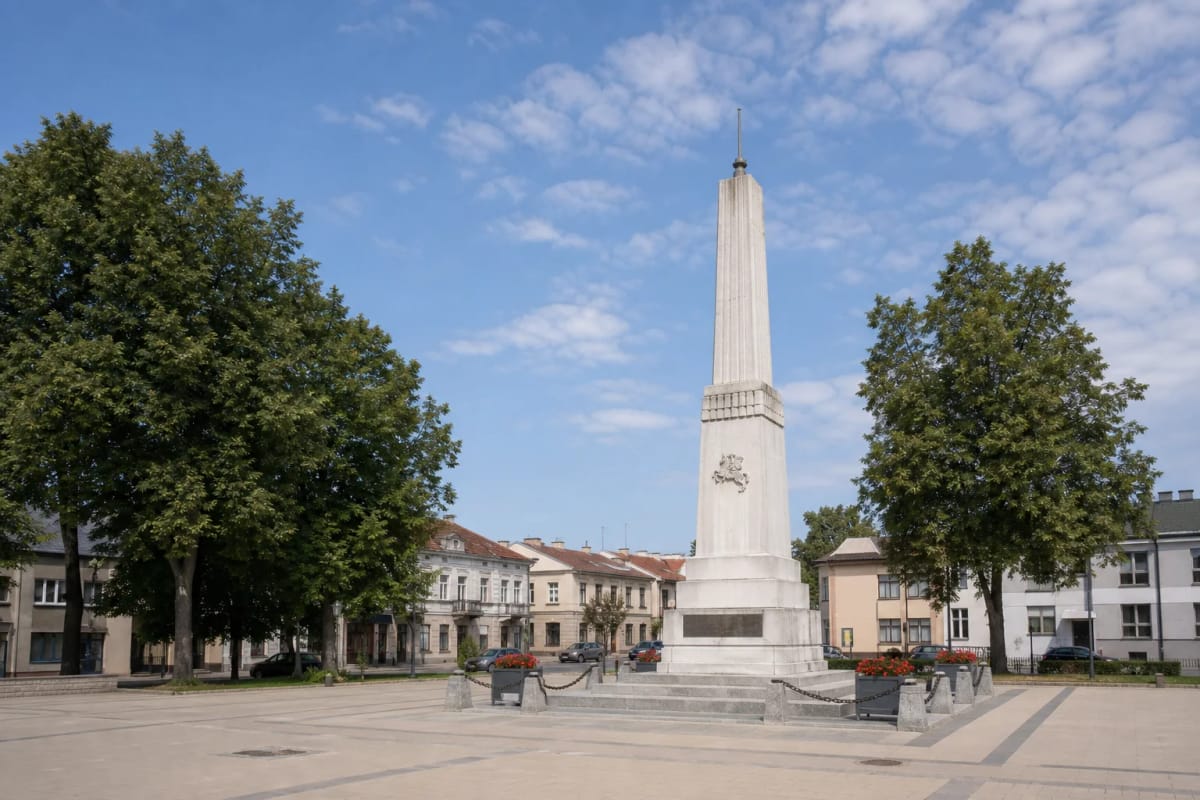
In Kęstutis Square in Ukmergė Old Town stands a white obelisk with the Vytis and the Latin inscription LITUANIA RESTITUTA, meaning Restored Lithuania. It is the city's main symbol of freedom, where people gather on February 16, March 11, and Freedom Defenders' Day.
Its story is exceptional: built in the interwar period, demolished and buried in the same square under Soviet rule, and later literally dug up and restored by the community. This burial and resurrection story makes it one of Lithuania's most eloquent signs of the national revival.
1930: how the monument rose
The foundations were blessed on May 15, 1928, marking the tenth anniversary of independent Lithuania, and a message to descendants was built into them. Construction was completed and the monument was solemnly unveiled on September 8, 1930, on the National Day, in the Year of Vytautas the Great, marking 500 years from the planned coronation of Vytautas.
Because of these two dates, the monument's purpose is described in different ways: some link it with the tenth anniversary of independence, others with Vytautas the Great. Both meanings are correct. The monument was created by artist Liudas Truikys, built by sculptor Silvanas Jakševičius, and funded by residents' donations and the town municipality.
Form and inscription
The monument is a reinforced-concrete obelisk on a stepped pedestal. On the front is a relief in a semicircular niche, above it the inscription LITUANIA RESTITUTA, and at the top the Vytis; two altar-like elements rise from the base. Tourism descriptions often interpret the relief as a vaidilutė tending sacred fire.
After restoration, the listed dimensions are 16.70 m high and about 550 t in weight. It is one of the most imposing interwar freedom monuments in the region; claims that it is the tallest monument in Lithuania should be treated cautiously because primary sources do not confirm them.
Soviet period: demolished and buried
After the Soviet occupation of Lithuania, the monument became unacceptable. In 1951 it was demolished and its parts were buried in the same square. It is said that money was offered for the demolition but no volunteers came forward, so the authorities did the work themselves.
The square was renamed Soviet Square, and Soviet objects later stood on the monument site, including the sculpture Vėliavnešiai. When foundations for a new monument were being dug, the original 1928 capsule with a message to descendants was accidentally found. Vėliavnešiai survives and now stands elsewhere in the city.
National revival: dug up and restored
In 1988 a special commission asked residents for information about the buried monument and decided to restore it in its authentic place. On March 18, 1989, a community work action began searching for the buried parts; after the whole square was dug through, they were found. On May 15, 1989, the same calendar day as in 1928, the foundations of the restored monument were blessed.
The restored relief was designed by artist Erikas Varnas. Crucially, authentic originals survived: the monument plaque and Vytis were secretly saved in 1951 by Ukmergė residents Jonas Fišeris and Rapolas Diečkus. The original plaque is kept in Ukmergė Museum, while a copy cast from it is attached to the restored monument; the original Vytis was returned. The monument was solemnly unveiled again on February 16, 1990.
How to visit
The monument stands in an open town square and can be visited freely at any time, without a ticket. The monument itself usually takes 10-15 minutes to see, and it combines easily with a walk through Ukmergė Old Town.
It is most powerful during state holidays, February 16, March 11, and January 13, when candles burn, tricolours fly, and commemorations take place around it.